
The Pioneer DJ PLX-CRSS12 is a professional direct-drive turntable that combines conventional analogue vinyl playback with tone-arm-free digital vinyl control. In DVS mode, the MAGVEL CLAMP reads platter movement directly, so the stylus does not need to sit in a control record groove and needle skipping is removed from the digital-control workflow.
For scratch and open-format DJs, this hybrid design is the key attraction: one deck can behave like a traditional turntable for real records and like a needle-free DVS controller for digital tracks.
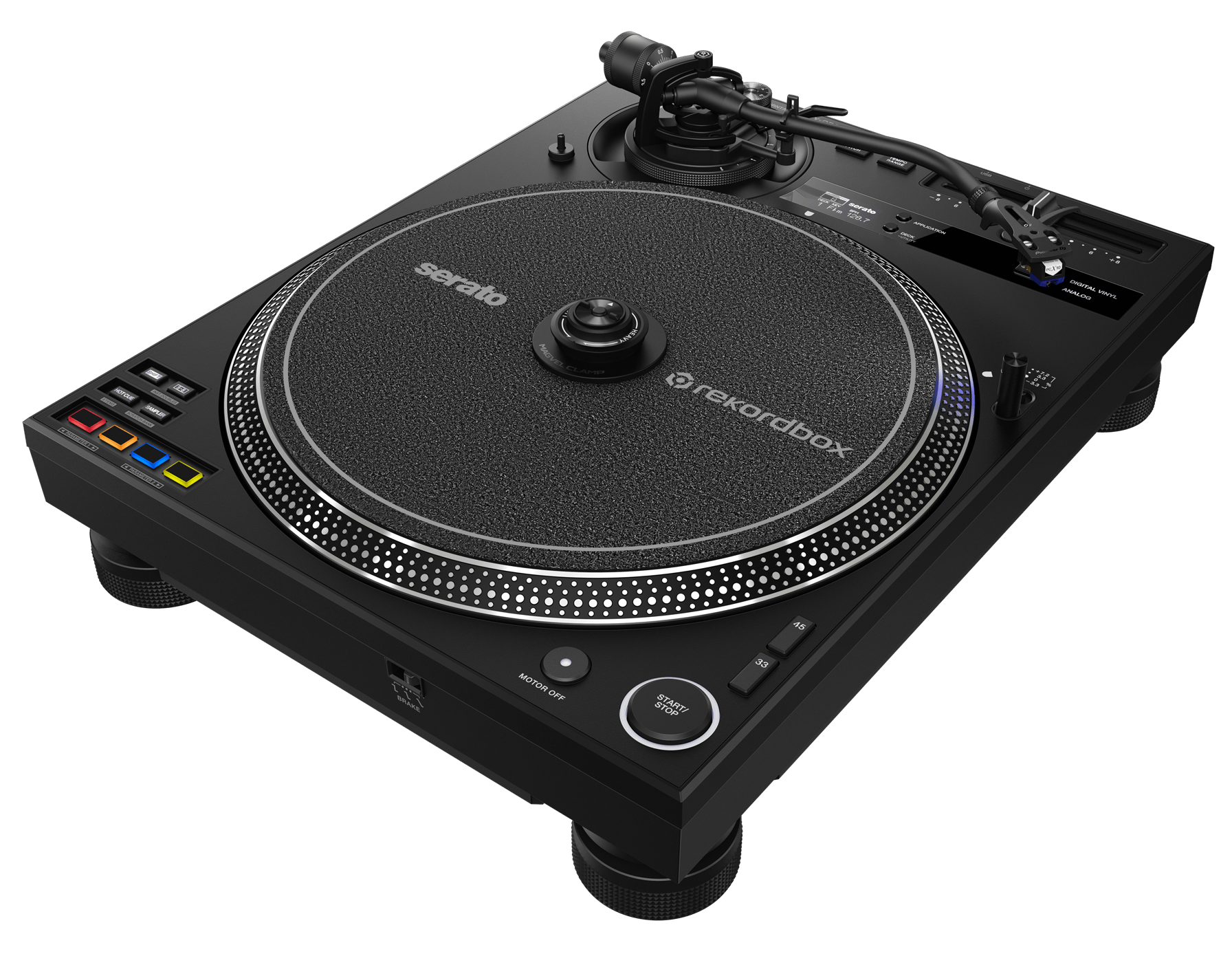
PLX-CRSS12 key features
- Tone-arm-free DVS control.
- Traditional analogue vinyl playback.
- MAGVEL CLAMP.
- Adjustable clamp feel.
- Three torque settings.
- Four built-in performance pads.
- OLED track-information display.
- Serato DJ Pro and rekordbox support.
- Heavy die-cast zinc chassis.
- Gold-plated RCA outputs.
Tone-arm-free DVS control
In Digital Vinyl mode, the MAGVEL CLAMP tracks the record’s movement directly. Because the control signal no longer depends on the stylus remaining in a groove, aggressive scratching cannot cause a traditional needle skip in the digital track.
The tone arm remains available whenever you want to play a normal record. Switching between digital and analogue workflows therefore does not require a second turntable.
MAGVEL CLAMP and feel adjustment
The MAGVEL CLAMP holds the record and transfers its movement to the DVS system. A top-mounted adjustment changes how heavy or light the record feels, providing another way to tune the deck without changing slip mats or slip sheets.
Torque settings
Three torque settings — High, Mid and Low — let the DJ choose between very fast start-up and a more traditional turntable response. This matters because scratch DJs often have strong personal preferences about platter acceleration and resistance.
Performance pads and OLED display
Four performance pads provide direct access to software functions such as Hot Cues and samples. The OLED display can show BPM, key, deck information and utility settings, keeping useful software information on the turntable rather than only on the laptop.
Analogue vinyl playback
For real records, the PLX-CRSS12 follows the high-mass construction approach of the PLX-1000. The upper chassis uses die-cast zinc, while the lower structure and damping materials are intended to reduce vibration and unwanted resonance. Gold-plated RCA terminals provide the analogue output.
PLX-CRSS12 strengths
- True analogue and digital-hybrid operation.
- Needle-free DVS eliminates digital needle skipping.
- Adjustable platter feel and torque.
- Performance pads and OLED display reduce laptop dependence.
- Professional heavy-duty construction.
PLX-CRSS12 limitations
- Heavy at 12.2 kg.
- Premium price.
- DVS features depend on compatible software.
- More complex than a conventional analogue turntable.
Pioneer DJ PLX-CRSS12 full specifications
- Dimensions: 453 × 353 × 159 mm.
- Weight: 12.2 kg.
- Drive: professional direct drive.
- DVS: tone-arm-free digital vinyl control with MAGVEL CLAMP.
- Software: rekordbox and Serato DJ Pro.
- Performance pads: 4.
- Display: OLED.
Frequently asked questions
Can the PLX-CRSS12 play normal records?
Yes. It works as a conventional analogue turntable as well as a tone-arm-free DVS controller.
Does DVS need the needle?
No. In its digital-control mode, the MAGVEL CLAMP tracks platter movement without relying on a stylus in the groove.
Overall view
The PLX-CRSS12 is one of the most technically distinctive Pioneer DJ products because it removes one of the traditional weaknesses of DVS scratching while preserving genuine analogue vinyl playback. DJs who actively use both formats are the audience most likely to justify its cost.