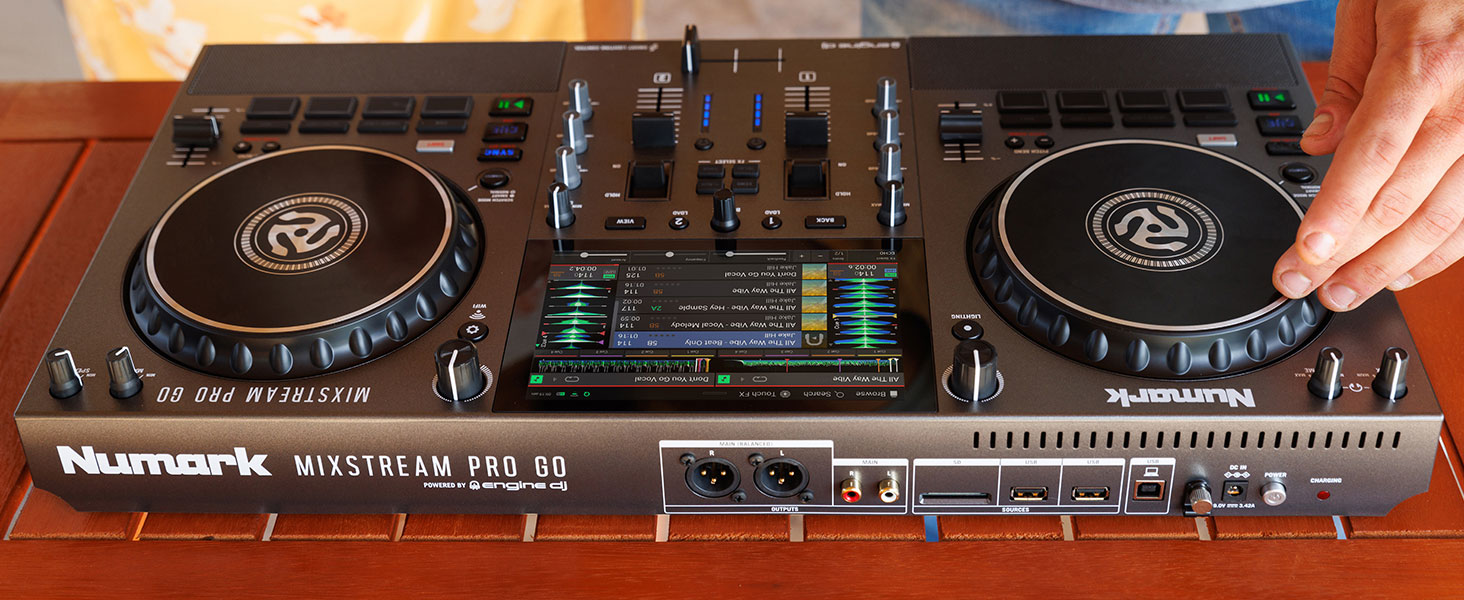
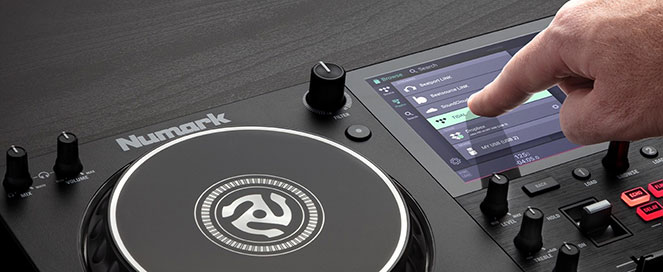
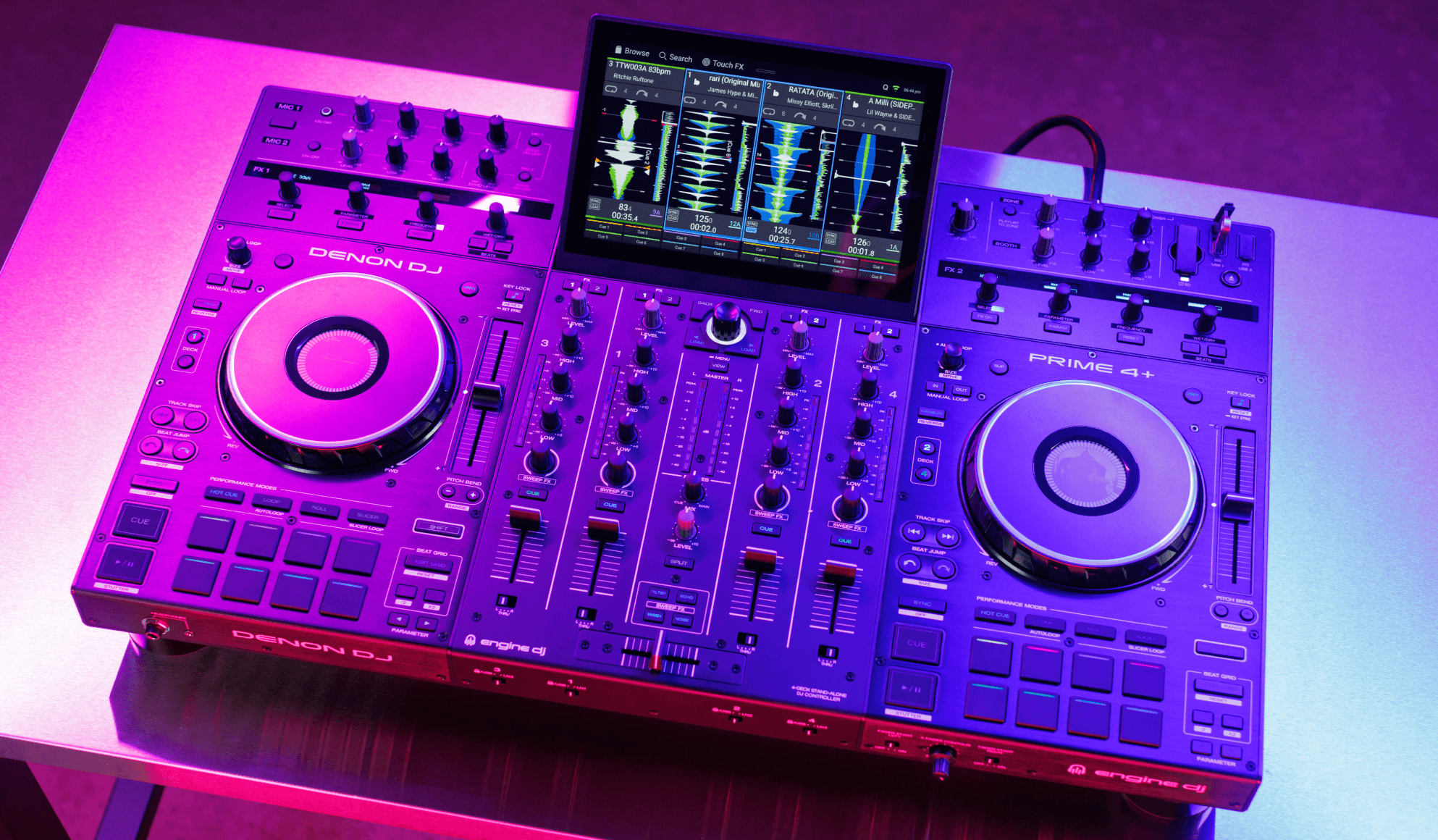
The Numark Mixstream Pro Go is a battery-powered standalone DJ controller built around Engine DJ. It combines a 7-inch touchscreen, built-in speakers, Wi-Fi, music streaming, USB and SD playback, professional XLR outputs and a rechargeable battery in a unit designed for completely laptop-free performance.
Its main appeal is portability. You can prepare music in Engine DJ, load tracks from local storage or supported streaming services, and perform without carrying a laptop or even staying near a mains socket.
Numark Mixstream Pro Go key features
Battery-powered standalone Engine DJ operation.
7-inch multi-gesture HD touchscreen.
Built-in Wi-Fi for supported streaming services.
Apple Music, Amazon Music Unlimited and other supported streaming options.
Built-in speakers with independent volume control.
Two USB media ports and one SD-card slot.
6-inch capacitive-touch jog wheels.
Smart Scratch feature.
Four dual-layer performance pads per deck.
Built-in effects and channel filters.
Engine Lighting integration.
Balanced XLR and RCA main outputs.
Microphone input.
Serato DJ Lite, Serato DJ Pro and VirtualDJ support in Computer Mode.
Battery-powered standalone DJing
The built-in rechargeable battery is what separates the Mixstream Pro Go from most standalone controllers. It can run away from mains power, making it suitable for practice, content creation, mobile setups and locations where a conventional powered system would be inconvenient.
Combined with Wi-Fi, local-media playback and built-in speakers, this gives the controller genuine all-in-one portability rather than simply making it a smaller desktop unit.
Engine DJ standalone workflow
Engine DJ provides the standalone operating system. Music can be prepared in Engine DJ Desktop and exported to USB or SD media, while tracks can also be analysed directly on the hardware for BPM, key and beat-grid information.
Libraries from Serato, rekordbox and iTunes can be prepared through Engine DJ Desktop before export, giving users a practical route into standalone performance without rebuilding everything from scratch.
7-inch touchscreen
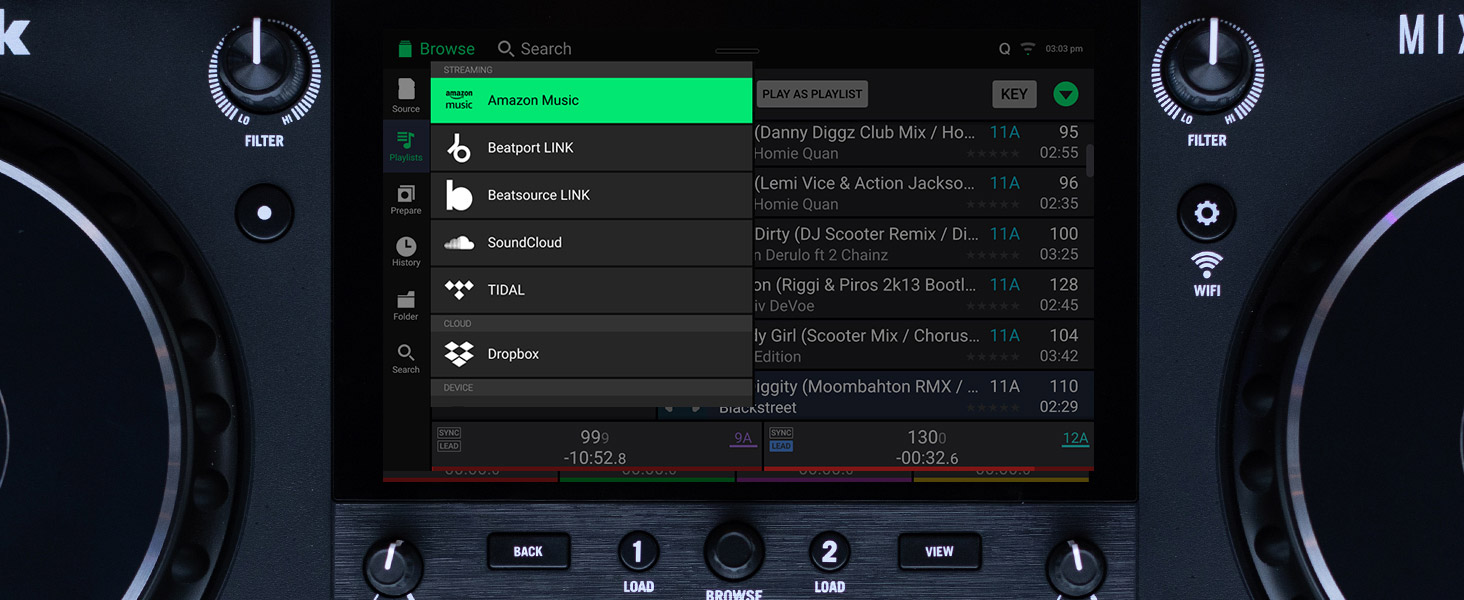
The 7-inch multi-gesture touchscreen handles library browsing, waveforms, track loading, effects control and system settings. It is smaller than the 10.1-inch screens on flagship Engine DJ systems, but it remains large enough for a straightforward two-deck standalone workflow.
Streaming and Wi-Fi
Built-in Wi-Fi provides direct access to supported streaming services through Engine DJ. Numark lists services including Apple Music, Amazon Music Unlimited, TIDAL, Beatport, Beatsource, SoundCloud GO+ and Dropbox, subject to the relevant account or subscription requirements.
For DJs taking requests, that can be useful when a requested track is not already stored locally. A prepared local library is still the safest foundation for a set, but streaming adds useful flexibility.
Built-in speakers
The integrated speakers have their own volume control and are useful for practice, livestreaming and personal monitoring. They also make the controller practical for quick informal sessions without connecting an external sound system.
For events or larger rooms, the balanced XLR outputs remain the appropriate way to connect a professional PA.
6-inch jog wheels and Smart Scratch
The two 6-inch capacitive jog wheels support cueing, pitch adjustment and scratching. Smart Scratch is designed to help the track return to the beat after a scratch movement, making basic scratch techniques easier to integrate without throwing the mix completely off time.
Performance pads and effects
Each deck has four dual-layer pads with performance modes including Cue, Saved Loop, Auto Loop and Roll. Engine DJ also adds access to newer embedded features such as Sampler, Remote Library and Touch FX through the wider operating system.
The dedicated effects section provides four core effects with toggle controls, while large channel Filter knobs and three-band EQ provide the main hands-on tonal controls.
Serato and VirtualDJ support
Computer Mode allows the Mixstream Pro Go to work as a software controller. Numark currently supports Serato DJ Lite, Serato DJ Pro and VirtualDJ, with the appropriate paid licence required for Serato DJ Pro or VirtualDJ.
This means the same hardware can be used either as a fully standalone Engine DJ system or as a conventional computer-based controller.
Engine Lighting
Engine Lighting can control compatible Philips Hue, Nanoleaf and DMX lighting systems from the controller. This is particularly useful for mobile DJs who want a simple audio-and-lighting workflow without adding another laptop to the setup.
Professional outputs and microphone
Balanced XLR and unbalanced RCA main outputs are both provided, making the controller suitable for anything from powered home speakers to professional PA systems. A 6.35 mm microphone input and both 6.35 mm and 3.5 mm headphone sockets are also included.
Mixstream Pro Go strengths
True battery-powered standalone operation.
Built-in speakers.
Strong streaming support.
Engine DJ standalone workflow.
Balanced XLR outputs.
USB and SD media support.
Serato and VirtualDJ computer modes.
Only around 3.7 kg.
Mixstream Pro Go limitations
Two channels rather than four.
Compact control spacing compared with flagship systems.
No dedicated booth output.
Built-in speakers are convenient rather than a replacement for a proper PA.
Battery run time depends on wireless, screen and speaker use.
Numark Mixstream Pro Go full specifications
Decks: 2.
Display: 7-inch multi-gesture HD touchscreen.
Jog wheels: 6-inch capacitive touch.
Performance pads: 4 dual-layer pads per deck.
Media: 2 × USB plus SD card.
Wireless: built-in Wi-Fi.
Main output: balanced XLR plus RCA.
Microphone: 6.35 mm input.
Headphones: 6.35 mm and 3.5 mm.
Battery: built-in rechargeable.
Dimensions: 566 × 284 × 74 mm.
Weight: approximately 3.7 kg.
Frequently asked questions
Can the Mixstream Pro Go work without a laptop?
Yes. It runs Engine DJ and can perform from compatible local media and supported streaming sources.
Does it have a battery?
Yes. A built-in rechargeable battery allows portable operation away from mains power.
Does it work with Serato DJ Pro?
Yes. Numark supports Serato DJ Lite and Serato DJ Pro in Computer Mode, with a paid Serato DJ Pro licence required.
Overall view
The Mixstream Pro Go is one of Numark’s most distinctive controllers because portability is built into the whole design rather than treated as an afterthought. Battery power, built-in speakers, Wi-Fi, local storage and Engine DJ let it operate almost anywhere without relying on a laptop.
For DJs who want a compact standalone system for practice, travel, livestreaming or mobile use, it offers a useful balance of convenience and professional connectivity.
The Numark Mixstream Pro+ is a two-deck standalone DJ controller powered by Engine DJ. It combines a 7-inch touchscreen, built-in speakers, Wi-Fi streaming, USB and SD playback, effects, performance pads and professional XLR outputs in a compact all-in-one system.
Unlike the battery-powered Mixstream Pro Go, the Pro+ is designed for mains-powered use, but otherwise keeps much of the same Engine DJ workflow and portable all-in-one philosophy.
Numark Mixstream Pro+ key features
Standalone Engine DJ operation.
7-inch multi-gesture HD touchscreen.
Built-in Wi-Fi for supported streaming services.
Apple Music, Amazon Music Unlimited and other supported streaming services.
Built-in speakers with volume control.
Two USB media ports and SD-card slot.
6-inch capacitive jog wheels with Smart Scratch.
Four dual-layer performance pads per deck.
Built-in effects and channel filters.
Engine Lighting integration.
Balanced XLR and RCA main outputs.
Serato DJ and VirtualDJ support in Computer Mode.
Standalone Engine DJ performance
The Mixstream Pro+ runs Engine DJ directly on the hardware, so a laptop is not required for normal performance. Tracks can be prepared in Engine DJ Desktop, loaded from USB or SD media and analysed on the controller itself.
Engine DJ also supports libraries prepared from Serato, rekordbox and iTunes, making it easier to move an existing collection into a standalone workflow.
7-inch touchscreen and onboard analysis
The 7-inch touchscreen handles music browsing, waveforms, track loading, performance information and system settings. Tracks can be analysed for BPM and key as they are loaded, reducing the need to prepare every file in advance.
Streaming and Wi-Fi
Built-in Wi-Fi gives direct access to supported Engine DJ streaming services including Apple Music, Amazon Music Unlimited, TIDAL, Beatport, Beatsource, SoundCloud GO+ and Dropbox, subject to the relevant subscriptions and accounts.
Built-in speakers
Integrated speakers make the Mixstream Pro+ useful for practice, livestreaming and personal monitoring without immediately connecting an external system. Their level is independently adjustable from the main output.
For events and larger rooms, the balanced XLR outputs provide the appropriate connection to a professional PA.
Jog wheels, pads and effects
The two 6-inch capacitive jog wheels support cueing, pitch adjustment and scratching. Smart Scratch is designed to help the track stay rhythmically aligned after a scratch movement.
Four dual-layer pads per deck provide Cue, Saved Loop, Auto Loop and Roll modes, while the effects section includes beat-synchronised effects triggered from dedicated toggle switches.
Serato DJ and VirtualDJ
Computer Mode allows the Mixstream Pro+ to operate as a software controller for Serato DJ and VirtualDJ. Serato DJ Lite is supported free, while Serato DJ Pro and VirtualDJ require the appropriate paid licence.
Engine Lighting
Engine Lighting provides embedded control for compatible Philips Hue, Nanoleaf and DMX lighting setups. This can be useful for mobile DJs who want to manage audio and lighting from the same system.
Mixstream Pro+ strengths
Laptop-free Engine DJ operation.
Strong streaming support.
Built-in speakers.
Balanced XLR outputs.
USB and SD media support.
Serato and VirtualDJ compatibility.
Compact 3.68 kg design.
Mixstream Pro+ limitations
No built-in battery.
Two channels only.
No dedicated booth output.
Built-in speakers are for monitoring and practice rather than venue sound.
Numark Mixstream Pro+ full specifications
Decks: 2.
Display: 7-inch multi-gesture HD touchscreen.
Jog wheels: 6-inch capacitive touch.
Media: 2 × USB plus SD/SDHC/SDXC.
Wireless: built-in Wi-Fi.
Main output: balanced XLR plus RCA.
Microphone: 6.35 mm input.
Headphones: 6.35 mm and 3.5 mm.
Dimensions: 566 × 284 × 74 mm.
Weight: 3.68 kg.
Mixstream Pro+ vs Mixstream Pro Go
The Mixstream Pro Go adds a rechargeable battery for cable-free portable use. The Pro+ keeps the same general Engine DJ and streaming concept but is intended for powered operation.
Frequently asked questions
Can the Mixstream Pro+ work without a laptop?
Yes. It runs Engine DJ in standalone mode from local media and supported streaming services.
Does it have built-in speakers?
Yes. The integrated speakers have independent volume control.
Does it work with Serato?
Yes. Serato DJ Lite and Serato DJ Pro are supported in Computer Mode, with the appropriate licence required for Pro.
Overall view
The Mixstream Pro+ is a straightforward way into standalone Engine DJ. Its combination of streaming, local media, built-in speakers and professional XLR outputs makes it more flexible than a basic laptop controller without becoming as large or expensive as a flagship standalone system.
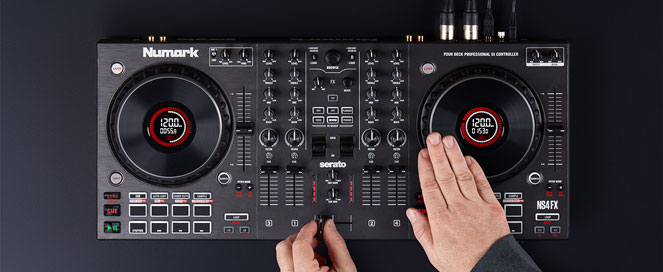
The Numark NS4FX is a four-channel DJ controller designed for Serato DJ Lite and Serato DJ Pro. It combines four independent mixer channels, 6-inch jog wheels with colour displays, performance pads, paddle-style effects controls and professional XLR outputs in a relatively compact unit.
It is aimed at DJs who want genuine four-deck control without moving to a much larger flagship controller, making it especially relevant for mobile, event and livestreaming setups.
Numark NS4FX key features
Four-channel mixer with independent channel faders.
Control of up to four software decks.
6-inch capacitive jog wheels with colour displays.
Eight performance pads per deck.
Six selectable software effects with paddle controls.
Dedicated loop sections.
Crossfader assignment switches.
Long pitch faders.
24-bit audio interface.
Balanced XLR main output.
RCA booth output.
Two microphone inputs.
Serato DJ Lite included.
Serato DJ Pro upgrade ready.
VirtualDJ and Algoriddim djay compatibility.
Four-channel mixing
The NS4FX provides four physical mixer channels, each with its own volume fader, three-band EQ and high-pass/low-pass Filter control. This means all four software decks can remain visible and independently mixed rather than relying on a simple two-channel layer system.
Front-panel crossfader assignment switches let each channel be routed to either side of the crossfader or bypass it completely.
6-inch jog wheels with displays
The two 6-inch capacitive jog wheels include colour displays that show track position, BPM, pitch range and time information. Deck Layer buttons switch each physical side between its two software decks.
Performance pads
Eight performance pads on each deck provide direct access to functions such as Cue, Auto Loop, Fader Cuts and Sampler. Additional modes become available when upgrading to Serato DJ Pro.
Effects paddles
The effects section includes six quick-selection buttons, wet/dry and beat-division controls, plus two paddle-style switches for momentary or latched triggering. This makes effects easier to perform rhythmically than relying entirely on software controls.
Professional connections
Balanced XLR main outputs are joined by a separate RCA booth output, giving the NS4FX enough connectivity for mobile DJ work and event systems. Two microphone inputs are provided, and the rear microphone connection can also be switched to an auxiliary RCA source.
Microphone audio is included in the USB mix, which is useful for livestreaming because voice and music can be captured together without an additional interface.
Serato DJ Lite and Pro
The NS4FX ships with Serato DJ Lite and is fully mapped for Serato DJ Pro. The Pro upgrade unlocks the fuller four-deck performance feature set and additional pad modes.
Numark also lists compatibility with VirtualDJ and Algoriddim djay.
NS4FX strengths
Four real mixer channels.
Useful jog-wheel displays.
Professional XLR output.
Separate booth output.
Two microphone inputs.
Good effects and performance-pad control.
Only about 3 kg.
NS4FX limitations
Requires a computer for normal operation.
Serato DJ Pro requires a separate upgrade.
Static jog wheels rather than motorised platters.
No standalone media playback.
Numark NS4FX full specifications
Channels: 4.
Jog wheels: 6-inch capacitive touch with colour displays.
Audio: 44.1 kHz, 24-bit.
Main output: balanced XLR.
Booth output: RCA.
Microphone inputs: 2 × 6.35 mm.
Auxiliary input: RCA via switchable rear input.
Headphones: 6.35 mm and 3.5 mm.
Dimensions: 597 × 274 × 61 mm.
Weight: approximately 3.0 kg.
Frequently asked questions
Does the NS4FX have four mixer channels?
Yes. It has four physical channel strips and can control four software decks.
Does the NS4FX include Serato DJ Pro?
It includes Serato DJ Lite and is upgrade-ready for Serato DJ Pro, which requires the appropriate licence.
Does it have XLR outputs?
Yes. Balanced XLR main outputs are provided.
Overall view
The NS4FX offers a lot of four-channel control without becoming physically huge. Its mixer layout, jog displays, effects paddles, XLR output and microphone options make it especially practical for DJs who want room to grow beyond a basic two-deck controller.
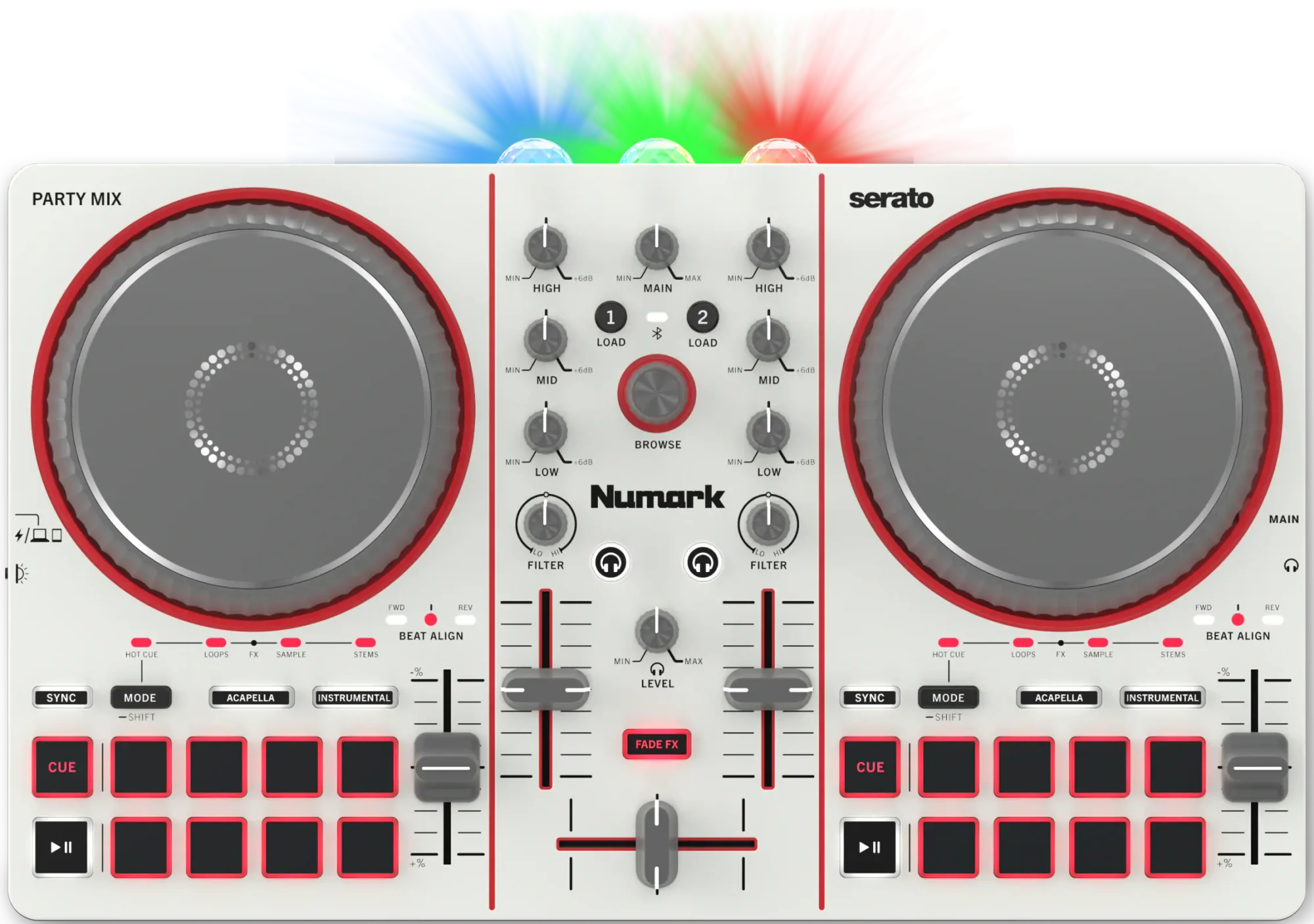
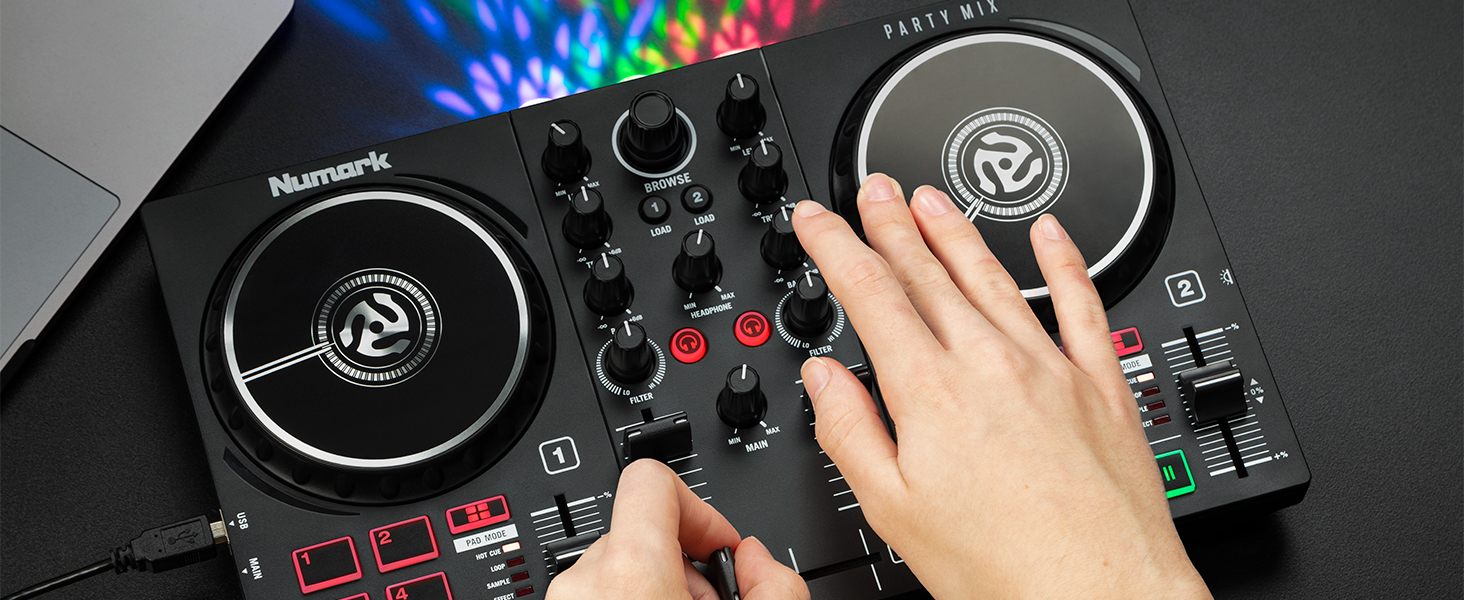
The Numark Party Mix III is a compact two-deck DJ controller aimed at beginners and casual DJs, with built-in beat-synchronised lighting, Stems controls, eight performance pads per deck, Bluetooth MIDI and plug-and-play support for Serato DJ Lite and Algoriddim djay.
The third-generation model is a substantial update over the earlier Party Mix controllers. It adds deeper performance controls, dedicated Instrumental and Acapella buttons, Fade FX, Beat Align indicators and modern mobile-device support while staying small and USB powered.
Numark Party Mix III key features
Two-deck compact DJ controller.
Built-in beat-synchronised LED light show.
Eight performance pads per deck.
Dedicated Stems controls.
Instrumental and Acapella buttons.
Fade FX controlled from the crossfader.
Beat Align visual guidance.
Three-band EQ and Filter controls.
Bluetooth Low Energy MIDI.
USB-C connectivity.
24-bit / 48 kHz audio.
Serato DJ Lite and Algoriddim djay included.
Serato DJ Pro and VirtualDJ support with additional licences.
Built for learning and quick setup
Party Mix III keeps the familiar two-decks-and-a-mixer layout, so the basic controls translate naturally to larger DJ systems. Dedicated Browse and Load controls, Cue and Play buttons, pitch sliders and a central crossfader make it possible to learn the fundamentals without navigating everything from the computer screen.
Stems controls
Dedicated Instrumental and Acapella buttons provide quick access to compatible software Stems functions. The pad section can also enter a Stems mode so individual track elements such as vocals, drums and bass can be manipulated during a mix.
That gives a beginner-focused controller access to creative remix techniques that previously tended to appear on more expensive hardware.
Eight performance pads per deck
Each deck now has eight pads, doubling the pad count of the previous generation. Modes include Hot Cue, Auto Loop, Sampler, Stems and Pad FX, while compatible software can expose additional functions such as Beat Jump.
Fade FX
Fade FX automatically combines effects and EQ changes with crossfader movement. It is intended to help newer DJs produce more energetic transitions without first learning a complicated multi-control effects routine.
Beat Align indicators
Visual Beat Align indicators show when a track needs a small forward or backward adjustment to line up with the other deck. This can help beginners understand manual beat matching rather than relying entirely on the Sync button.
Built-in light show
The integrated LED lighting projects beat-synchronised colours behind the controller. It is primarily a fun home and party feature rather than a substitute for dedicated event lighting, but it gives the Party Mix range its distinctive character.
Bluetooth and mobile DJing
Bluetooth Low Energy MIDI allows wireless control of Algoriddim djay on compatible iOS and Android devices. USB-C can also be used for a wired connection to laptops, tablets and smartphones.
Software support
Party Mix III includes plug-and-play support for Serato DJ Lite and Algoriddim djay. Serato DJ Pro and VirtualDJ are also supported with the appropriate paid licences.
Party Mix III strengths
Very compact and light.
Good beginner-friendly layout.
Modern Stems controls.
Eight pads per deck.
Bluetooth MIDI for compatible mobile devices.
Built-in light show.
USB bus power.
Useful software bundle.
Party Mix III limitations
Beginner-focused rather than professional event hardware.
No balanced XLR outputs.
Compact controls may feel cramped to experienced DJs.
Requires compatible DJ software rather than operating standalone.
Numark Party Mix III full specifications
Decks: 2.
Audio: 24-bit / 48 kHz.
Wireless MIDI: Bluetooth Low Energy.
Computer/mobile connection: USB-C.
Performance pads: 8 per deck.
Power: USB bus powered, 5 V / 500 mA.
Dimensions: 339 × 205 × 47 mm.
Weight: 1.1 kg.
Frequently asked questions
Does Party Mix III have built-in lights?
Yes. A beat-synchronised LED light show is built into the controller.
Can Party Mix III work with a phone or tablet?
Yes. It supports compatible mobile devices through Algoriddim djay, including Bluetooth MIDI control on supported devices.
Does it support Stems?
Yes. Dedicated Instrumental and Acapella buttons and a Stems pad mode are provided for compatible software.
Overall view
Party Mix III is still unmistakably a beginner controller, but the third generation adds genuinely useful modern features rather than simply changing the appearance. Stems, eight-pad banks, Fade FX, Beat Align and mobile support give new DJs plenty to learn without making the controller intimidating.
The Numark Mixstream Pro is a two-deck standalone DJ controller powered by Engine DJ. It combines a 7-inch touchscreen, built-in speakers, Wi-Fi streaming, USB and SD playback, effects, performance pads and balanced XLR outputs in a compact all-in-one system.
It was the original model in the Mixstream family and established the basic formula later expanded by the Mixstream Pro+ and battery-powered Pro Go.
Numark Mixstream Pro key features
Standalone Engine DJ operation.
7-inch multi-gesture HD touchscreen.
Built-in Wi-Fi for supported streaming services.
Built-in speaker monitors.
Two USB media ports and SD-card slot.
6-inch capacitive jog wheels with Smart Scratch.
Four dual-layer performance pads per deck.
Four built-in effects and dedicated Filter controls.
Engine Lighting integration.
Balanced XLR and RCA main outputs.
Microphone input and dual-size headphone outputs.
Standalone Engine DJ workflow
The Mixstream Pro can perform from compatible USB and SD media without a computer. Engine DJ handles browsing, waveforms, track loading and onboard analysis for BPM and key information.
Streaming and Wi-Fi
Built-in Wi-Fi provides access to supported streaming services through Engine DJ, including TIDAL, Beatport, Beatsource, SoundCloud GO+ and Dropbox. The exact service list can change with Engine DJ updates.
Built-in speakers
Integrated speakers with independent volume control are useful for practice, livestreaming and personal monitoring. For events and larger rooms, balanced XLR main outputs connect the controller to a professional sound system.
Jog wheels, pads and effects
The 6-inch capacitive jog wheels support cueing and scratching, with Smart Scratch designed to help the track stay rhythmically aligned after a scratch movement. Four dual-layer pads per deck cover Cue, Saved Loop, Auto Loop and Roll functions.
Four onboard effects and large Filter knobs provide the main creative transition tools, while later Engine DJ updates add further performance features through the operating system.
Engine Lighting
Engine Lighting provides embedded control for compatible smart-lighting and DMX systems, helping mobile DJs combine music and lighting control from the same hardware.
Mixstream Pro strengths
True standalone operation.
Built-in speakers.
Strong local-media and streaming support.
Professional XLR outputs.
Simple two-deck layout.
Compact 3.68 kg design.
Mixstream Pro limitations
No built-in battery.
Two channels only.
No dedicated booth output.
Original model has fewer streaming-specific headline features than later Mixstream variants.
Numark Mixstream Pro full specifications
Decks: 2.
Display: 7-inch HD touchscreen.
Jog wheels: 6-inch capacitive touch.
Media: 2 × USB plus SD/SDHC/SDXC.
Main output: balanced XLR plus RCA.
Microphone: 6.35 mm input.
Dimensions: 566 × 284 × 74 mm.
Weight: 3.68 kg.
Mixstream Pro vs Mixstream Pro+
The Mixstream Pro+ follows the same core hardware concept but adds newer streaming support and remains the more current mains-powered Mixstream choice.
Overall view
The original Mixstream Pro remains an important standalone controller in Numark’s current catalogue. It offers a straightforward Engine DJ workflow with built-in speakers and professional outputs without requiring a laptop.
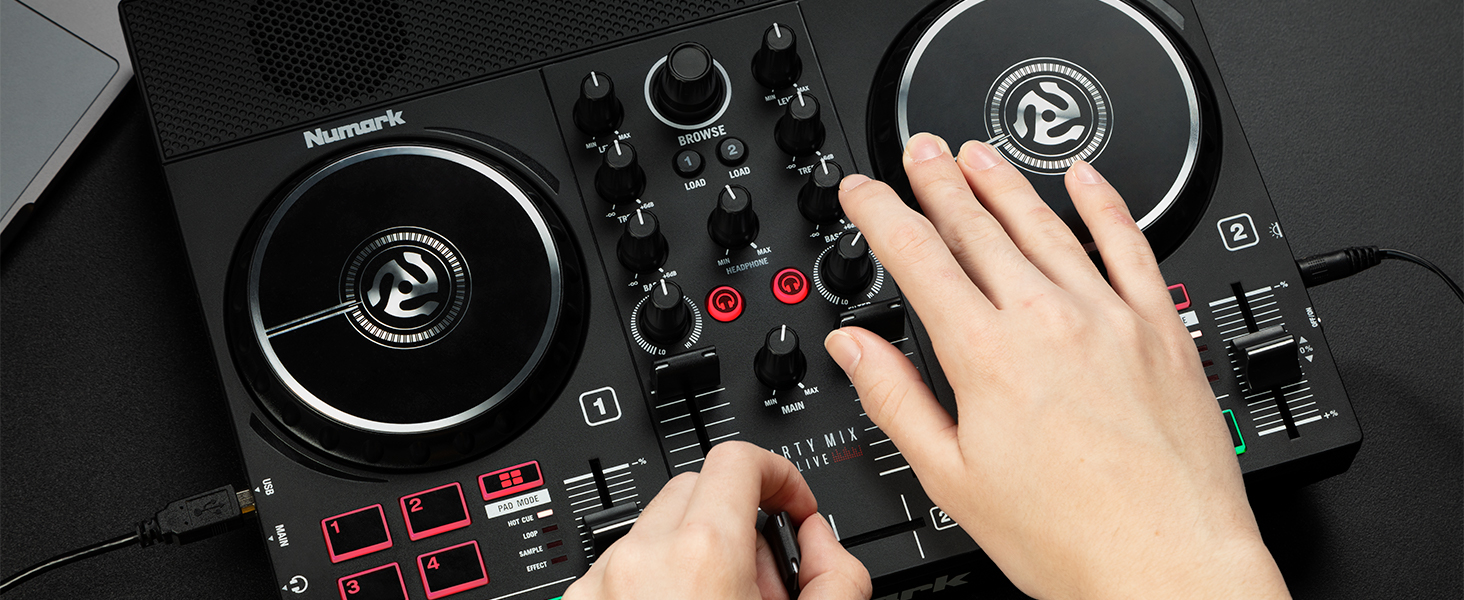
The Numark Party Mix Live is a compact two-deck DJ controller with built-in stereo speakers and a beat-synchronised LED light show. It is designed for beginners, home use and small informal parties, with Serato DJ Lite support and compatibility with mobile DJ apps.
Numark Party Mix Live key features
Two-deck DJ controller.
Built-in stereo speakers.
Built-in beat-synchronised LED light show.
Touch-sensitive jog wheels.
Four performance pads per deck.
Filter controls and two-band EQ.
Serato DJ Lite included.
Algoriddim djay Pro AI and other supported software.
3.5 mm main and headphone outputs.
Built-in speakers
Two 2-inch speakers are built into the controller, allowing music to be heard without connecting external speakers. A switch lets the internal speakers be turned off when headphones or another sound system are being used.
Built-in light show
Three coloured LEDs project a beat-synchronised light show behind the controller. It is designed as a fun room effect rather than professional event lighting, but it makes the unit more self-contained for casual parties.
Jog wheels and pads
The touch-sensitive jog wheels support cueing, pitch nudging and scratching. Four pads per deck provide Effect, Cue, Loop and Sampler modes for basic creative performance.
Software and streaming
Party Mix Live ships with Serato DJ Lite, which can access supported streaming services through the software. Numark also lists compatibility with Algoriddim djay Pro AI and other supported DJ applications.
Party Mix Live strengths
Built-in speakers.
Built-in lighting.
Compact beginner-friendly layout.
Touch-sensitive jog wheels.
Serato DJ Lite included.
Party Mix Live limitations
No professional XLR outputs.
Requires DJ software rather than running standalone.
Built-in speakers are intended for small-room use.
Only two-band EQ.
Numark Party Mix Live full specifications
Decks: 2.
Speakers: 2 × 2-inch drivers, 5 W each.
Main output: 3.5 mm.
Headphones: 3.5 mm.
Dimensions: 325.5 × 256 × 66.4 mm.
Weight: 1.22 kg.
Party Mix Live vs Party Mix III
The newer Party Mix III adds Stems, Bluetooth MIDI and a much deeper performance-pad workflow. Party Mix Live remains the model to choose from Numark’s current range if built-in speakers are the priority.
Overall view
Party Mix Live is a deliberately simple controller, but its speakers and lighting make it unusually self-contained for beginners who want to start mixing without assembling a larger setup.
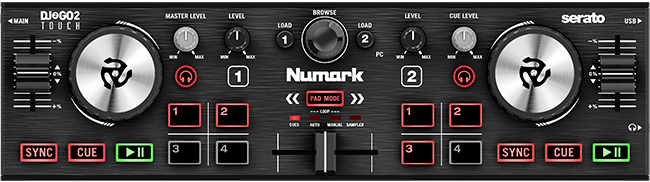
The Numark DJ2GO2 Touch is a pocket-sized two-deck DJ controller with capacitive touch jog wheels, a built-in audio interface and Serato DJ Lite support. It is designed for preparation, travel, compact performances and backup use where a full-size controller would be impractical.
Numark DJ2GO2 Touch key features
Ultra-compact two-deck DJ controller.
Capacitive touch jog wheels for cueing and scratching.
Built-in audio interface.
Four performance pads per deck.
Dedicated Browse and Load controls.
Pitch sliders, Sync, Cue and Play controls.
Master and headphone level controls.
Serato DJ Lite included.
Serato DJ Pro upgrade support.
USB powered.
Designed for portability
DJ2GO2 Touch is small enough to sit directly in front of a laptop and is easy to carry as a backup controller. Its compact size also makes it useful for music preparation, small informal sets and situations where a normal controller would take up too much desk or travel space.
Capacitive touch jog wheels
The Touch version adds capacitive platter control, so the jog wheels can be used for more direct cueing and scratch-style movement rather than only pitch nudging.
Performance pads
Four pads per deck provide access to performance functions such as cue points, loops and samples, depending on the selected software mode.
Built-in audio interface
An onboard sound card provides separate main and headphone outputs, allowing track cueing before the mix is sent to the audience. That is an important distinction from tiny MIDI-only controllers that still need a separate audio interface.
Serato DJ Lite and Pro
DJ2GO2 Touch includes Serato DJ Lite and can also be used with Serato DJ Pro when the appropriate upgrade is available. Numark lists it as a class-compliant controller on supported systems.
DJ2GO2 Touch strengths
Extremely portable.
Built-in audio interface.
Touch-sensitive jog wheels.
Useful as a backup controller.
Serato DJ Lite included.
USB powered.
DJ2GO2 Touch limitations
Very small controls.
No full three-band channel EQ.
No professional balanced outputs.
Not intended to replace a full-size performance controller.
Overall view
DJ2GO2 Touch is specialised rather than basic. Its strength is that it provides genuine two-deck software control, cueing and a built-in sound card in a format small enough to travel almost anywhere. For preparation and backup duty in particular, that makes it unusually practical.
The Technics SL-1200MK7 / SL-1210MK7 is the current DJ-focused generation of the legendary SL-1200 series. It retains the familiar direct-drive layout, S-shaped tonearm and pitch control that made earlier models club standards, while adding a coreless motor, adjustable torque and braking, reverse playback, detachable cables and digital pitch control.
In the UK, the black SL-1210MK7 is the model most commonly associated with the current DJ range. The SL-1200MK7 shares the same core MK7 platform in other markets and finishes.
Technics SL-1200MK7 / SL-1210MK7 key features
Coreless direct-drive motor.
33⅓ and 45 RPM with switchable 78 RPM.
Reverse Play mode.
Digital pitch control with ±8% and ±16% ranges.
Adjustable starting torque and brake speed.
Static-balance S-shaped tonearm.
High-brightness white LED stylus illuminator.
Detachable power and phono cables.
Gold-plated phono terminals.
High-rigidity chassis with vibration-damping construction.
Coreless direct-drive motor
The MK7 uses a coreless direct-drive motor designed to remove the cogging behaviour associated with some traditional direct-drive motors. Technics combines that design with digital motor control to provide stable rotation, strong starting torque and consistent pitch response.
Pitch control for DJ mixing
The long pitch fader retains the familiar Technics layout but uses digital control. DJs can work within ±8% for finer tempo adjustment or switch to ±16% for a wider range. A reset control returns the deck to the standard playback speed.
Adjustable torque and braking
Starting torque and brake speed can be adjusted in four steps. That lets the deck feel be tuned for different DJ techniques rather than forcing every user into one fixed response.
Reverse Play and 78 RPM
The MK7 adds Reverse Play, giving DJs another creative playback option. Alongside the familiar 33⅓ and 45 RPM speeds, 78 RPM can also be enabled from the deck’s internal settings.
S-shaped tonearm
The static-balance S-shaped tonearm keeps the classic Technics geometry while using high-precision bearings for reliable groove tracking. Arm height, tracking force and anti-skating can all be adjusted for the chosen cartridge and playing style.
Detachable cables
Unlike many earlier SL-1200 generations, the MK7 uses detachable power and phono cables. This makes damaged cables easier to replace and simplifies transport and maintenance. The phono terminals are gold plated.
Chassis and vibration control
An aluminium die-cast chassis is combined with a glass-fibre-reinforced ABS material to improve rigidity and damping. Spring-and-rubber insulators help reduce external vibration and acoustic feedback in loud DJ environments.
SL-1200MK7 / SL-1210MK7 strengths
Familiar industry-standard Technics layout.
Stable coreless direct drive.
Adjustable torque and braking.
Accurate pitch control.
Reverse playback.
Detachable cables.
Robust vibration-resistant construction.
SL-1200MK7 / SL-1210MK7 limitations
No cartridge is normally the main focus of the package, so the chosen cartridge and stylus remain an additional setup decision.
Heavier and less portable than compact controller-based systems.
Purely analogue deck control means a mixer and, for digital vinyl systems, compatible DVS hardware/software are still required.
Technics SL-1200MK7 / SL-1210MK7 full specifications
Drive: direct drive.
Motor: brushless coreless DC motor.
Speeds: 33⅓, 45 and switchable 78 RPM.
Starting torque: 0.18 N·m / 1.8 kg-cm.
Start-up: approximately 0.7 seconds to 33⅓ RPM.
Pitch: ±8% / ±16%.
Wow and flutter: 0.025% WRMS.
Platter: aluminium die-cast, 332 mm.
Tonearm: universal static-balance S-shape.
Effective arm length: 230 mm.
Dimensions: 453 × 169 × 353 mm.
Weight: approximately 9.6 kg.
Frequently asked questions
Is the SL-1210MK7 still a current Technics model?
Yes. Technics continues to list the MK7 platform in its current DJ range.
Does the MK7 have reverse playback?
Yes. Reverse Play can be enabled as part of the deck’s DJ-focused operating settings.
Can the torque be adjusted?
Yes. Starting torque and brake speed can each be adjusted in four steps.
Overall view
The MK7 succeeds by modernising the classic Technics DJ formula without changing the control layout DJs expect. Coreless direct drive, adjustable motor response, reverse playback and detachable cables make it a practical contemporary version of one of the most influential DJ turntables ever made.
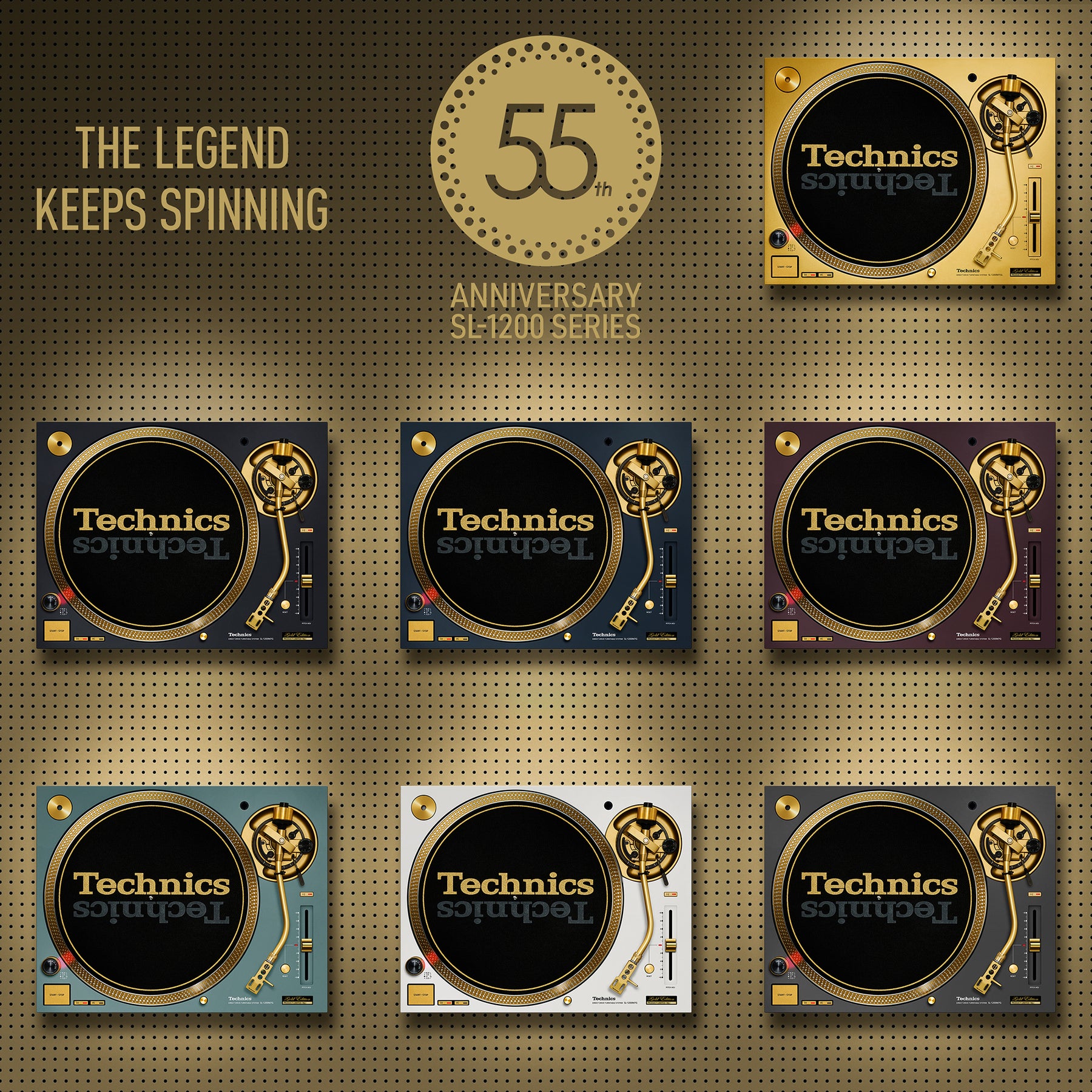
The Technics SL-1200M7G 55th Anniversary Edition is a limited-edition DJ turntable based on the proven SL-1200MK7 platform. Launched for the SL-1200 series’ 55th anniversary, it keeps the MK7’s coreless direct-drive motor, digital pitch control, reverse play and adjustable motor behaviour while adding distinctive gold detailing and a numbered commemorative design.
Technics is limiting worldwide production to 12,000 units across seven colourways. That makes the M7G both a working DJ turntable and a collectable version of the current MK7 platform.
Technics SL-1200M7G key features
55th Anniversary limited edition.
Worldwide production limited to 12,000 units.
Seven colourways with gold detailing.
Individually numbered anniversary badge.
Coreless direct-drive motor.
33⅓, 45 and 78 RPM playback.
Digital pitch control with ±8% and ±16% ranges.
Reverse Play mode.
Static-balance S-shaped tonearm.
Gold-finished tonearm and platter detailing.
Detachable power and phono cables.
High-rigidity, vibration-damped cabinet.
Based on the MK7 platform
Underneath the special-edition styling, the M7G is fundamentally built around the current MK7 DJ platform. That means it retains the same coreless direct-drive architecture, pitch control, motor response and DJ-focused operating features rather than becoming a purely decorative collector’s model.
55th Anniversary design
The visual treatment is the main distinction. Gold details appear across the tonearm, platter edge, controls and slipmat, while an anniversary badge carries an individual serial number. Technics offers seven colour options to make the edition visually distinct from the standard MK7.
Coreless direct-drive motor
The direct-drive system uses a coreless stator to remove the cogging behaviour associated with some traditional motors. Technics combines this with digital motor control for stable rotation, high starting torque and consistent pitch response.
Pitch control and reverse playback
The long pitch fader supports ±8% and ±16% adjustment ranges. Reverse Play is also available, extending the creative options beyond normal forward playback.
Three playback speeds
In addition to 33⅓ and 45 RPM, the M7G supports 78 RPM. That makes the deck suitable for a broader range of vinyl formats and mirrors the expanded speed options of the MK7 platform.
Tonearm and cartridge flexibility
The static-balance S-shaped tonearm uses high-precision bearings and offers adjustable height and tracking force. DJs can therefore choose a cartridge and stylus appropriate to mixing, scratching or more conventional record playback.
SL-1200M7G strengths
Proven MK7 DJ platform.
Coreless direct drive and accurate pitch control.
Reverse Play and 78 RPM support.
Distinctive limited-edition styling.
Individually numbered production.
Detachable cables.
Seven colour options.
SL-1200M7G limitations
The performance platform is closely related to the standard MK7, so much of the premium is tied to the limited-edition design.
Availability is inherently limited.
As with other professional DJ turntables, a mixer and suitable cartridge are still required for a complete setup.
Technics SL-1200M7G full specifications
Drive: direct drive.
Motor: brushless DC, coreless design.
Speeds: 33⅓, 45 and 78 RPM.
Pitch: ±8% / ±16%.
Starting torque: 0.18 N·m / 1.8 kg-cm.
Start-up: approximately 0.7 seconds to 33⅓ RPM.
Wow and flutter: 0.025% WRMS.
Platter: aluminium die-cast, 332 mm.
Tonearm: universal static-balance S-shape.
Effective arm length: 230 mm.
Dimensions: 453 × 169 × 353 mm.
Weight: approximately 9.6 kg.
Production: 12,000 units worldwide across seven colours.
SL-1200M7G vs standard MK7
The standard SL-1200MK7 / SL-1210MK7 provides essentially the same core DJ platform. The M7G adds the anniversary styling, gold components, numbered badge and limited production run.
Frequently asked questions
How many SL-1200M7G turntables are being made?
Technics says worldwide production is limited to 12,000 units across the available colourways.
Is the M7G technically different from the MK7?
It is based on the MK7 platform, so the core direct-drive and DJ performance technology is closely related. The anniversary design and limited production are the main distinctions.
Overall view
The SL-1200M7G is most interesting to DJs who already value the MK7 platform but want something visually distinctive and collectable. It keeps the working features of a proper Technics DJ deck while marking 55 years of the SL-1200 series with a genuinely limited production run.
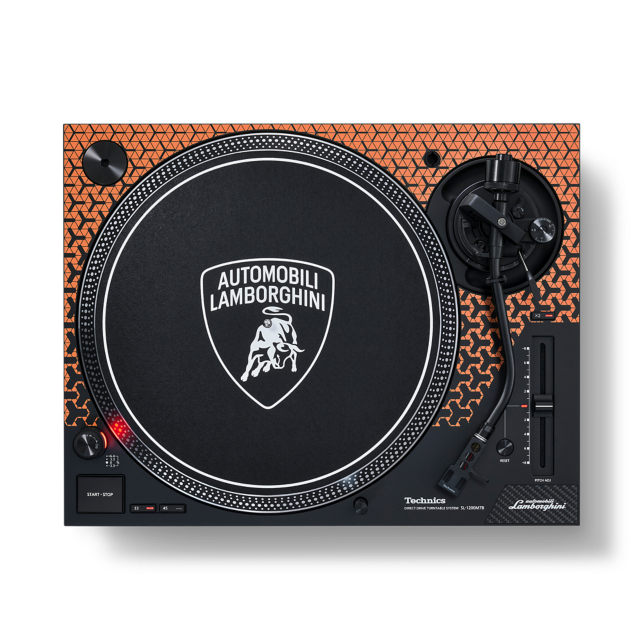
The Technics SL-1200M7B Lamborghini Edition is a special-edition direct-drive DJ turntable created with Automobili Lamborghini. It is based on the proven SL-1200MK7 platform, combining the familiar Technics DJ layout with Lamborghini-inspired styling, exclusive accessories and three distinctive colour options.
Underneath the visual treatment, the M7B retains the core MK7 features that matter to DJs: a coreless direct-drive motor, digital pitch control, reverse playback, adjustable motor response, S-shaped tonearm and vibration-resistant chassis.
Technics SL-1200M7B key features
Special edition developed with Automobili Lamborghini.
Based on the SL-1200MK7 DJ platform.
Coreless direct-drive motor.
33⅓, 45 and 78 RPM playback.
Digital pitch control with ±8% and ±16% ranges.
Reverse Play mode.
Adjustable torque and brake response.
High-sensitivity S-shaped tonearm.
High-rigidity, vibration-damped cabinet.
Detachable power and phono connections.
Available in Lamborghini-inspired orange, yellow and green finishes.
Lamborghini-inspired design
The M7B’s main distinction is its visual design. Technics created the model with Automobili Lamborghini, using bold colour finishes and graphic details inspired by the Italian car maker’s design language.
The special edition also includes exclusive themed items supplied with the turntable, making it as much a collector-focused version of the MK7 as a working DJ deck.
Coreless direct-drive motor
The M7B uses the MK7’s coreless direct-drive architecture, designed to eliminate cogging while maintaining strong torque and stable rotation. That provides the immediate response DJs expect from the SL-1200 family.
Pitch, torque and braking
Digital pitch control offers ±8% and ±16% ranges, while starting torque and brake speed can be adjusted to suit different performance styles. This lets the deck response be tuned rather than fixed.
Reverse Play and 78 RPM
Reverse Play expands the creative options for DJs, while 78 RPM support sits alongside the standard 33⅓ and 45 RPM speeds.
Tonearm and vibration control
The familiar S-shaped static-balance tonearm uses high-precision bearings for reliable groove tracking. The cabinet and insulators are designed to reduce external vibration and acoustic feedback in high-volume environments.
SL-1200M7B strengths
Proven MK7 performance platform.
Distinctive Lamborghini collaboration design.
Stable direct-drive motor.
Adjustable pitch, torque and braking.
Reverse playback.
Detachable cables.
Genuine working DJ deck rather than a purely decorative edition.
SL-1200M7B limitations
Core performance is closely related to the standard MK7.
The special-edition styling may carry a premium over a regular SL-1200/1210MK7.
Availability varies by region and colour.
A suitable cartridge and mixer are still required for a complete DJ setup.
Technics SL-1200M7B full specifications
Drive: direct drive.
Motor: brushless coreless DC motor.
Speeds: 33⅓, 45 and 78 RPM.
Pitch: ±8% / ±16%.
Tonearm: universal static-balance S-shape.
Dimensions: 453 × 169 × 353 mm.
Weight: approximately 9.6 kg.
Colours: orange, yellow and green.
SL-1200M7B vs standard MK7
The standard SL-1200MK7 / SL-1210MK7 provides the same underlying DJ platform. The M7B adds the Lamborghini collaboration, exclusive styling and included themed extras.
Overall view
The SL-1200M7B is best understood as a special visual edition of a serious DJ turntable rather than a different performance class. DJs get the proven MK7 mechanics and controls, while collectors and Lamborghini fans get a much more distinctive version of the deck.
The Native Instruments Traktor MX2 is a compact two-channel DJ controller built for Traktor Pro 4. It combines touch-sensitive jog wheels, 16 RGB performance pads, Stems control, Pattern Player, full deck effects, Mixer FX and a 24-bit/96 kHz audio interface in a portable all-in-one controller.
MX2 is designed as the modern entry point into Native Instruments’ Traktor hardware range, but its creative tools go well beyond basic beginner controls.
Traktor MX2 key features
Two-channel DJ controller for Traktor Pro 4.
Traktor Pro 4 included.
Two touch-sensitive jog wheels.
16 colour-customisable RGB performance pads.
Dedicated Stems pad mode.
Pattern Player pad mode.
Hot Cue and Flux Loop pad modes.
Full Mixer FX controls.
Two full Deck FX units with access to more than 40 effects.
24-bit / 96 kHz audio interface.
USB-C connectivity.
Microphone input.
RCA and 3.5 mm main outputs.
Dual-size headphone outputs.
Two-channel Traktor workflow
The mixer uses a familiar two-channel layout with channel faders, three-band EQ, gain, filters and a crossfader. That makes the basic mixing workflow straightforward, while the surrounding controls provide direct access to more advanced Traktor features.
Touch-sensitive jog wheels
The two jog wheels support conventional nudging and cueing as well as a TurnTable-style mode. Their non-slip surface is designed for direct manual control without needing to rely entirely on Sync.
Stems control
MX2 can control Traktor Pro 4’s stem-separated track elements from the performance pads. Individual stems can be adjusted for volume, filtering and effects sends, making the controller useful for remix-style transitions and live rearrangement.
Pattern Player
Pattern Player is integrated into the pad workflow, allowing drum patterns to be triggered and layered alongside normal tracks. This gives the controller a more performance-oriented character than a simple two-deck mixer-and-jogs layout.
Mixer FX and Deck FX
Each channel has direct one-knob Mixer FX access, with nine effects available including Filter, Reverb, Delay, Gater and Crush-style processing. Two full Deck FX units provide access to more than 40 Native Instruments effects for deeper performance control.
Performance pads
Sixteen RGB pads provide Hot Cues, Stems, Flux Loops and Pattern Player modes. The pad colours can be customised, helping visual separation between different performance functions.
24-bit/96 kHz audio interface
The integrated audio interface supports up to 24-bit/96 kHz operation. RCA and 3.5 mm main outputs provide flexible speaker connections, while both 3.5 mm and 6.35 mm headphone sockets are included for cueing.
Microphone and USB-C
A 6.35 mm microphone input supports voice or MC use, and USB-C provides the main computer connection. The controller is designed for plug-and-play integration with Traktor Pro 4.
Traktor MX2 strengths
Traktor Pro 4 included.
Strong Stems integration.
Pattern Player built into the performance workflow.
16 RGB pads.
Excellent effects access.
24-bit/96 kHz audio.
Compact and modern USB-C design.
Traktor MX2 limitations
Two mixer channels only.
Main professional output is not balanced XLR.
Designed primarily around Traktor rather than broad multi-software support.
Requires a computer rather than operating standalone.
Native Instruments Traktor MX2 full specifications
Channels: 2.
Software: Traktor Pro 4 included.
Jog wheels: 2 touch-sensitive.
Performance pads: 16 RGB.
Audio interface: up to 24-bit / 96 kHz.
Main output: RCA and 3.5 mm.
Headphones: 3.5 mm and 6.35 mm.
Microphone: 6.35 mm input.
Connection: USB-C.
Frequently asked questions
Does Traktor MX2 include Traktor Pro 4?
Yes. Native Instruments includes Traktor Pro 4 with the controller.
Does MX2 control Stems?
Yes. A dedicated Stems pad mode provides direct control over stem-separated track elements.
Can it work without a laptop?
No. MX2 is a software controller designed to work with Traktor running on a computer.
Overall view
Traktor MX2 is a compact controller, but it is not limited to basic beginner features. Stems, Pattern Player, two full effects units and a high-resolution audio interface give it enough depth for creative Traktor users while keeping the physical layout easy to understand.
The Native Instruments Traktor Z1 MK2 is an ultra-compact DJ mixer controller and audio interface designed for Traktor Pro 4. It combines channel faders, a crossfader, EQ or Stem controls, Mixer FX, three OLED displays and a 24-bit/96 kHz sound card in a portable modular unit.
Z1 MK2 is built for DJs who want a small mixer at the centre of a Traktor setup. It can be used on its own for a compact software workflow or paired with controllers such as the Traktor X1 MK3 for a more complete modular system.
Traktor Z1 MK2 key features
Ultra-compact two-channel mixer controller.
Dual-layer control for up to four Traktor channels.
Three OLED displays.
EQ and Stem-control modes.
Nine Mixer FX.
Channel faders and crossfader.
24-bit / 96 kHz audio interface.
Master and headphone outputs.
Designed for Traktor Pro 4.
Compact modular format for pairing with Traktor X1 MK3.
Compact mixer workflow
The Z1 MK2 provides the controls most DJs expect at the centre of a mixer: channel faders, crossfader, gain and three rotary controls per channel. Its small footprint makes it particularly useful for travel, secondary setups and modular booths where a full-size mixer is unnecessary.
EQ and Stem control
The channel rotary controls can work as conventional EQ or be reassigned to Traktor Pro 4’s Stems workflow. That allows the same hardware to move between traditional frequency control and stem-element mixing without adding another controller.
Dual-layer control
Although the physical surface is compact, dual-layer operation can extend control beyond the two visible channels. This makes the Z1 MK2 more flexible in larger Traktor setups where additional software decks are in use.
Three OLED displays
Three small OLED displays provide direct feedback for channel and effects information. This reduces the amount of basic status checking that needs to be done on the laptop screen.
Nine Mixer FX
Dedicated one-knob Mixer FX controls provide fast access to nine effects within Traktor Pro 4. This keeps filters and creative transition effects immediately available from the mixer surface.
24-bit / 96 kHz audio interface
The built-in sound card supports up to 24-bit/96 kHz audio, allowing Z1 MK2 to act as both the control surface and audio output for a compact Traktor system.
Pairing Z1 MK2 with X1 MK3
Z1 MK2 and Traktor X1 MK3 are natural partners. Z1 handles mixing and audio output while X1 adds transport, browsing, loops and deeper effects control. Together they create a compact modular alternative to a conventional all-in-one DJ controller.
Traktor Z1 MK2 strengths
Very compact and portable.
Built-in high-resolution audio interface.
Useful Stems integration.
Nine Mixer FX.
OLED feedback.
Pairs neatly with X1 MK3.
Can control more than two software channels through layering.
Traktor Z1 MK2 limitations
No jog wheels or full deck transport section.
Designed primarily around Traktor rather than broad multi-software compatibility.
Compact controls are less spacious than a full-size mixer.
Requires a computer running Traktor.
Native Instruments Traktor Z1 MK2 full specifications
Mixer channels: 2 physical channels with dual-layer software control.
Displays: 3 OLED screens.
Effects: 9 Mixer FX.
Audio interface: up to 24-bit / 96 kHz.
Controls: channel faders, crossfader, EQ/Stem rotary controls and cueing.
Software: designed for Traktor Pro 4.
Frequently asked questions
Is Traktor Z1 MK2 a standalone mixer?
It is a mixer controller and audio interface designed around Traktor software, rather than a fully standalone DJ mixer for independent analogue sources.
Can Z1 MK2 control Stems?
Yes. Its channel controls can be used for Traktor Pro 4 Stems as an alternative to conventional EQ control.
Overall view
Traktor Z1 MK2 is a specialised compact mixer rather than an all-in-one controller. Its value comes from combining a proper mixer workflow, Stems control, effects and a high-resolution audio interface in a footprint small enough for genuinely portable Traktor setups.
The Native Instruments Traktor X1 MK3 is a compact modular DJ controller designed for Traktor Pro 4. It focuses on transport, browsing, looping, effects and mixer control rather than jog wheels, making it a flexible companion for digital DJ setups built around an external mixer or the Traktor Z1 MK2.
The third-generation X1 adds five OLED displays, extensive RGB feedback and a built-in powered USB hub while keeping the narrow modular format that made the X1 series popular for portable and club-style Traktor setups.
Traktor X1 MK3 key features
Compact modular controller for Traktor Pro 4.
Five OLED displays.
Dedicated transport controls.
Loop and browsing encoders.
Direct Deck FX control.
Mixer mode for channel mixing without a separate controller.
Extensive RGB button and light feedback.
Three-port powered USB hub.
Customisable control mapping.
Traktor Pro 4 included.
Five OLED displays
Five OLED displays provide direct feedback for track, loop, effects and mixer information. The screens reduce the need to keep checking the laptop for basic performance data and make the compact surface easier to navigate in a dark booth.
Transport and deck control
Dedicated Play, Cue and Sync controls handle the essential deck functions, while touch-sensitive browse and loop encoders speed up library navigation and loop adjustment. The X1 is designed to control digital decks without requiring traditional jog wheels.
Deck FX control
The upper section gives direct access to Traktor’s Deck FX units, including effect selection, parameter control and activation. This makes X1 especially useful for DJs who use Traktor’s extensive effects library as a major part of their performance.
Mixer mode
Mixer mode lets the X1 take over essential channel functions inside Traktor, allowing a very compact software-only setup even when a separate mixer controller is not available.
For a more tactile dedicated mixer, it pairs naturally with the Traktor Z1 MK2.
RGB feedback and lighting
Buttons and side lighting provide colour-coded feedback for deck states and alerts. The visual system is useful in dark environments and helps distinguish different layers and functions on a controller with a relatively small footprint.
Three-port powered USB hub
A built-in three-port powered USB hub simplifies modular setups by allowing additional compatible USB hardware to connect through the X1 rather than occupying several computer ports.
Traktor Pro 4 included
Native Instruments includes Traktor Pro 4 with the X1 MK3, so the controller and software are designed as one integrated workflow rather than requiring a separate DJ application purchase.
Traktor X1 MK3 strengths
Very compact modular format.
Five useful OLED displays.
Excellent effects and loop control.
Built-in powered USB hub.
Strong RGB feedback.
Traktor Pro 4 included.
Pairs well with Z1 MK2 and external mixers.
Traktor X1 MK3 limitations
No jog wheels.
No built-in audio interface for a complete standalone output path.
Designed primarily around Traktor.
Best suited to modular workflows rather than DJs wanting one all-in-one controller.
Native Instruments Traktor X1 MK3 full specifications
Displays: 5 OLED screens.
Control focus: transport, browsing, loops, FX and mixer mode.
USB hub: 3 powered USB ports.
Visual feedback: RGB buttons and side lighting.
Software: Traktor Pro 4 included.
Format: compact modular controller.
Frequently asked questions
Does Traktor X1 MK3 include Traktor Pro 4?
Yes. Traktor Pro 4 is included with the controller.
Does X1 MK3 have jog wheels?
No. It is designed around transport, loops, browsing, effects and modular control rather than traditional jog-wheel operation.
Overall view
Traktor X1 MK3 is deliberately different from a conventional DJ controller. Its strength is compact, direct control over the functions digital Traktor DJs use most: browsing, transport, loops and effects. Paired with a mixer or Z1 MK2, it can form an extremely portable but capable modular system.
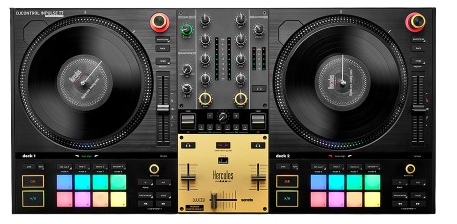
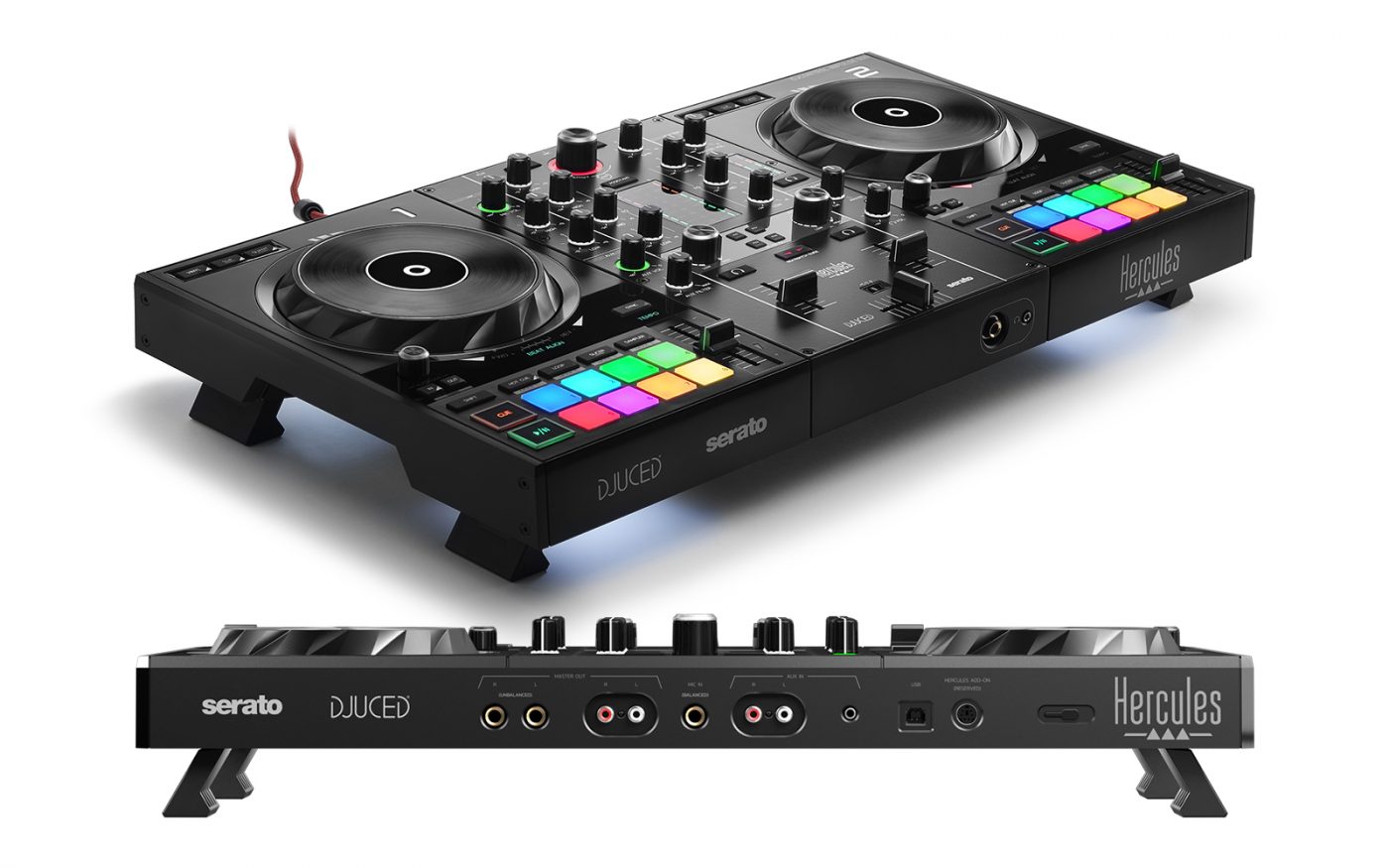
The Hercules DJControl Inpulse T7 is a two-deck motorised DJ controller designed to help DJs learn and perform with a more turntable-like feel. It uses removable 7-inch vinyl records and felt slipmats on motorised platters, while retaining the convenience of Serato DJ Lite and DJUCED software.
The T7 is particularly interesting for DJs who want to practise beatmatching, scratching and backspins on moving platters without moving straight to a pair of full-size turntables and a separate mixer.
Hercules DJControl Inpulse T7 key features
Two motorised 7-inch platters.
Removable vinyl records and felt slipmats.
Platters reach 33⅓ RPM in around 0.1 seconds.
Dedicated Stems controls for vocals and instrumentals.
Built-in Beatmatch Guide.
Three-band EQ and Filter controls.
Effects section with selectable FX and paddles.
Long 100 mm pitch faders.
Adjustable crossfader curve.
Balanced XLR and RCA main outputs.
Balanced microphone input.
Serato DJ Lite and DJUCED included.
Serato DJ Pro compatible.
Motorised 7-inch platters
The T7’s biggest feature is its pair of motorised platters. Each deck uses a separate 7-inch vinyl record, felt slipmat and metal platter, giving the user a physical relationship with the deck that is much closer to a turntable than a conventional static jog wheel.
The records can be removed and handled independently of the platter, while the motors reach standard vinyl speed quickly enough for practical performance use.
Beatmatch Guide
Hercules’ Beatmatch Guide uses visual light indicators around the tempo and beat controls to show which direction the DJ needs to adjust. It is designed as a learning aid for manual beatmatching and can be switched off once the technique becomes familiar.
Stems control
Dedicated Stems buttons provide fast control over vocal and instrumental separation in compatible software. This makes it possible to build live mash-ups and cleaner transitions without reaching for software controls on the laptop.
Effects and filters
Each deck includes three FX selection buttons, a performance paddle, a Filter control and beat/parameter controls. The layout gives effects a more hands-on role than on simpler Inpulse controllers.
Long pitch faders
The 100 mm pitch faders provide more room for fine tempo adjustments than the short sliders found on many compact beginner controllers. Combined with the moving platters, this makes the T7 better suited to practising turntable-style manual beatmatching.
Professional outputs and microphone
Balanced XLR and RCA master outputs allow the controller to connect directly to professional PA systems as well as conventional powered speakers. A balanced microphone input with hardware level control supports mobile and event use.
Serato DJ Lite and DJUCED
The controller includes both Serato DJ Lite and DJUCED. It is also compatible with Serato DJ Pro through the appropriate paid upgrade, giving users a route from beginner software into a more advanced Serato workflow without replacing the hardware.
DJControl Inpulse T7 strengths
Genuine moving-platter feel.
Removable vinyl records and slipmats.
Useful learning aids for manual beatmatching.
Dedicated Stems controls.
Professional XLR outputs.
Long pitch faders.
Relatively light for a motorised controller at around 5 kg.
DJControl Inpulse T7 limitations
Two channels rather than four.
Requires a computer and DJ software.
Motorised platters add size and complexity compared with static-jog controllers.
Serato DJ Pro requires a separate upgrade.
Hercules DJControl Inpulse T7 full specifications
Decks: 2.
Platters: 2 × motorised 7-inch / 17.8 cm.
Platter speed: 33⅓ RPM.
Pitch faders: 100 mm.
EQ: 3-band per channel.
Main outputs: 2 × XLR plus 2 × RCA.
Headphones: 3.5 mm and 6.35 mm.
Microphone: balanced input.
Software: DJUCED and Serato DJ Lite included; Serato DJ Pro compatible.
Weight: approximately 5 kg.
Frequently asked questions
Are the T7 platters motorised?
Yes. Both platters are motorised and use removable 7-inch vinyl records and felt slipmats.
Does the T7 include Serato DJ Pro?
It includes Serato DJ Lite. Serato DJ Pro is compatible but requires the appropriate upgrade or subscription.
Overall view
The DJControl Inpulse T7 is one of the more distinctive Hercules controllers because its learning focus is built around genuine moving platters rather than simulated vinyl behaviour. For DJs who want to develop turntable-style technique while staying in a compact software-controller setup, it offers a useful bridge between beginner hardware and traditional decks.
The Hercules DJControl Inpulse T7 Premium Edition is an upgraded version of the motorised Inpulse T7 controller. It keeps the same two 7-inch moving platters, Stems controls, Beatmatch Guide and Serato/DJUCED workflow, while adding a Premium Fader Module, scratch-focused slipmats, additional mixing slipmats, gold-coloured detailing and a semi-rigid carrying case.
Inpulse T7 Premium Edition key features
Two motorised 7-inch platters with removable vinyl records.
Premium double-rail fader module.
Two scratch slipmats plus two standard mixing slipmats.
Semi-rigid EVA carrying case.
Dedicated Stems controls.
Beatmatch Guide learning lights.
Effects section with paddles.
Three-band EQ and Filter controls.
Balanced XLR and RCA main outputs.
Serato DJ Lite and DJUCED included.
Serato DJ Pro compatible.
Premium Fader Module
The most important hardware change is the factory-installed Premium Fader Module. Its three double-rail faders are designed for smoother movement and improved durability compared with the standard T7 fader assembly.
Scratch and mixing slipmats
The Premium Edition includes two slipmats optimised for scratching and another two intended for conventional mixing. Because the T7 uses removable vinyl records and slipmats over its motorised platters, changing the slipmat directly affects how freely the record moves against the platter.
Motorised vinyl-style control
Like the standard Inpulse T7, the Premium Edition uses genuine 7-inch records over motorised platters. The platters reach 33⅓ RPM rapidly, providing the moving-deck response needed for scratching, backspins and manual beatmatching.
Stems and effects
Dedicated controls can isolate vocals or instrumentals in compatible DJUCED and Serato workflows. Each deck also provides FX selection, a performance paddle, Filter control and beat/parameter controls for hands-on transitions.
Carrying case
A semi-rigid EVA case is included with the Premium Edition. It provides a fitted space for the controller and its power accessories, making the package more practical for DJs who regularly transport the T7.
Professional audio connections
Balanced XLR and RCA master outputs support professional speaker systems, while both 3.5 mm and 6.35 mm headphone connections are provided. The microphone input and hardware level controls make the controller suitable for mobile and event use as well as home practice.
T7 Premium strengths
Smoother premium fader assembly.
Motorised 7-inch vinyl-style platters.
Scratch and mixing slipmats included.
Protective carrying case included.
Dedicated Stems and effects controls.
Professional XLR outputs.
Still relatively light for a motorised controller.
T7 Premium limitations
The core deck and software architecture remains closely related to the standard T7.
Two mixer channels only.
Requires a computer.
Serato DJ Pro requires an additional paid licence or subscription.
Hercules DJControl Inpulse T7 Premium full specifications
Decks: 2.
Platters: 2 × motorised 7-inch / 17.8 cm.
Faders: Premium double-rail fader module.
EQ: 3-band plus Filter.
Main outputs: XLR and RCA.
Headphones: 3.5 mm and 6.35 mm.
Software: DJUCED and Serato DJ Lite included; Serato DJ Pro compatible.
Weight: approximately 5 kg.
T7 Premium vs standard T7
The standard T7 provides the same motorised platter concept and core software controls. The Premium Edition is primarily for users who value the upgraded faders, extra slipmats, carrying case and premium finish enough to justify the higher package price.
Overall view
The T7 Premium Edition is not a completely different controller, but its upgrades are meaningful for DJs who intend to scratch regularly or transport the unit. The smoother faders and extra slipmats address the physical parts of the controller that matter most to a motorised-deck workflow.
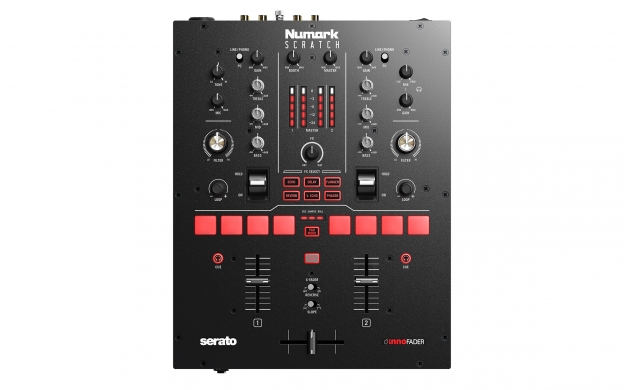
The Numark Scratch is a two-channel 24-bit scratch mixer built around Serato DJ Pro and DVS. It combines an Innofader crossfader, performance pads, paddle-style software effects controls, instant looping and professional XLR outputs in a compact all-metal mixer.
It is designed primarily for turntablists and Serato users who want a straightforward battle-style mixer without moving into a much larger flagship model.
Numark Scratch key features
Two-channel 24-bit digital DJ mixer.
Serato DJ Pro and DVS support.
Innofader crossfader with reverse and slope controls.
Four performance pads per deck.
Six software FX triggers with dual paddles.
Dedicated Dry/Wet FX control.
Instant Loop encoders.
Channel Filter controls.
Phono and line inputs on both channels.
Combo microphone input with tone control.
Balanced XLR main output.
Separate booth output.
6.35 mm and 3.5 mm headphone outputs.
Innofader crossfader
The built-in Innofader is the centre of the Scratch workflow. Reverse and slope controls let the response be configured for sharp scratch cuts or smoother mixing, while the compact two-channel layout keeps the important controls close to the fader area.
Serato DJ Pro and DVS
Scratch unlocks Serato DJ Pro and Serato DVS, allowing compatible timecode vinyl or control CDs to control digital tracks. Traditional turntables and media players can also be connected as conventional audio sources.
Performance pads
Four pads per deck provide quick access to Cue, Roll and Sampler functions. The pad controls are deliberately simple, keeping the mixer focused on the core performance tools most scratch DJs use regularly.
Effects paddles
Six software effects can be selected from dedicated buttons, then triggered with two paddle-style switches. A Dry/Wet control adjusts the amount of processed signal, making quick momentary effects easy to perform without relying on the laptop screen.
Inputs and outputs
Each channel supports phono and line-level sources, making the mixer suitable for turntables and media players. Balanced XLR main output and a separate booth output provide the connections expected in a professional setup, while the combo microphone input supports announcements or MC use.
Numark Scratch strengths
Serato DJ Pro and DVS included.
Excellent Innofader crossfader.
Useful paddle-style effects controls.
Performance pads and looping.
Balanced XLR main output.
Compact battle-style layout.
Numark Scratch limitations
Two channels only.
Pad section is simpler than on larger battle mixers.
Software effects depend on the connected Serato setup.
No large display or standalone playback.
Numark Scratch full specifications
Channels: 2.
Audio: 24-bit.
Crossfader: Innofader with reverse and slope control.
Performance pads: 4 per deck.
Main output: balanced XLR.
Booth output: unbalanced.
Microphone: XLR/6.35 mm combo.
Headphones: 6.35 mm and 3.5 mm.
Dimensions: 306 × 244 × 84 mm.
Frequently asked questions
Does Numark Scratch unlock Serato DJ Pro?
Yes. Serato DJ Pro and DVS are supported when the mixer is connected.
Can normal vinyl records be mixed?
Yes. Each channel has phono inputs for conventional turntables as well as line inputs for other sources.
Overall view
Numark Scratch is a focused two-channel mixer that puts the important battle-DJ features first: a strong crossfader, Serato DVS, pads, effects paddles and professional outputs. It is particularly attractive to DJs who want a compact Serato scratch setup without paying for a much larger mixer.
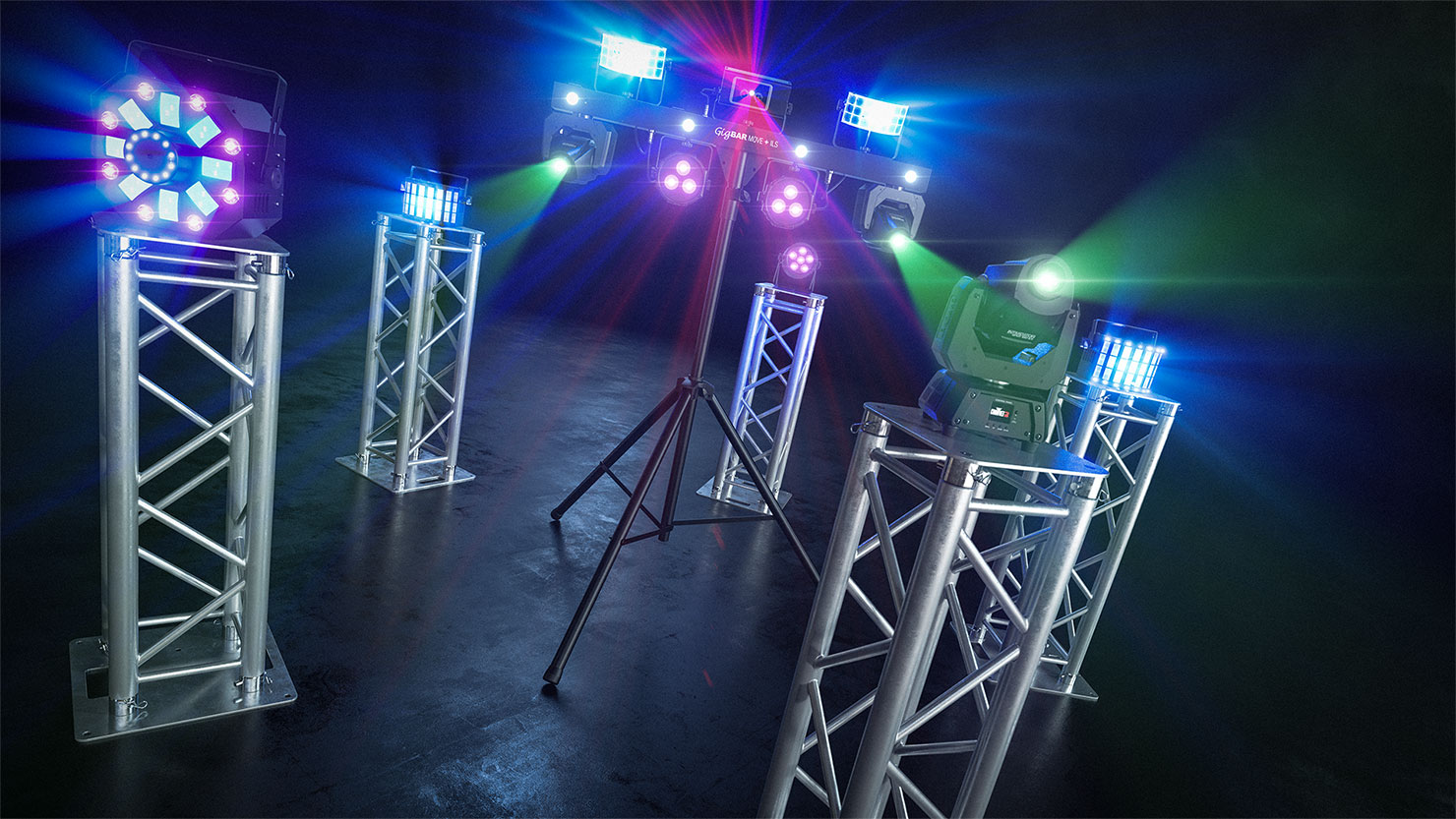
The CHAUVET DJ GigBAR Move + ILS is a 5-in-1 mobile lighting system that combines moving heads, derby effects, wash lights, a laser and strobe effects on a single bar. It is designed for mobile DJs and small events where fast setup matters, while still providing enough control for more elaborate programmed shows.
The system is part of CHAUVET DJ’s ILS ecosystem, allowing compatible fixtures to be synchronised through Instant Light Shows without building a full DMX programme from scratch. A built-in D-Fi transceiver also supports wireless ILS or DMX control.
GigBAR Move + ILS key features
5-in-1 lighting system on a single bar.
Two 32 W moving heads.
Derby effects, wash lights, RGB laser and strobe.
ILS compatibility for coordinated multi-fixture shows.
Built-in D-Fi transceiver for wireless ILS or DMX.
Full-colour LCD display.
Totem Mode to keep moving heads focused on the dance floor.
Built-in automated and sound-active programmes.
RF remote and wireless footswitch included.
Tripod and carry bags included.
Power linking for multiple units.
Five lighting effects in one rig
The main appeal of GigBAR Move + ILS is the amount of lighting it combines into one transportable system. The moving heads provide focused beams and gobos, the wash sections fill larger areas with colour, the derby effects create wider moving patterns, the strobe adds high-impact flashes and the RGB laser adds aerial effects.
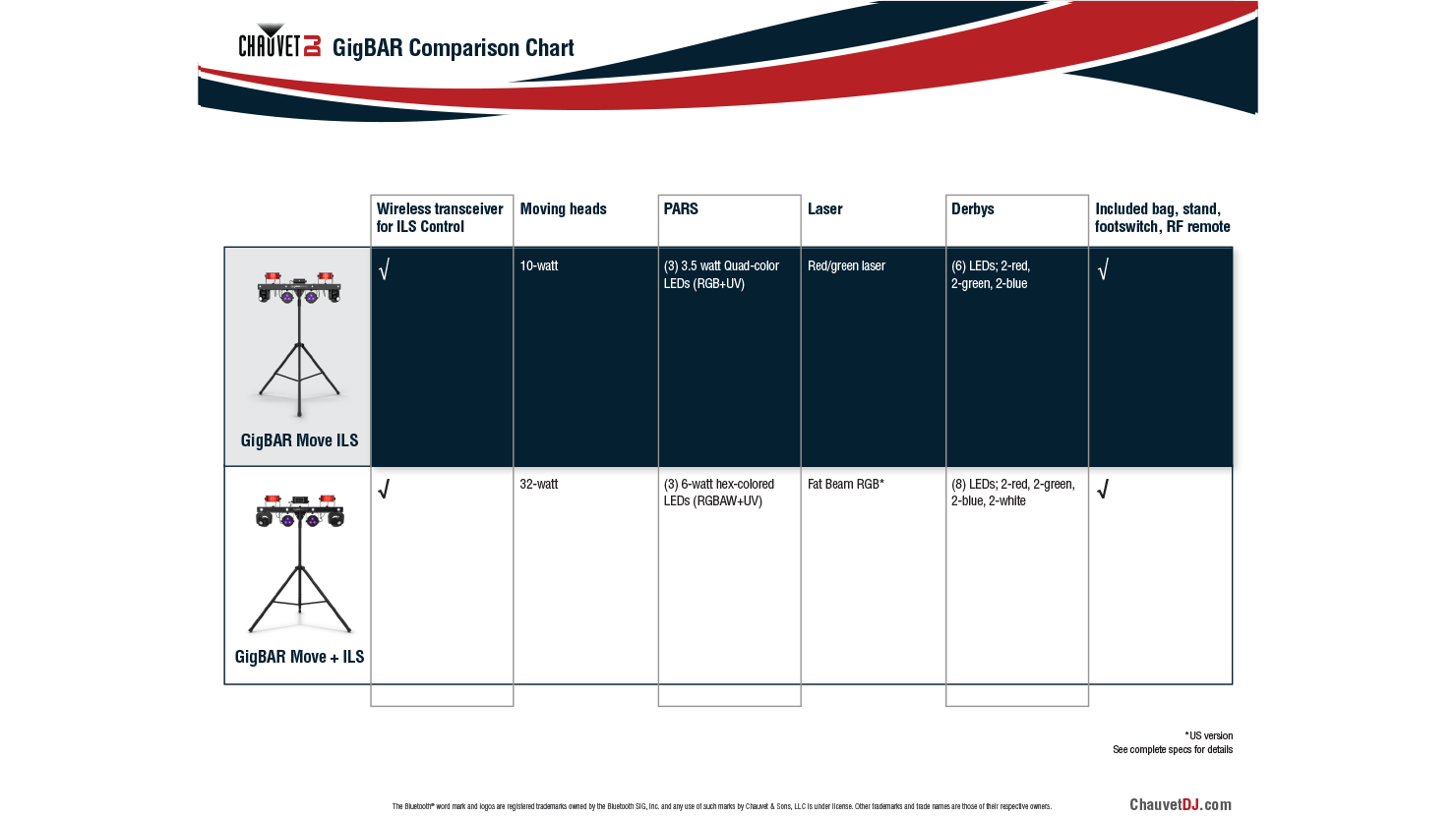
More powerful moving heads
Compared with the standard GigBAR Move ILS, the Move + version uses 32 W moving-head LEDs rather than 10 W units. CHAUVET DJ specifies 5,140 lux at 2 metres per moving head, making this the stronger option where the moving-head section needs to stand out in a larger room.
Separate colour and gobo wheels allow more creative programming, while Totem Mode can restrict movement so the beams stay focused on the intended dance-floor area.
ILS and wireless D-Fi control
Instant Light Shows allow compatible CHAUVET DJ fixtures to work together without manually programming each fixture as a separate DMX device. GigBAR Move + ILS can participate in the ILS ecosystem and communicate wirelessly through its built-in D-Fi transceiver.
For mobile DJs, this can make it much faster to expand the lighting rig while keeping the overall show coordinated.
Control options
The system can run automated or sound-active shows on its own, or be controlled through DMX, RF remote or the included wireless footswitch. That gives a useful range from simple plug-and-play operation through to detailed programmed control.
Portable mobile-DJ package
CHAUVET DJ includes a tripod, wireless footswitch, RF remote and carry bags. The complete package is therefore designed to move as one lighting system rather than requiring several separate fixtures and stands.
GigBAR Move + ILS strengths
Very broad range of effects from one bar.
Powerful 32 W moving heads.
ILS and wireless D-Fi support.
Good control options for both simple and advanced use.
Tripod, footswitch, remote and bags included.
Strong fit for mobile DJ work.
GigBAR Move + ILS limitations
Large and relatively heavy at around 14 kg for the bar alone.
More complex than a simple wash or derby fixture.
Laser use must follow venue rules and applicable safety requirements.
Overkill for very small rooms or simple background lighting.
CHAUVET DJ GigBAR Move + ILS full specifications
DMX channels: 3, 29 or 51.
DMX connector: 3-pin XLR.
Pan/Tilt: 540° / 180°.
Moving-head LED: 32 W cool white per head.
Wash LEDs: 3 × 6 W RGBAW+UV per wash section.
Laser: RGB laser.
Strobe rate: 0–30 Hz.
Moving-head beam angle: 17°.
Input voltage: 100–240 V AC, 50/60 Hz.
Power consumption: approximately 248 W at 230 V.
Bar dimensions: 1100 × 144 × 449 mm.
Bar weight: 14 kg.
GigBAR Move + ILS vs GigBAR Move ILS
The standard GigBAR Move ILS follows the same 5-in-1 concept but uses lower-powered moving heads and a simpler effects specification. The Move + model is the stronger option where brighter moving-head output and a more powerful overall show are the priority.
Frequently asked questions
Does GigBAR Move + ILS work without DMX?
Yes. It can run built-in automated and sound-active programmes and can also be controlled with the included RF remote or wireless footswitch.
Can it control or sync with other CHAUVET DJ lights?
Yes. It supports CHAUVET DJ’s ILS ecosystem and includes built-in D-Fi for wireless ILS or DMX communication with compatible fixtures.
Is a tripod included?
Yes. CHAUVET DJ includes the tripod, wireless footswitch, RF remote and carry bags with the system.
Overall view
GigBAR Move + ILS is aimed squarely at mobile entertainers who want a complete lighting show with minimal setup. The combination of moving heads, washes, derbies, laser and strobe gives one fixture unusually broad coverage, while ILS makes it easier to expand the system later without turning every job into a full DMX programming session.
The CHAUVET DJ GigBAR Move ILS is a 5-in-1 mobile lighting system that combines moving heads, derby effects, wash lights, a red/green laser and strobe effects on a single bar. It is designed for mobile DJs who want a complete lighting show with minimal setup and the option to expand into CHAUVET DJ’s ILS ecosystem.
GigBAR Move ILS key features
5-in-1 lighting system.
Moving heads, derbies, wash lights, laser and strobe effects.
ILS compatibility.
Built-in D-Fi transceiver for wireless ILS or DMX.
Full-colour LCD display.
Totem Mode for dance-floor-focused moving heads.
RF remote and wireless footswitch included.
Tripod and carrying bags included.
Automated and sound-active programmes.
Five effects in one mobile system
The system combines two moving heads, derby effects, RGB+UV wash lights, a red/green laser and strobe sections. This gives a mobile DJ several different visual effects without carrying and wiring multiple separate fixtures.
ILS and wireless D-Fi
GigBAR Move ILS can form part of CHAUVET DJ’s Instant Light Show ecosystem, allowing compatible fixtures to produce coordinated shows. The built-in D-Fi transceiver supports wireless ILS or DMX communication, reducing the number of data cables required around a mobile rig.
Moving heads and Totem Mode
The moving heads use 10 W cool-white LEDs with separate colour and gobo wheels. Totem Mode limits movement so the beams can remain focused on the dance floor rather than sweeping into unwanted areas of the room.
Control options
The system can run automatically, react to sound, operate through DMX, or be controlled with the supplied RF remote and wireless footswitch. That makes it practical both for quick setup and more detailed programmed use.
GigBAR Move ILS strengths
Complete multi-effect lighting system.
ILS and wireless D-Fi built in.
Tripod, footswitch, remote and bags included.
Useful mix of moving, wash, laser and strobe effects.
Lower power draw than the Move + version.
GigBAR Move ILS limitations
Moving heads are less powerful than GigBAR Move + ILS.
Still a relatively large system to transport.
Laser use must follow venue and safety requirements.
CHAUVET DJ GigBAR Move ILS full specifications
DMX channels: 3, 27 or 46.
DMX connector: 3-pin XLR.
Pan/Tilt: 540° / 180°.
Moving-head LED: 10 W cool white per head.
Wash LEDs: RGB+UV quad-colour.
Laser: red and green.
Strobe rate: 0–20 Hz.
Input voltage: 100–240 V AC.
Power consumption: approximately 79 W at 230 V.
Dimensions: 1100 × 144 × 449 mm.
Weight: 10.7 kg.
GigBAR Move ILS vs GigBAR Move + ILS
The GigBAR Move + ILS follows the same five-effect concept but adds much more powerful 32 W moving heads and a stronger overall effects package. GigBAR Move ILS is lighter and uses considerably less power.
Overall view
GigBAR Move ILS gives mobile DJs a complete, synchronisable light show in one transportable system. Its strongest advantage is convenience: moving heads, washes, derbies, laser and strobe are already mounted together and can be expanded through ILS later.
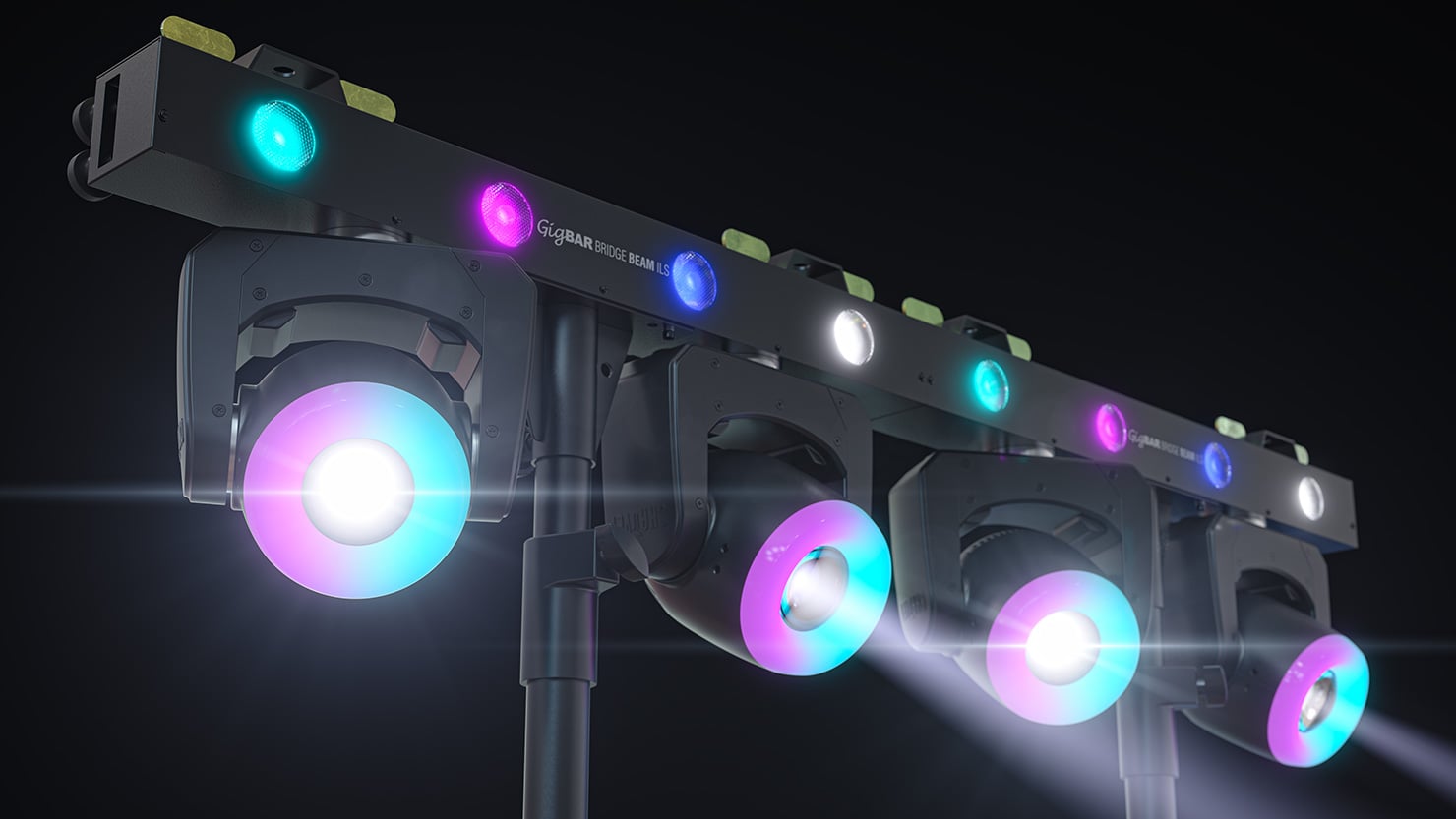
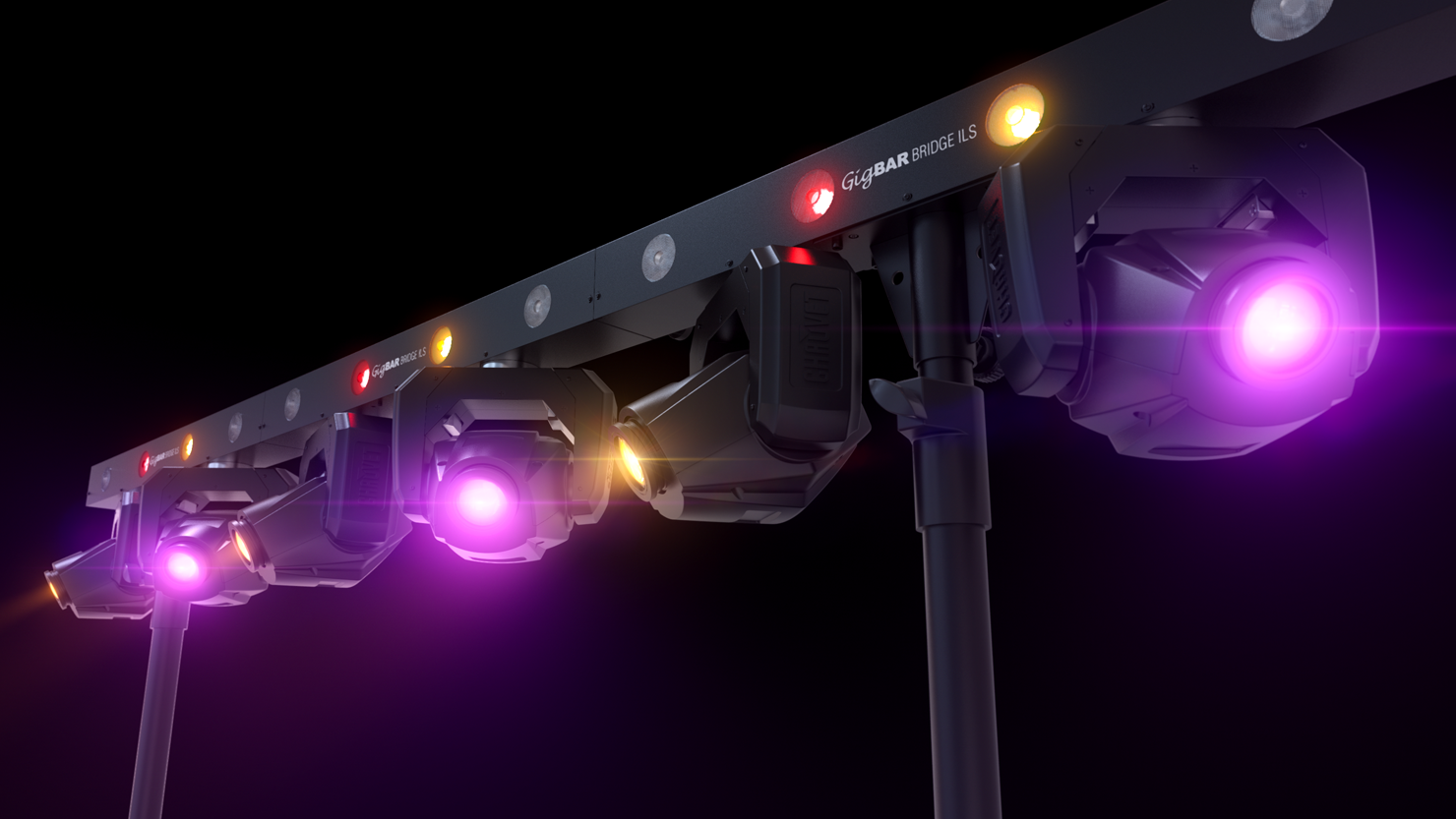
The CHAUVET DJ GigBAR Bridge Beam ILS is a 3-in-1 mobile lighting system that combines two beam moving heads, RGBAW+UV wash lights and RGBW LED rings on a compact pre-mounted bar. It is designed for mobile DJs who want stronger directional beams than a standard wash-based GigBAR while keeping setup fast.
The system supports CHAUVET DJ’s ILS ecosystem and includes a built-in D-Fi transceiver, so compatible fixtures can be synchronised wirelessly without building a complex DMX programme from scratch.
GigBAR Bridge Beam ILS key features
3-in-1 lighting system.
Dual RGBW beam moving heads.
RGBAW+UV wash lights.
RGBW LED rings for eye-candy effects.
ILS compatibility.
Built-in D-Fi transceiver.
RF remote included.
Full-colour LCD display.
Totem Mode.
Locking system for connecting multiple fixtures.
Carry case included.
Dual beam moving heads
The two moving heads are designed for narrow, high-impact beams. CHAUVET DJ specifies a 5° beam angle and very high illuminance at 2 metres, making the Beam model noticeably more focused than a conventional wash mover.
Totem Mode can restrict movement so the beams remain aimed at the intended dance-floor area.
Wash lights and LED rings
Four RGBAW+UV wash sections provide broader room colour, while the RGBW LED rings around the moving heads add visual effects that remain visible even when the beam itself is aimed elsewhere.
ILS and wireless D-Fi
Instant Light Shows allow compatible CHAUVET DJ fixtures to run coordinated programmes together. The built-in D-Fi transceiver supports wireless ILS or DMX communication, which is particularly useful for mobile rigs where reducing cable runs matters.
Compact expandable design
The Bridge system uses a built-in locking arrangement so multiple compatible sections can be joined securely. It can also mount to mobile tripods or truss using the removable brackets.
GigBAR Bridge Beam ILS strengths
Very strong narrow beam output.
Wash and eye-candy effects built in.
ILS and wireless D-Fi support.
Compact compared with full-size GigBAR Move systems.
Good fit for mobile DJs wanting more dramatic beam effects.
Carry case and RF remote included.
GigBAR Bridge Beam ILS limitations
No laser.
No derby effect.
Beam movers are more specialised than general wash movers.
Best results may depend on haze or atmospheric effects in suitable venues.
CHAUVET DJ GigBAR Bridge Beam ILS full specifications
DMX channels: 3, 24 or 60.
DMX connector: 3-pin XLR.
Moving heads: 2 × RGBW LEDs, 80 W total.
Wash source: RGBAW+UV, 40 W total.
LED rings: 48 RGBW LEDs, 10 W total.
Moving-head beam angle: 5°.
Wash beam angle: 20°.
Pan/Tilt: up to 540° / 270°.
Strobe rate: 0–20 Hz.
Input voltage: 100–240 V AC.
Power consumption: approximately 144 W at 230 V.
Dimensions: approximately 638 × 204 × 297 mm.
Weight: 7.5 kg.
GigBAR Bridge Beam ILS vs GigBAR Bridge ILS
The Beam version prioritises very narrow RGBW beams and LED rings. GigBAR Bridge ILS uses more conventional moving heads with colour and gobo wheels, making it more flexible for patterned spot-style effects.
Overall view
GigBAR Bridge Beam ILS is aimed at mobile DJs who want punchy moving beams without carrying separate movers, washes and eye-candy fixtures. Its compact size, ILS support and wireless D-Fi make it particularly attractive for fast event setup.
The Numark Party Mix II is a compact two-deck DJ controller with a built-in beat-synchronised LED light show, touch-sensitive jog wheels, performance pads and Serato DJ Lite support. It is designed as an affordable entry point for beginners who want hands-on DJ controls without a complicated setup.
Numark Party Mix II key features
Two-deck DJ controller.
Built-in beat-synchronised LED light show.
Touch-sensitive jog wheels.
Four performance pads per deck.
Filter knobs and two-band EQ.
Pitch sliders and Sync controls.
Serato DJ Lite included.
Algoriddim djay and other supported software.
3.5 mm main and headphone outputs.
USB powered.
Beginner-friendly two-deck layout
The controller uses the traditional two-decks-and-a-mixer arrangement, with dedicated Play, Cue, Sync, pitch and browsing controls. It is easy to understand for new DJs while still teaching the basic layout used on larger DJ systems.
Built-in light show
Three multicolour LEDs project a beat-synchronised light effect behind the controller. It can be switched on or off and is primarily intended for home parties and casual use.
Jog wheels and performance pads
The touch-sensitive jog wheels can be used for cueing, pitch nudging and scratching. Four pads per deck provide Effect, Cue, Loop and Sampler modes for basic performance techniques.
Software and streaming
Party Mix II includes Serato DJ Lite, which supports compatible streaming services through the software. Numark also lists compatibility with Algoriddim djay and VirtualDJ with the appropriate software or licence.
Party Mix II strengths
Very affordable and compact.
Easy beginner layout.
Built-in light show.
Touch-sensitive jog wheels.
Serato DJ Lite included.
USB powered.
Party Mix II limitations
No built-in speakers.
No professional balanced outputs.
Two-band EQ only.
Requires DJ software rather than operating standalone.
Numark Party Mix II full specifications
Decks: 2.
Main output: 3.5 mm.
Headphones: 3.5 mm.
Power: USB.
Dimensions: 325.5 × 199 × 51 mm.
Weight: 0.95 kg.
Party Mix II vs Party Mix III
The newer Party Mix III adds Stems controls, eight pads per deck, Bluetooth MIDI, Fade FX and more advanced learning tools. Party Mix II remains the simpler older option in Numark’s current catalogue.
Overall view
Party Mix II is a straightforward beginner controller that focuses on the basics. Its light show and compact size make it fun for casual use, while Serato DJ Lite provides a familiar route into software-based DJing.
The Numark Mixtrack Pro FX is a two-deck Serato DJ controller built around large 6-inch jog wheels, dedicated effects paddles, 16 performance pads and a 24-bit audio interface. It is aimed at developing DJs who want more physical control than an entry-level compact controller without moving into a four-channel system.
Numark Mixtrack Pro FX key features
Two-deck DJ controller.
6-inch capacitive-touch jog wheels.
Six quick-launch software effects.
Dual paddle-style effects triggers.
Eight performance pads per deck.
Dedicated auto-loop controls.
Three-band EQ and Filter knobs.
24-bit audio interface.
Serato DJ Lite included.
Serato DJ Pro upgrade ready.
Microphone input and RCA main output.
Large 6-inch jog wheels
The 6-inch capacitive jog wheels provide a much larger control surface than Numark’s compact beginner controllers. They support cueing, nudging and scratching, with textured edges for pitch adjustment during manual beat matching.
Effects paddles
Six software effects can be selected directly from the controller, including Echo, Reverb, Flanger, Phaser, high-pass filter and low-pass filter. Two paddle switches allow momentary or sustained triggering without reaching for the laptop.
Performance pads and loops
Eight pads per deck provide Hot Cue, Auto Loop, Sample and Fader Cuts modes. A separate Auto Loop section with multiplier controls makes it easier to build transitions and tighten loops without switching pad modes.
Serato DJ Lite and Pro
Mixtrack Pro FX includes Serato DJ Lite and is upgrade-ready for Serato DJ Pro. Streaming access depends on the services supported by the installed Serato version and the relevant accounts.
Mixtrack Pro FX strengths
Large jog wheels.
Fast paddle-style effects control.
Eight pads per deck.
24-bit audio.
Dedicated loop controls.
Serato DJ Lite included.
Mixtrack Pro FX limitations
Two software decks only.
No jog-wheel displays.
No professional XLR output.
Requires a computer.
Numark Mixtrack Pro FX full specifications
Decks: 2.
Jog wheels: 6-inch capacitive touch.
Performance pads: 8 per deck.
Audio: 44.1 kHz, 24-bit.
Main output: RCA.
Microphone: 6.35 mm input.
Power: USB bus powered.
Mixtrack Pro FX vs Mixtrack Platinum FX
The Mixtrack Platinum FX adds four-deck layering and displays inside the jog wheels. The Pro FX keeps the same broad effects-and-pad philosophy in a simpler two-deck package.
Overall view
The Mixtrack Pro FX sits neatly between beginner controllers and more advanced four-channel hardware. Its large jog wheels, paddles and pad section make it especially useful for DJs learning more expressive transitions and performance techniques.
The Numark Mixtrack Platinum FX is a four-deck DJ controller for Serato DJ Lite and Serato DJ Pro, built around 6-inch capacitive jog wheels with colour displays, paddle-style effects controls, 16 performance pads and a 24-bit audio interface.
Numark Mixtrack Platinum FX key features
Four-deck software layering.
6-inch capacitive jog wheels.
Colour jog-wheel displays.
Six quick-launch software effects.
Dual effects paddles.
Eight performance pads per deck.
Dedicated auto-loop controls.
Three-band EQ and Filter knobs.
24-bit audio interface.
Serato DJ Lite included.
Serato DJ Pro upgrade ready.
Four-deck control
Deck-select controls let each physical side switch between two software decks, giving access to four playback decks from a conventional two-deck hardware layout.
Jog-wheel displays
The high-resolution displays inside the 6-inch jog wheels show key track information including BPM, platter position, time remaining, pitch adjustment and key. This reduces the amount of basic information you need to read from the laptop screen.
Effects paddles
Six software effects can be selected from dedicated buttons, while two paddle switches provide fast momentary or latched triggering. Wet/dry and timing controls make the section suitable for build-ups and transition effects.
Performance pads and loops
Eight pads per deck provide Hot Cue, Auto Loop, Sample and Fader Cuts functions. A separate Auto Loop section keeps loop-length control available without constantly changing pad mode.
Serato DJ Lite and Pro
Mixtrack Platinum FX includes Serato DJ Lite and is ready for the paid Serato DJ Pro upgrade. The four-deck workflow becomes particularly useful when moving into the fuller Pro feature set.
Mixtrack Platinum FX strengths
Four-deck layering.
Useful jog-wheel displays.
Large 6-inch jogs.
Fast effects paddles.
Eight pads per deck.
24-bit audio.
Mixtrack Platinum FX limitations
Four decks share two physical deck sections.
No balanced XLR output.
Requires a computer.
Serato DJ Pro requires a separate licence.
Numark Mixtrack Platinum FX full specifications
Software decks: 4.
Jog wheels: 6-inch capacitive touch with colour displays.
Performance pads: 8 per deck.
Audio: 44.1 kHz, 24-bit.
Main output: RCA.
Microphone: 6.35 mm input.
Power: USB bus powered.
Dimensions: 536 × 246 × 51 mm.
Weight: 2.3 kg.
Mixtrack Platinum FX vs Mixtrack Pro FX
The Mixtrack Pro FX uses the same general effects-and-pad layout but keeps a simpler two-deck workflow and omits the jog-wheel displays.
Overall view
Mixtrack Platinum FX is a strong step up for DJs who want four-deck capability and useful hardware feedback without moving to a much larger professional controller. The jog displays and effects paddles are the features that distinguish it most clearly from the Pro FX.
The Numark Mixtrack Go is an ultra-compact two-deck DJ controller designed for portable laptop, tablet and smartphone setups. It combines capacitive jog wheels, Stems controls, performance pads, Bluetooth MIDI and a built-in audio interface in a controller weighing around 0.6 kg.
Numark Mixtrack Go key features
Ultra-compact two-deck layout.
Capacitive touch jog wheels.
Dedicated Acapella and Instrumental Stems controls.
Performance pads with Hot Cue, Loop, Sampler, Stems and Pad FX modes.
Fade FX controlled from the crossfader.
Bluetooth Low Energy MIDI.
USB-C connection and power.
24-bit / 48 kHz audio.
Serato DJ Lite and Algoriddim djay included.
Serato DJ Pro and VirtualDJ compatibility with additional licences.
Designed for portability
At only 324 mm wide and around 0.6 kg, Mixtrack Go is designed to travel easily. It can be powered from a laptop, compatible phone or tablet, USB power block or battery bank through USB-C.
Stems controls
Dedicated Acapella and Instrumental buttons give quick access to compatible software Stems features, while a Stems pad mode provides deeper control over vocals, drums, bass and instrumental elements.
Bluetooth MIDI and mobile DJing
Bluetooth Low Energy MIDI can control Algoriddim djay wirelessly on compatible iOS and Android devices. A USB-C connection remains available when a wired setup is preferred.
Performance pads and Fade FX
The performance pads cover Hot Cue, Auto Loop, Sampler, Stems and Pad FX functions. Fade FX can automatically combine effects and tonal changes with crossfader movement to make transitions easier for developing DJs.
Mixtrack Go strengths
Extremely small and light.
Modern Stems controls.
Bluetooth MIDI.
USB-C connectivity.
Built-in audio interface.
Useful software support.
Mixtrack Go limitations
Very compact controls.
No professional balanced outputs.
Requires compatible DJ software.
Not intended to replace a full-size event controller.
Numark Mixtrack Go full specifications
Decks: 2.
Audio: 24-bit / 48 kHz.
Wireless MIDI: Bluetooth Low Energy.
Connection: USB-C.
Power: USB, 5 V / 500 mA.
Dimensions: 324 × 93 × 40 mm.
Weight: 0.6 kg.
Overall view
Mixtrack Go is built around convenience rather than maximum control surface size. For travel, preparation, casual mobile mixing and very small setups, its Stems, Bluetooth MIDI and USB-C connectivity make it far more capable than its dimensions suggest.
The Hercules DJControl Inpulse 500 is a two-deck USB DJ controller for DJUCED and Serato DJ Lite. It combines touch-sensitive jog wheels, a built-in audio interface and beatmatching light guides with useful connections for home practice and live setups.
Key features
Two decks with 14 cm touch-sensitive jog wheels.
Sixteen RGB performance pads.
Beatmatch Guide lights for tempo and beat alignment.
Dedicated Filter/FX controls and adjustable crossfader curve.
Built-in audio interface, microphone input and auxiliary input.
Retractable feet for cable clearance.
Who is it for?
The Inpulse 500 offers useful learning aids without making you rely on them. The tempo and beat guides help when practising manual transitions, while the microphone and auxiliary inputs give it more flexibility than a basic controller.
Software and connections
Hercules lists DJUCED and Serato DJ Lite as included software. Serato DJ Pro is compatible with a separate licence or subscription. Streaming options depend on the software and service subscription; check current compatibility before choosing a platform.
There are two RCA and two 6.35 mm master outputs, 3.5 mm and 6.35 mm headphone sockets, RCA and 3.5 mm auxiliary inputs, and a balanced 6.35 mm microphone input. The auxiliary hardware mixer can handle an external source independently of DJ software.
Hercules DJControl Inpulse 500 specifications
Decks: two.
Jog wheels: 14 cm diameter with touch detection.
Pads: sixteen backlit RGB pads.
Audio: built-in 44.1 kHz / 24-bit interface.
Master outputs: two 6.35 mm jack and two RCA.
Headphone outputs: 3.5 mm and 6.35 mm jack.
Inputs: RCA and 3.5 mm auxiliary; balanced 6.35 mm microphone.
Dimensions: 542 × 296 × 70 mm.
Weight: 3.2 kg.
Overall view
This is a flexible two-deck controller for someone who wants practice aids and useful physical connections. Compare its size, software support and output options with your planned setup.
The Numark M2 is a compact two-channel scratch mixer designed for turntables, media players and other line-level sources. It combines switchable phono/line inputs, three-band channel EQ, a replaceable crossfader and microphone controls in a simple analogue layout.
Numark M2 key features
Two-channel DJ mixer.
Two switchable phono/line RCA inputs.
Two additional line RCA inputs.
Three-band EQ and gain on each channel.
Replaceable crossfader.
Crossfader reverse and slope controls.
Microphone input with EQ and gain.
Master and Record RCA outputs.
Crossfader-style headphone cueing.
Two-channel analogue workflow
The M2 is deliberately straightforward. Each channel provides gain and three-band EQ, while the input section can handle turntables, media players and other line-level sources. That makes it suitable for practice setups, small mobile rigs and simple two-deck systems.
Crossfader controls
The crossfader is replaceable and includes reverse and slope controls, allowing the response to be configured for sharper scratch cuts or smoother blending.
Microphone and cueing
A dedicated 6.35 mm microphone input has its own EQ and gain controls. Headphone cueing uses a crossfader-style blend control so the incoming and outgoing channels can be compared before a transition.
M2 strengths
Simple two-channel layout.
Phono and line compatibility.
Three-band EQ.
Replaceable crossfader.
Useful crossfader adjustment.
Compact size.
M2 limitations
No USB audio interface.
No balanced XLR output.
No built-in effects.
Two channels only.
Numark M2 full specifications
Channels: 2.
Inputs: 2 × switchable phono/line RCA, 2 × line RCA, 1 × 6.35 mm mic.
Outputs: Master RCA, Record RCA, 6.35 mm headphones.
Channel EQ: 3-band.
Product dimensions: approximately 290 × 241 × 91 mm.
Overall view
The M2 is a traditional analogue mixer rather than a software-focused performance hub. For a basic two-deck setup using turntables or media players, its simple signal path and adjustable crossfader remain easy to understand and practical to use.
The Numark M4 is a three-channel analogue DJ mixer designed for DJs who need more input flexibility than a basic two-channel unit. It combines six source inputs, three-band EQ on every channel, microphone control, LED metering and an adjustable replaceable crossfader.
Numark M4 key features
Three mixer channels.
Two switchable phono/line RCA inputs.
Four additional line RCA inputs.
Three-band EQ and gain on every channel.
Microphone input with EQ.
Six-segment LED signal metering.
Master/PFL meter switching.
Replaceable crossfader.
Crossfader reverse and slope controls.
Master and Record RCA outputs.
Three-channel flexibility
The M4 gives three physical mixer channels rather than two, allowing more sources to remain connected at once. Two channels can accept phono or line-level sources, while the additional line inputs are useful for media players, samplers or other devices.
Three-band EQ and metering
Each channel includes gain and three-band EQ with deep cut ranges. The central LED meter can monitor master or PFL levels, making gain matching easier before a source reaches the main mix.
Crossfader controls
The replaceable crossfader includes reverse and slope controls. That allows the mixer to work for smooth blending as well as faster scratch-style cuts.
M4 strengths
Three full mixer channels.
Six source inputs.
Phono and line compatibility.
Three-band EQ.
Replaceable adjustable crossfader.
Useful master/PFL metering.
M4 limitations
No USB audio interface.
No balanced XLR output.
No built-in effects.
Traditional analogue workflow only.
Numark M4 full specifications
Channels: 3.
Inputs: 2 × switchable phono/line RCA, 4 × line RCA, 1 × 6.35 mm mic.
Outputs: Master RCA, Record RCA, 6.35 mm headphones.
Channel EQ: 3-band.
Frequency response: 20 Hz–20 kHz on line inputs.
Distortion: less than 0.05%.
M4 vs M2
The M2 is a simpler two-channel scratch mixer. The M4 adds a third channel and more line inputs, making it the more flexible choice for multi-source setups.
Overall view
The M4 is built for DJs who need several analogue sources connected at once but do not need USB audio or software integration. Its main advantage is straightforward routing and a genuine third mixer channel.
The Numark M6 USB is a four-channel DJ mixer with a built-in USB audio interface. It can mix turntables, media players, microphones and computer audio while also sending the master mix back to a computer for recording.
Numark M6 USB key features
Four mixer channels.
USB audio input and recording output.
Three-band EQ and gain on every channel.
LED level metering per channel.
Multiple phono and line inputs.
Dedicated XLR microphone channel.
Second microphone input on channel four.
Replaceable crossfader with slope control.
Assignable crossfader routing.
Balanced XLR main outputs.
RCA Master, Booth and Record outputs.
Four-channel mixing
The M6 USB provides four full mixer channels with gain, three-band EQ and LED metering. Any channel can be assigned to either side of the crossfader, which is useful when combining several players or turntables in one setup.
USB audio for playback and recording
The USB connection allows audio from a computer to be mixed through the hardware and also allows the mix to be recorded back into compatible recording software. The USB audio connection is class compliant.
Turntables, line sources and microphones
Multiple phono and line inputs make the mixer suitable for turntables, media players and other analogue sources. A dedicated XLR microphone channel is joined by a second microphone input on channel four.
Professional outputs
Balanced XLR main outputs allow direct connection to professional sound systems, while separate RCA Master, Booth and Record outputs provide additional routing for monitors and recording devices.
M6 USB strengths
Four channels.
Built-in USB audio.
Balanced XLR main outputs.
Separate Booth and Record outputs.
Useful microphone connectivity.
Assignable replaceable crossfader.
M6 USB limitations
No built-in effects.
No performance pads or software-control section.
Traditional mixer layout rather than a modern controller workflow.
Larger than the M2 and M4.
Numark M6 USB full specifications
Channels: 4.
USB: 2-channel computer audio for playback and recording.
Main output: balanced XLR plus RCA.
Booth output: RCA.
Record output: RCA.
Microphones: dedicated XLR mic channel plus secondary mic input.
Dimensions: 321 × 362 × 102 mm.
Weight: approximately 4.35 kg.
M6 USB vs M4
The M4 is a simpler three-channel analogue mixer. The M6 USB adds a fourth channel, computer audio, balanced XLR main outputs and more microphone and output routing.
Overall view
The M6 USB is a practical traditional mixer for DJs who need four channels and computer recording without moving to a software-controller format. Its strongest advantages are the broad analogue connectivity, USB audio and balanced outputs.
The Numark M101 is a compact two-channel analogue DJ mixer intended for straightforward mobile, practice and small-event setups. It supports turntables and line-level sources, provides simple two-band EQ, microphone input and a stereo RCA master output, and can be rack-mounted.
Numark M101 key features
Two-channel analogue DJ mixer.
Two switchable phono/line RCA input pairs.
Two-band channel EQ.
Crossfader.
6.35 mm microphone input.
Stereo RCA master output.
Rack-mountable design.
Simple two-channel mixing
M101 is built around a basic two-channel workflow. Each channel can accept a turntable or line-level source, making it suitable for simple setups using vinyl decks, media players or other analogue sources.
Two-band EQ
Each channel includes straightforward tone control for quick adjustments to the mix. The design prioritises ease of use over advanced performance features or effects.
Microphone and rack mounting
A 6.35 mm microphone input supports announcements and basic MC use. The rack-mountable chassis is useful for mobile DJs who keep their mixer permanently installed in a case or rack.
M101 strengths
Very simple layout.
Phono and line compatibility.
Rack-mountable.
Microphone input.
Compact and easy to integrate.
M101 limitations
Two-band EQ rather than three-band.
No USB audio.
No balanced XLR outputs.
No built-in effects or performance controls.
Overall view
The M101 is aimed at DJs who need a basic dependable analogue mixer rather than a feature-heavy performance hub. It makes the most sense in compact two-source setups where simplicity and easy rack integration matter more than software features.
The Numark M101USB is a two-channel analogue DJ mixer with a built-in USB audio interface. It combines the simple phono/line workflow of the M101 with computer playback and recording, making it useful for DJs who want traditional analogue controls with basic digital connectivity.
Numark M101USB key features
Two-channel rack-mountable mixer.
Built-in USB audio interface.
USB playback from a computer.
USB recording of the mixer output.
Two switchable phono/line RCA input pairs.
Two-band EQ.
6.35 mm microphone input.
Stereo RCA master output.
Class-compliant USB operation.
USB audio for playback and recording
The USB connection allows a computer to act as an audio source and also lets the mixer send its output back to compatible recording software. This is the main difference between the M101USB and standard M101.
Analogue inputs
Two switchable phono/line RCA input pairs allow turntables, media players and other line-level equipment to be connected. That means the mixer can combine traditional DJ hardware and computer audio in the same setup.
Rack-mountable mobile-DJ design
The compact rack-mountable format suits mobile rigs and installed systems where the mixer needs to remain permanently mounted in a case or rack.
M101USB strengths
Simple analogue workflow.
USB playback and recording.
Phono and line compatibility.
Rack-mountable.
Class-compliant USB connection.
M101USB limitations
Two channels only.
Two-band EQ.
No balanced XLR outputs.
No built-in effects or performance controls.
M101USB vs M101
The M101 provides the same basic analogue two-channel concept without USB. M101USB is the more flexible option if computer playback or set recording is important.
Overall view
The M101USB is best understood as a simple analogue mixer with a useful digital bridge. It does not try to become a controller or effects mixer, but USB playback and recording make it more versatile than a purely analogue entry-level unit.
The Numark PT01 Scratch is a portable turntable designed specifically for scratch practice and turntablism away from a full DJ setup. It combines a built-in adjustable Scratch Slide Switch, battery operation, an integrated speaker, USB recording and three playback speeds in a compact carrying-case design.
Unlike a conventional club turntable, the PT01 Scratch is built around portability. It can run from mains power or six D-cell batteries, making it useful for practice, portable scratching and casual vinyl listening almost anywhere.
Numark PT01 Scratch key features
Built-in adjustable Scratch Slide Switch.
User-replaceable scratch switch.
33⅓, 45 and 78 RPM playback.
Built-in speaker.
USB connection for recording vinyl to a computer.
RCA line outputs.
Headphone outputs.
3.5 mm stereo auxiliary input with gain control.
Protective dust cover and integrated carrying handle.
AC adaptor or six D-cell battery operation.
Cartridge and removable slipmat included.
Adjustable Scratch Slide Switch
The defining feature is Numark’s Scratch Slide Switch, which acts as a compact scratch-cut control. It can be repositioned for left- or right-handed use and is user-replaceable, making the PT01 Scratch much more suitable for portable turntablism than a normal portable record player.
Portable battery operation
The turntable can run from the included AC adaptor or six D-cell batteries. The hard case and built-in handle make it practical to carry between locations without needing a permanent DJ booth.
Built-in speaker and auxiliary input
An integrated speaker allows basic monitoring without external equipment. A 3.5 mm stereo input can accept a phone, tablet or other audio source, letting a backing beat play while a scratch record is used on the platter.
USB vinyl recording
The class-compliant USB connection can send the turntable’s audio to a computer for recording and archiving. It does not power the turntable, so the AC adaptor or batteries are still required.
Three playback speeds
Support for 33⅓, 45 and 78 RPM records makes the PT01 Scratch suitable for a broad range of vinyl sizes and formats, not only specialist scratch records.
PT01 Scratch strengths
Highly portable.
Purpose-built scratch switch.
Battery operation.
Built-in speaker.
USB recording.
Three playback speeds.
RCA and headphone outputs.
PT01 Scratch limitations
Not a replacement for a full-size professional direct-drive turntable.
Built-in speaker is intended for personal monitoring rather than event sound.
Battery operation requires six D cells.
No conventional mixer crossfader.
Numark PT01 Scratch full specifications
Speeds: 33⅓, 45 and 78 RPM.
Power: included AC adaptor or six D-cell batteries.
USB: class-compliant computer recording.
Outputs: RCA line and headphone outputs.
Auxiliary input: 3.5 mm stereo with gain control.
Speaker: built in.
Weight: 4.3 lb / approximately 1.95 kg.
Dimensions: 11.9 × 11.9 × 4 inches.
Frequently asked questions
Can the PT01 Scratch run on batteries?
Yes. It can run from six D-cell batteries or the included AC adaptor.
Can it record vinyl to a computer?
Yes. The USB connection can send audio to a computer for recording.
Can the scratch switch be moved for left-handed use?
Yes. Numark designed the switch so it can be repositioned to suit left- or right-handed scratching.
Overall view
The PT01 Scratch is deliberately different from a conventional DJ turntable. Its value is portability: a scratch switch, battery operation, built-in speaker and USB recording are all packed into a small case that can travel easily.
The Numark PT01 USB is a portable belt-drive turntable designed for listening to vinyl and recording records to a computer. It combines three playback speeds, a built-in speaker, USB audio, pitch control, RCA line outputs and battery operation in a compact carrying-case format.
Unlike the PT01 Scratch, this model is aimed primarily at portable listening and vinyl archiving rather than scratch performance.
Numark PT01 USB key features
Portable belt-drive turntable.
33⅓, 45 and 78 RPM playback.
USB connection for recording vinyl to a computer.
±10% pitch control.
Built-in speaker.
RCA line outputs.
Headphone output.
Protective dust cover and carrying handle.
AC adaptor or six D-cell battery operation.
Cartridge and 45 RPM adaptor included.
USB vinyl archiving
The USB connection allows records to be transferred to a computer for digital archiving. Numark supplies support for EZ Vinyl Converter software, which is intended to simplify recording vinyl into digital audio files.
Three playback speeds
Support for 33⅓, 45 and 78 RPM means the PT01 USB can play a broad range of records, from standard LPs and singles to older 78 RPM discs.
Built-in speaker and outputs
The integrated speaker allows basic standalone listening, while RCA line outputs can connect the turntable to powered speakers, a mixer or a home audio system. A headphone output is also available for private listening.
Battery-powered portability
The PT01 USB can run from the included AC adaptor or six D-cell batteries. Its hard dust cover and integrated handle make it easy to move between rooms or take to locations where a normal hi-fi turntable would be impractical.
Pitch control
A ±10% pitch control allows small playback-speed adjustments. It is useful for correcting pitch on older records or experimenting with playback speed, although the PT01 USB is not intended as a professional beat-matching deck.
PT01 USB strengths
Portable and battery powered.
USB vinyl recording.
Three playback speeds.
Built-in speaker.
RCA line output.
Pitch adjustment.
Protective carrying-case design.
PT01 USB limitations
Belt-drive design rather than a professional direct-drive motor.
Built-in speaker is intended for personal listening.
No scratch switch.
Not designed as a club-performance turntable.
Numark PT01 USB full specifications
Drive: belt drive.
Speeds: 33⅓, 45 and 78 RPM.
Pitch control: ±10%.
USB: class-compliant computer audio.
Outputs: RCA line and headphone.
Speaker: built in.
Power: AC adaptor or six D-cell batteries.
Weight: 4.3 lb / approximately 1.95 kg.
Dimensions: 11.9 × 11.9 × 4 inches.
PT01 USB vs PT01 Scratch
The PT01 Scratch is built around portable turntablism and adds the dedicated Scratch Slide Switch and removable slipmat. PT01 USB is the simpler choice for listening to records and archiving vinyl to a computer.
Frequently asked questions
Can the PT01 USB record vinyl to a computer?
Yes. The USB connection sends the turntable’s audio to a compatible computer for recording.
Can it run on batteries?
Yes. Six D-cell batteries can be used instead of the AC adaptor.
Can it play 78 RPM records?
Yes. The turntable supports 33⅓, 45 and 78 RPM playback.
Overall view
The PT01 USB is designed around convenience rather than professional DJ performance. For portable vinyl listening and simple computer archiving, its battery operation, built-in speaker and USB output make it an easy all-in-one option.
The CHAUVET DJ GigBAR 3 ILS is a 3-in-1 mobile lighting system that combines LED derbies, LED pars and a built-in LED strip on a single bar. It is aimed at mobile DJs who want fast setup, broad room coverage and easy expansion through CHAUVET DJ’s ILS ecosystem.
Unlike the GigBAR Move models, GigBAR 3 ILS does not use moving heads or a laser. Instead, it focuses on wash coverage, chasing derby beams and an eye-candy LED strip, making it a simpler and lighter system for many mobile setups.
GigBAR 3 ILS key features
3-in-1 lighting bar.
LED derbies, LED pars and LED strip.
ILS compatibility.
Built-in D-Fi transceiver.
Full-colour LCD display.
Wireless footswitch included.
RF remote included.
Tripod and carry bags included.
Up to four extra fixtures can be mounted to the bar.
Automated and sound-active shows.
Three effects in one bar
GigBAR 3 ILS combines a pair of derbies for moving multicoloured beams, pars for room-filling colour washes and an LED strip for visual effects along the bar itself. The result is a more compact all-in-one show than the moving-head GigBAR systems.
ILS and D-Fi
ILS allows compatible CHAUVET DJ fixtures to create coordinated light shows without individually programming every fixture. The built-in D-Fi transceiver supports wireless ILS or DMX communication, helping reduce cabling in mobile setups.
Expandable mobile rig
CHAUVET DJ allows up to four additional fixtures to be mounted to the top of the bar. This means the system can start as a compact all-in-one and later become the centre of a larger mobile lighting rig.
Control options
GigBAR 3 ILS can be controlled directly from its full-colour display, through DMX, with the included RF remote or with the wireless footswitch. Built-in automated and sound-active programmes are available for fast setup when detailed programming is not needed.
GigBAR 3 ILS strengths
Simple all-in-one mobile package.
ILS and wireless D-Fi built in.
LED strip adds a different visual effect from older GigBAR models.
Can mount additional fixtures.
Tripod, footswitch and bags included.
Good fit for weddings, parties and small events.
GigBAR 3 ILS limitations
No moving heads.
No laser.
Less directional beam control than the Move or Bridge models.
More suited to broad coverage than tightly programmed moving-light effects.
CHAUVET DJ GigBAR 3 ILS full specifications
DMX channels: 2, 21 or 132.
DMX connector: 3-pin XLR.
Strobe rate: up to 20 Hz.
Effects: LED derbies, LED pars and LED strip.
Wireless: built-in D-Fi.
Control: display, DMX, RF remote and wireless footswitch.
System: ILS compatible.
GigBAR 3 ILS vs GigBAR Move ILS
The GigBAR Move ILS adds moving heads, laser and strobe effects for a more varied show. GigBAR 3 ILS is simpler, lighter in concept and focuses on washes, derbies and the LED strip.
Overall view
GigBAR 3 ILS is a strong option for mobile DJs who want a coordinated, easy-to-expand lighting rig without the size and complexity of a moving-head system. Its combination of wash, derby and strip effects covers a lot of visual ground from one bar.
The CHAUVET DJ GigBAR Bridge ILS is a compact 2-in-1 mobile lighting system that combines moving heads and RGBAW+UV wash lights on a single bar. It is designed for mobile DJs who want a cleaner, more focused alternative to the larger multi-effect GigBAR systems while still keeping ILS and wireless D-Fi control.
The Bridge design can also connect with additional compatible units, giving DJs a modular way to expand the lighting rig without changing to a completely different system.
GigBAR Bridge ILS key features
2-in-1 lighting system.
Dual moving heads.
RGBAW+UV wash lights.
ILS compatibility.
Built-in D-Fi transceiver.
Full-colour LCD display.
Separate colour and gobo wheels in the moving heads.
Totem Mode.
RF remote included.
Locking system for connecting compatible Bridge fixtures.
Power linking.
Moving heads with colour and gobos
The moving heads use 40 W cool-white LEDs with separate colour and gobo wheels. This gives the Bridge ILS more pattern and colour control than the narrow-beam Bridge Beam model, making it better suited to classic moving-head effects.
CHAUVET DJ specifies 6,594 lux at 2 metres per moving head, while Totem Mode can keep movement concentrated on the dance floor.
RGBAW+UV wash lighting
Four hex-colour wash LEDs add broad room coverage, including amber, white and UV alongside the standard RGB colours. The wash sections are useful for filling a room while the moving heads provide more directional effects.
ILS and wireless D-Fi
GigBAR Bridge ILS works within CHAUVET DJ’s Instant Light Show ecosystem and includes built-in D-Fi for wireless ILS or DMX communication. This helps mobile DJs build a coordinated multi-fixture show without running extra DMX cable between every unit.
Modular Bridge design
The built-in locking system allows compatible Bridge units to connect quickly and securely. The bar can also mount to a mobile tripod or truss using the removable brackets.
GigBAR Bridge ILS strengths
Strong 40 W moving heads.
Colour and gobo wheels.
RGBAW+UV wash lighting.
ILS and wireless D-Fi support.
Compact modular design.
Good balance of directional and room-filling effects.
GigBAR Bridge ILS limitations
No laser or derby effects.
Less of an all-in-one show than GigBAR Move models.
Additional fixtures are needed if very wide room coverage is required.
CHAUVET DJ GigBAR Bridge ILS full specifications
DMX channels: 3, 16 or 46.
DMX connector: 3-pin XLR.
Moving-head source: 40 W cool-white LED per head.
Wash source: 4 × 10 W RGBAW+UV LEDs.
Strobe rate: 0–20 Hz.
Wash beam angle: 22°.
Wash field angle: 38°.
Input voltage: 100–240 V AC.
Power consumption: approximately 175 W at 230 V.
Dimensions: 660 × 71 × 305 mm.
Weight: 8.4 kg.
GigBAR Bridge ILS vs Bridge Beam ILS
The GigBAR Bridge Beam ILS uses narrow RGBW beam movers and LED rings for a sharper aerial effect. GigBAR Bridge ILS uses conventional moving heads with colour and gobo wheels, making it the more flexible choice for patterned spot-style effects.
Frequently asked questions
Does GigBAR Bridge ILS support wireless DMX?
Yes. The built-in D-Fi transceiver can carry wireless DMX or ILS signals.
Can multiple Bridge units be connected?
Yes. The system includes a locking design for connecting compatible Bridge fixtures securely.
Overall view
GigBAR Bridge ILS is a strong middle ground between a simple wash bar and a larger multi-effect GigBAR. The 40 W moving heads, colour and gobo wheels, UV-capable washes and ILS support make it flexible without becoming as bulky as the Move systems.
The CHAUVET DJ GigBAR Flex is a 3-in-1 mobile lighting system that combines two LED derbies, RGB+UV par lights and strobe effects on a single bar. It is designed for DJs who want a simple Pack-n-Go system with wide room coverage, UV capability and flexible mounting options.
GigBAR Flex is one of the simpler current GigBAR models. It does not use moving heads, lasers or ILS, but it remains useful for mobile setups where fast installation, sound-active shows and broad coverage matter more than advanced synchronised programming.
GigBAR Flex key features
3-in-1 mobile lighting system.
Two LED derby effects.
RGB+UV quad-colour par lights.
White and UV strobe effects.
Pass-through mounting hole for stage and speaker stands.
Four individually adjustable light heads.
Wireless footswitch included.
IRC-6 remote included.
Automated and sound-active programmes.
DMX and master/slave operation.
Carry bag included.
Three effects in one compact system
The two derby fixtures create moving multicoloured beams, the par sections provide broader RGB+UV colour washes and the strobe zones add white or UV flashes. The combination is designed to cover a typical mobile-DJ dance floor without needing several separate fixtures.
RGB+UV pars
The par sections use quad-colour RGB+UV LEDs. The UV element adds blacklight-style effects and gives the colour mixing more flexibility than a simple RGB par.
Flexible mounting
A pass-through mounting hole allows GigBAR Flex to work with compatible stage and speaker stands, while the individual light heads can be adjusted to spread coverage around the room rather than pointing every effect in the same direction.
Control options
The system can run built-in automated or sound-active programmes, work through DMX, or be controlled using the supplied wireless footswitch and IRC-6 remote. Multiple units can also be linked in master/slave mode.
GigBAR Flex strengths
Simple and quick to set up.
Three useful effect types in one bar.
Built-in UV.
Flexible stand mounting.
Wireless footswitch included.
Only around 5 kg.
Good choice for smaller mobile-DJ rigs.
GigBAR Flex limitations
No moving heads.
No laser.
No ILS or built-in D-Fi.
Older design than the newer GigBAR ILS models.
Less suited to tightly programmed moving-light shows.
CHAUVET DJ GigBAR Flex full specifications
DMX channels: 3, 8 or 20.
DMX connector: 3-pin XLR.
Par LEDs: 6 × 3.5 W RGB+UV.
Derby LEDs: 6 × 5 W RGB.
Strobe LEDs: 4 × 5 W white and UV.
Strobe rate: 0–18 Hz.
Par beam angle: 13°.
Derby coverage angle: 114°.
Input voltage: 100–240 V AC.
Power consumption: approximately 46 W at 230 V.
Dimensions: 949 × 110 × 388 mm.
Weight: 5 kg.
GigBAR Flex vs GigBAR 3 ILS
The GigBAR 3 ILS is the newer approach, adding ILS, built-in D-Fi and an LED strip. GigBAR Flex remains the simpler choice if you mainly want derbies, pars and strobes with basic DMX, sound-active and footswitch control.
Frequently asked questions
Does GigBAR Flex support DMX?
Yes. It supports 3, 8 or 20-channel DMX modes through 3-pin XLR.
Does it include a footswitch?
Yes. A wireless footswitch is included, along with the IRC-6 remote and a carry bag.
Overall view
GigBAR Flex is not as advanced as CHAUVET DJ’s newer ILS models, but it remains a useful compact lighting package. For DJs who want simple room-filling effects with quick setup and minimal programming, the combination of derbies, RGB+UV pars and strobes still makes practical sense.
The CHAUVET DJ SlimPAR Pro H USB is a low-profile LED wash light for event colour, stage lighting and on-camera work. Its 12 six-colour LEDs mix red, green, blue, amber, white and UV, giving more control over warm tones and pale colours than a basic RGB par.
It runs quietly without moving parts and supports several ways to control a show. The D-Fi USB port can enable wireless DMX or master/slave control with an optional D-Fi USB transceiver; the transceiver is not built into the light.
Key features
12 RGBAW+UV LEDs rated at 10 W each.
Six-colour mixing for washes, warm tones and UV effects.
Silent operation with no moving parts.
Flicker-free output suited to on-camera use.
6, 7 and 12-channel DMX modes through 3-pin XLR.
Optional D-Fi USB transceiver for wireless control.
Power input and output for linking compatible fixtures.
Optional IRC-6 remote for static colours and programmes.
Where it fits
This is a focused wash light rather than a multi-effect dance-floor fixture. It makes sense for illuminating performers, walls and event spaces when colour quality and quiet operation matter. Its 24° beam and 41° field give useful coverage, though the number of fixtures needed depends on the room and the distance to the target.
Control and setup
Use 3-pin DMX for a programmed rig, choose onboard static colour or automatic programmes for simpler jobs, or add a compatible D-Fi USB transceiver for wireless DMX or master/slave control. The IRC-6 remote is optional. At 230 V, CHAUVET DJ specifies power linking for up to ten units, subject to the manufacturer’s cabling and power guidance.
Strengths and considerations
Strengths: six-colour mixing, quiet running, camera-friendly output and several control options.
Considerations: D-Fi USB and IRC-6 are optional accessories; this fixture provides a colour wash rather than moving-beam effects.
UK note: CHAUVET DJ says the white-housing version is unavailable in European markets.
CHAUVET DJ SlimPAR Pro H USB specifications
LEDs: 12 × 10 W RGBAW+UV.
DMX channels: 6, 7 or 12.
DMX connectors: 3-pin XLR.
Beam angle: 24°.
Field angle: 41°.
Illuminance: 3,218 lux at 2 m; 483 lux at 5 m.
Strobe rate: 0–31 Hz.
PWM frequency: 1.2 kHz.
Input: 100–240 V AC, 50/60 Hz.
Consumption at 230 V: 96 W, 0.8 A.
Power linking at 230 V: up to 10 units.
Size: 253 × 98 × 290 mm.
Weight: 3.3 kg.
Overall view
The SlimPAR Pro H USB suits event operators who need a capable, quiet colour wash with amber, white and UV available alongside RGB. Check the accessories required for your preferred control method before planning a wireless or remote-operated rig.
The CHAUVET DJ SlimPAR Pro Q USB is a compact, high-output LED wash light built around red, green, blue and amber colour mixing. It is aimed at event lighting where a focused colour wash, quiet operation and flexible control are more useful than moving effects.
The amber LEDs help create warmer tones than a basic RGB fixture. With no moving parts and flicker-free output, the light is also suitable for quiet spaces and on-camera work. Its D-Fi USB port supports wireless control when used with an optional transceiver.
Key features
12 quad-colour RGBA LEDs rated at 6 W each.
Amber channel for warmer colour mixing.
4, 5 and 10-channel DMX modes via 3-pin XLR.
Optional D-Fi USB transceiver for wireless DMX or master/slave control.
Flicker-free output suited to camera work.
Silent operation with no moving parts.
Optional IRC-6 remote for colours and automatic programmes.
Compatible with most 7.5-inch barn doors for light-spill control.
A focused wash for events
Its 16° beam and 31° field suit a more focused wash than a very wide flood. CHAUVET DJ specifies 5,690 lux at 2 m, but actual coverage depends on the mounting position, throw distance and the number of fixtures. The slim housing helps when space is limited.
Control options
The fixture offers wired DMX, onboard static colours and automatic programmes. A D-Fi USB transceiver can add wireless DMX or master/slave operation; the USB capability alone does not mean the wireless accessory is included. The IRC-6 remote is also optional.
What to consider
Good fit: a quiet, relatively focused colour wash with amber mixing and flexible control.
Check before buying: wireless and remote control require optional accessories.
Colour choice: this RGBA model has no dedicated white or UV channel. For those channels, compare the SlimPAR Pro H USB.
CHAUVET DJ SlimPAR Pro Q USB specifications
Light source: 12 × 6 W RGBA LEDs.
DMX channels: 4, 5 or 10.
DMX connectors: 3-pin XLR.
Beam angle: 16°.
Field angle: 31°.
Illuminance: 5,690 lux at 2 m; 1,015 lux at 5 m.
Strobe rate: 0–31 Hz.
Input: 100–240 V AC, 50/60 Hz.
Consumption at 230 V: 78 W, 0.6 A.
Power linking at 230 V: up to 13 units, according to the manufacturer.
Size: 253 × 98 × 290 mm.
Weight: 3.3 kg.
Overall view
The SlimPAR Pro Q USB is worth considering when you want a quiet wash with stronger warm-colour options than RGB alone. Its compact form and DMX support make it adaptable, while its accessory requirements and narrower beam are worth checking against your lighting plan.
The CHAUVET DJ SlimPAR Q12 ILS is a low-profile LED wash light with red, green, blue and amber colour mixing. It is part of CHAUVET DJ’s ILS range, allowing it to join coordinated shows with compatible fixtures, while still offering conventional DMX and standalone options.
Its 12 quad-colour LEDs are intended to produce bright washes and useful warm tones. The manufacturer also specifies flicker-free operation for on-camera work. An optional D-Fi USB transceiver adds wireless DMX or master/slave control; it is sold separately.
Key features
12 RGBA LEDs rated at 6 W each.
ILS compatibility for coordinated shows with compatible products.
Amber colour channel for warmer washes.
4 or 9-channel DMX via 3-pin XLR.
Optional D-Fi USB accessory for wireless DMX or master/slave control.
Static colours and standalone programmes.
Flicker-free output suitable for on-camera use.
Optional IRC-6 remote.
How ILS fits into a lighting rig
ILS lets compatible CHAUVET DJ fixtures work together in synchronised shows. That makes the Q12 ILS a useful wash-light addition if you already use an ILS-compatible setup. For a conventional rig, it also supports wired DMX, and its standalone settings allow basic operation without a controller.
RGBA colour and beam
The amber LEDs broaden the range of warm tones compared with RGB alone. CHAUVET DJ lists a 17° beam angle, 29° field angle and 2,684 lux at 2 m. These figures make it easier to compare fixtures, though room coverage will depend on distance and positioning.
Things to check
The D-Fi USB transceiver and IRC-6 remote are optional accessories.
RGBA provides amber but has no dedicated white or UV LED channel.
Check which ILS controller or compatible fixture will run a coordinated setup.
Power linking at 230 V: up to 18 units, according to CHAUVET DJ.
Dimensions: 247 × 92 × 293 mm.
Weight: 1.6 kg.
Approvals: CE, RoHS and UKCA.
Overall view
The SlimPAR Q12 ILS combines a compact RGBA wash with an easy route into CHAUVET DJ’s synchronised ILS ecosystem. Its standalone and DMX modes keep it useful in other setups too. Allow for the optional accessories when comparing complete systems.
The ADJ Encore LP5IP is an IP65-rated LED par designed for temporary outdoor events as well as indoor stages. Its five 20 W RGBL LEDs combine red, green, blue and lime, with colour temperature control from 2700 K to 7000 K.
ADJ supplies a removable 25° frost filter alongside the fixture’s approximately 10° native beam. This gives lighting designers a choice between a focused beam and a broader wash. The metal housing and weather-resistant connectors make it a more specialised choice than a basic indoor par.
Key features
Five 20 W red, green, blue and lime LEDs.
IP65 rating for temporary outdoor event use.
Approximately 10° native beam with a removable 25° frost filter included.
Adjustable white colour temperature from 2700 K to 7000 K.
Flicker-free operation with adjustable refresh rate for camera work.
Six DMX modes and RDM support.
Metal housing and outdoor-rated power and DMX connections.
Colour and beam options
The lime LED channel gives the LP5IP a different colour-mixing approach from standard RGB or RGBA pars. ADJ also provides preset white temperatures and 64 colour macros. The included frost filter widens the light for a softer wash, while the native beam suits more focused coverage.
Where it fits
The IP65 enclosure is useful for temporary outdoor productions, where suitable weather-rated equipment matters. Indoors, the selectable dimming behaviour, refresh settings and camera-friendly operation make it relevant to event and stage work. Check the complete installation and accessories against the venue requirements.
ADJ Encore LP5IP specifications
LED source: five 20 W RGBL LEDs.
Ingress protection: IP65.
Native beam angle: approximately 10°.
Included frost filter: 25°.
White temperature control: 2700–7000 K.
DMX modes: 4, 7, 8, 10, 13 or 16 channels.
Colour macros: 64.
Rated LED life: 50,000 hours, according to ADJ.
Overall view
The Encore LP5IP makes most sense where the outdoor rating, flexible white tones and choice of focused or softened output will be used. For a simple indoor dance-floor wash, a less specialised fixture may be sufficient.
The ADJ Encore LP7IP is a metal-housed, IP65-rated LED par for temporary outdoor events and indoor stages. Seven 20 W RGBL LEDs provide red, green, blue and lime colour mixing, while adjustable white colour temperature ranges from 2700 K to 7000 K.
Its native beam is 10°. A removable 25° frost filter is included when a softer, broader output is needed. The fixture also offers selectable dimming and refresh settings for productions using cameras.
Key features
Seven 20 W RGBL LEDs.
IP65-rated metal housing for temporary outdoor events.
10° native beam and included removable 25° frost filter.
White colour temperature control from 2700 K to 7000 K.
Six DMX modes with RDM support.
64 built-in colour macros.
Adjustable refresh rate and flicker-free operation.
Colour and coverage
The lime channel expands the colour choices beyond a standard RGB par. ADJ quotes 2,500 lumens for the LP7IP. The included frost filter makes it more adaptable for broader washes, while the native beam can be useful for focused accents.
LP7IP or LP5IP?
The LP7IP has seven 20 W LEDs and ADJ quotes 2,500 lumens. The smaller Encore LP5IP has five 20 W LEDs and is lighter. Both offer IP65 protection, RGBL colour mixing and an included 25° frost filter. Compare output, size and the intended placement before choosing.
ADJ Encore LP7IP specifications
Light source: seven 20 W RGBL LEDs.
Outdoor rating: IP65.
Output: 2,500 lumens, according to ADJ.
Beam: 10° native; 25° with included removable frost filter.
White temperature: 2700–7000 K.
DMX modes: 4, 7, 8, 10, 13 or 16 channels.
Connections: 5-pin DMX and locking power connections.
Maximum power: 103 W.
Dimensions: 220 × 160 × 242 mm.
Weight: 3.45 kg.
Overall view
The LP7IP is a strong option when temporary outdoor suitability, adjustable white tones and versatile beam shaping matter. It is a more substantial fixture than a compact indoor par, so compare its output and weight with the needs of the event.
The Denon DJ PRIME 4+ is a four-deck standalone DJ system built around Engine DJ. It combines a 10.1-inch multi-touch display, four-channel mixer, streaming services, onboard track analysis, standalone stems support, extensive effects and professional outputs in a single unit that can perform without a laptop.
It is aimed at working DJs who want a self-contained system with enough connectivity for mobile work, events, venues and more advanced home setups. The PRIME 4+ also supports computer-based DJ software, but its main strength is the amount it can do on its own.
Denon DJ PRIME 4+ key features
Four-deck standalone performance with four-channel mixing.
10.1-inch HD multi-touch display.
Engine DJ operating system.
Standalone four-part stems playback from Engine DJ-prepared tracks.
Built-in Wi-Fi and access to supported music streaming services.
Over 25 Main FX plus dedicated Sweep FX.
Six-inch high-resolution jog wheels with centre displays.
16 RGB performance pads.
Independent XLR Zone output.
Four USB-A ports, SD card slot and internal 2.5-inch SATA drive bay.
Two microphone channels.
Professional XLR main, booth and zone outputs.
Serato DJ Pro and VirtualDJ support in computer mode.
Engine Lighting integration.
Four standalone decks with Engine DJ
The PRIME 4+ can run four decks internally without needing a laptop. Music can be loaded from USB storage, SD card or an installed 2.5-inch SATA drive, while compatible streaming services can be accessed through the built-in Wi-Fi connection.
Engine DJ handles browsing, track analysis, beat grids, key information, playlists and performance data directly on the hardware. That makes the PRIME 4+ particularly useful for DJs who want to arrive with prepared media and leave the computer out of the performance setup.
10.1-inch multi-touch display
The central 10.1-inch display is one of the system’s defining features. It supports multiple waveform layouts and gives direct access to browsing, performance tools, effects, settings and library information. The screen is large enough to manage four-deck performance without constantly relying on separate hardware displays.
Standalone stems
Engine DJ supports four-part stems on the PRIME 4+. Tracks or playlists can be prepared in Engine DJ Desktop and exported to compatible storage, allowing vocals, melody, bass and drums to be isolated or removed during a standalone performance.
This is particularly useful for live mash-ups, acapella-style transitions and reworking familiar tracks without moving back to a laptop-based workflow.
Streaming and wireless music access
Built-in Wi-Fi allows the PRIME 4+ to access supported streaming platforms including Apple Music, Amazon Music Unlimited, TIDAL, Beatport, Beatsource and SoundCloud GO+, subject to the relevant service and account requirements. Dropbox and remote Engine DJ library access are also part of the wider library workflow.
For mobile and event DJs, that can be particularly useful when an unexpected request is not already stored locally. A properly prepared local library is still the safest basis for a set, but streaming gives the system another useful source option.
Main FX, Sweep FX and Touch FX
The PRIME 4+ includes more than 25 Main FX with controls for parameters, frequency, wet/dry balance and beat division. Dedicated OLED displays help show current settings without forcing the DJ to rely entirely on the main screen.
Each mixer channel also has a dedicated Sweep FX control, while the touch display can be used for more interactive effects manipulation. The result is a much broader effects workflow than the basic filter-and-echo arrangement found on simpler standalone systems.
Jog wheels and performance pads
The two six-inch capacitive jog wheels include central displays for track information and visual feedback. Their lighting can be customised by deck, which is useful when working across four virtual decks from two physical platters.
Sixteen RGB pads provide direct control over performance functions such as Hot Cue, Loop, Roll, Sampler and Slicer modes. Pad information is also reflected on the main display, helping make more complex performance states easier to follow.
Professional inputs and outputs
The PRIME 4+ is designed for more than a basic home setup. Main output is available on balanced XLR as well as RCA, with separate XLR booth and XLR zone outputs. The independent zone output is particularly useful for mobile and event work because a separate playlist or mix can be sent to another room or area.
Four RCA input pairs allow external equipment to be connected, with two inputs switchable between phono and line level. This means turntables, media players and other sources can be integrated into the four-channel mixer.
Microphones and event work
Two independent microphone channels provide dedicated controls for event announcements and MC use. Combined with the zone output, booth output and flexible source options, this makes the PRIME 4+ particularly well suited to mobile DJs, weddings and multi-area events.
Engine Lighting integration
Engine Lighting allows compatible lighting shows to be controlled from the PRIME 4+ itself. Automatic or prepared lighting can follow saved or streamed music, while parameters such as colour, dimming, movement, strobe and blackout can be controlled from the system.
This will not replace a dedicated lighting operator for every setup, but it gives mobile DJs a useful way to combine audio and lighting control without adding another laptop to the booth.
Serato DJ Pro and VirtualDJ
Although standalone operation is the main attraction, the PRIME 4+ can also work as a controller in computer mode. Denon DJ lists support for Serato DJ Pro and VirtualDJ, giving users the option to switch between Engine DJ standalone performance and a software-based workflow.
PRIME 4+ strengths
Four-deck standalone performance without a laptop.
Large 10.1-inch touchscreen.
Very strong media and streaming support.
Standalone stems workflow.
Extensive effects.
Independent zone output is excellent for mobile and event DJs.
Four external audio inputs add useful expansion.
Professional XLR main and booth connections.
Engine Lighting integration.
Internal drive bay provides a neat permanent-library option.
PRIME 4+ limitations
Large footprint compared with portable two-channel systems.
Many features will be unnecessary for DJs who only use two decks.
The Engine DJ workflow is different from rekordbox-based club setups.
Advanced streaming and connected features depend on network access and the relevant service accounts.
Denon DJ PRIME 4+ full specifications
Decks: 4 standalone decks.
Mixer channels: 4.
Display: 10.1-inch HD multi-touch.
Jog wheels: 6-inch capacitive jog wheels with centre displays.
Performance pads: 16 RGB pads.
Main FX: 26 listed by Denon DJ.
Media: USB flash storage and SD/SDHC cards.
Internal storage: 2.5-inch SATA drive bay.
USB: 4 × USB Type-A, 1 × USB Type-B.
Networking: built-in Wi-Fi and Ethernet.
Main output: balanced XLR plus RCA.
Booth output: XLR.
Zone output: XLR.
Headphones: 3.5 mm and 6.35 mm outputs.
Computer software: Serato DJ Pro and VirtualDJ support.
PRIME 4+ vs Pioneer DJ OPUS-QUAD
Both systems target DJs who want a high-end four-channel standalone setup, but their workflows are quite different. The PRIME 4+ is built around Engine DJ, extensive streaming, an internal drive bay, zone output and standalone stems. The Pioneer DJ OPUS-QUAD follows the rekordbox/Pioneer DJ ecosystem and a different control philosophy. The better fit depends heavily on the library and performance workflow you want to use.
Frequently asked questions
Can the PRIME 4+ work without a laptop?
Yes. It is a standalone DJ system and can perform from compatible local media and supported streaming sources using Engine DJ.
Does the PRIME 4+ support four decks?
Yes. Four decks can be mixed internally through the four-channel mixer.
Does the PRIME 4+ support stems?
Yes. Engine DJ-prepared four-part stems can be used during standalone performance.
Can it use streaming services?
Yes. Built-in Wi-Fi provides access to a range of supported services, subject to the appropriate subscriptions or accounts.
Can turntables be connected?
Yes. Two of the RCA inputs can be switched between phono and line level.
Overall view
The PRIME 4+ is one of the most feature-rich standalone DJ systems available. Its strongest advantage is not any single feature but the way four-deck standalone mixing, streaming, stems, effects, lighting control, external inputs and professional outputs are combined into one unit.
It is more system than a simple two-deck home setup needs, but for mobile DJs, event work and users who want a high-end Engine DJ workflow without relying on a laptop, the PRIME 4+ offers an unusually complete package.
The Denon DJ PRIME 4 G2 is a four-deck standalone DJ system built around Engine DJ, with a 10.1-inch HD touchscreen, full-size 8-inch jog wheels, onboard stems rendering, advanced effects, integrated DMX lighting control and a four-channel mixer. It takes the established PRIME 4 concept and pushes it further towards a complete performance workstation.
The biggest changes are not just cosmetic. Denon DJ has added substantially more processing power, dedicated stems controls, MPCe multi-zone performance pads, improved faders, larger jog wheels, built-in DMX output and a more modern USB-C-based connection layout.
Denon DJ PRIME 4 G2 key features
Four-deck standalone performance with four-channel mixing.
10.1-inch 1280 × 800 multi-touch display.
Full-size 8-inch jog wheels with dynamic displays.
Onboard stems rendering and playback.
Dedicated Instrumental and Acapella controls.
16 pressure- and velocity-sensitive MPCe multi-zone pads.
Four times the processing power of the previous generation.
Built-in Wi-Fi and Bluetooth 5.4.
Integrated 3-pin DMX output for Engine Lighting.
Balanced XLR Main, Booth and Zone outputs.
Internal SATA drive bay.
USB-A, USB-C and SD media support.
32-bit ESS DAC on the main balanced outputs.
Four-deck standalone Engine DJ performance
The PRIME 4 G2 can perform across four decks without a computer. USB drives, SD cards and an optional internal SATA drive can all be used as local music sources, while Engine DJ handles browsing, library information, beat grids and performance data directly on the hardware.
That means the G2 can operate as the centre of a full DJ setup rather than simply acting as a controller for software running elsewhere.
10.1-inch HD touchscreen
The main display is a 10.1-inch optically bonded multi-touch screen with 1280 × 800 resolution. It provides waveform views, library navigation, effects controls, lighting access, source selection and performance information in one central interface.
Because so many functions are handled onboard, the display is central to the way the PRIME 4 G2 works. The system is designed to keep the DJ focused on the hardware rather than a separate laptop screen.
Full-size 8-inch jog wheels
The G2 moves to full-size 8-inch jog wheels, a noticeable increase over the six-inch platters on the PRIME 4+. Each wheel includes a dynamic display for track and stems information, helping DJs monitor key information without constantly looking back to the main screen.
Onboard stems rendering
One of the headline upgrades is the ability to render stems directly on the unit. Tracks can still be prepared in advance on a computer, but the PRIME 4 G2 can also process stems onboard, allowing vocals and instrumental elements to be manipulated without first preparing every track in Engine DJ Desktop.
Dedicated Instrumental and Acapella controls, stems pad modes, stems effects and stems level EQ make the feature more deeply integrated than it was on the PRIME 4+.
MPCe multi-zone performance pads
The 16 MPCe pads are velocity- and pressure-sensitive and use multi-zone sensing. Rather than every pad being limited to one simple trigger, individual areas can control different functions or parameters. Denon DJ uses this for Hot Cues, rolls, stems, effects and lighting control.
For DJs who use the pads heavily, this is one of the clearest differences between the G2 and earlier PRIME hardware.
Expanded effects workflow
The effects section has also been redesigned. Two assignable FX toggle switches sit alongside quick-access favourite FX controls, while each channel retains Sweep FX. Touch FX remain available on the screen, and additional Fader FX, microphone FX, stems FX and pad-based effect modes provide several ways to manipulate a mix.
Built-in DMX lighting control
The PRIME 4 G2 includes a dedicated 3-pin DMX output, allowing compatible lighting rigs to connect directly without requiring a separate DMX interface. Engine Lighting and SoundSwitch integration can then be controlled from the unit itself.
The built-in DMX interface supports one universe of 512 channels, while supported external SoundSwitch hardware can expand the wider lighting setup further.
Wi-Fi, Bluetooth and streaming
Built-in dual-band Wi-Fi provides access to supported streaming services through Engine DJ. Denon DJ currently lists services including Apple Music, Amazon Music Unlimited, Beatport, SoundCloud Go+ and TIDAL, subject to the relevant subscriptions and service availability.
Bluetooth 5.4 can also be used for compatible audio devices and keyboards, adding another flexible input and control option.
Professional audio connections
Balanced XLR outputs are provided for Main, Booth and Zone feeds, while an additional RCA Main output is available for less complex systems. Two microphone combo inputs are included, and channels 3 and 4 can accept either line-level or phono-level sources through RCA connections.
The independent Zone output remains one of the most useful features for mobile and event DJs because a separate feed can be sent to another room or area without needing a second mixer.
Media and storage options
The PRIME 4 G2 supports USB-A, USB-C, SD/SDHC/SDXC media and an internal SATA drive. This gives DJs several ways to build a permanent or removable library, while the computer/media USB-C port can also handle computer connectivity.
Software support and OmniSource
At launch, the PRIME 4 G2 is designed primarily around Engine DJ. Denon DJ says future OmniSource functionality is planned to make switching between standalone media and supported DJ software more seamless, with planned support including Serato DJ Pro, Algoriddim djay and VirtualDJ.
Because that wider software support is described by Denon DJ as upcoming rather than current, buyers should check the latest compatibility information before relying on a particular software workflow.
PRIME 4 G2 strengths
Powerful four-deck standalone workflow.
Onboard stems rendering.
Large 8-inch jog wheels.
Excellent 10.1-inch touchscreen.
Highly flexible MPCe pads.
Built-in DMX lighting output.
Strong media and storage support.
Professional Main, Booth and Zone outputs.
32-bit ESS DAC on the balanced main outputs.
Future-facing processing and connectivity.
PRIME 4 G2 limitations
Large and relatively heavy at 9.9 kg.
Far more system than a simple two-deck setup needs.
Some advertised software integration depends on future updates.
Its Engine DJ workflow differs from rekordbox-based club setups.
Denon DJ PRIME 4 G2 full specifications
Decks: 4 standalone decks.
Mixer channels: 4.
Main display: 10.1-inch, 1280 × 800 multi-touch.
Jog wheels: 8-inch with dynamic displays.
Performance pads: 16 MPCe velocity- and pressure-sensitive pads.
Processor: 8-core ARM processor.
Memory: 4 GB RAM.
Main balanced output conversion: ESS ES9017S 32-bit DAC.
Wi-Fi: dual-band 2.4/5 GHz, Wi-Fi 5.
Bluetooth: version 5.4.
Media: USB-A, USB-C, SD/SDHC/SDXC and internal SATA.
Lighting: integrated 3-pin DMX output.
Main outputs: XLR and RCA.
Booth output: XLR.
Zone output: XLR.
Dimensions: 76.2 × 49.71 × 10.49 cm.
Weight: 9.9 kg.
PRIME 4 G2 vs PRIME 4+
The PRIME 4+ already provides four standalone decks, a 10.1-inch display, streaming, a zone output and Engine DJ performance. The G2 adds larger jog wheels, dedicated stems controls, onboard stems rendering, MPCe pads, built-in DMX, more processing power and a newer USB-C-based connection layout.
Frequently asked questions
Can the PRIME 4 G2 work without a laptop?
Yes. It is designed as a fully standalone four-deck DJ system using Engine DJ.
Can the PRIME 4 G2 create stems on the hardware?
Yes. Onboard stems rendering is one of the major upgrades over the previous generation.
Does it have built-in DMX?
Yes. A dedicated 3-pin DMX output allows direct connection to compatible lighting systems.
Does it support streaming services?
Yes. Built-in Wi-Fi provides access to supported Engine DJ streaming services, subject to the relevant accounts or subscriptions.
Overall view
The PRIME 4 G2 is a significant evolution of Denon DJ’s flagship standalone concept. Larger jog wheels, onboard stems rendering, advanced pads, integrated DMX and more processing power all make sense for DJs who actively use creative performance features rather than simply mixing two tracks at a time.
For mobile, event and performance-focused DJs who want a self-contained Engine DJ system with room to grow, the G2 is one of the most comprehensive standalone systems in Denon DJ’s range.
The Denon DJ PRIME GO+ is a compact, battery-powered standalone DJ system built around Engine DJ. It combines a 7-inch multi-touch display, two-channel mixer, built-in Wi-Fi, music streaming, onboard effects, professional outputs and an internal rechargeable battery in a unit small enough to travel easily.
It is designed for DJs who need genuine standalone performance without carrying a full-size controller and laptop. That makes it particularly interesting for mobile work, backup duties, outdoor sets, livestreams and situations where space or mains power is limited.
Denon DJ PRIME GO+ key features
Two-deck standalone Engine DJ system.
Built-in rechargeable battery.
7-inch multi-touch HD display.
Built-in Wi-Fi for supported streaming services.
USB and SD-card media playback.
26 Main FX, Sweep FX and Touch FX.
Four dual-layer performance pads per deck.
Balanced XLR main outputs.
Balanced 6.35 mm booth outputs.
Two XLR/TRS microphone inputs.
RCA auxiliary input.
Bluetooth audio input and output.
Engine Lighting integration.
VirtualDJ support in computer mode.
Battery-powered standalone DJing
The defining feature of the PRIME GO+ is that it can operate without either a laptop or a permanent mains connection. Its internal rechargeable battery makes it suitable for preparation, mobile performance and backup duties in places where a conventional full-size system would be awkward.
Denon DJ says the newer processor improves battery performance by around 25% compared with the original PRIME GO, although real-world running time will depend on factors such as screen brightness, Wi-Fi and Bluetooth use.
7-inch Engine DJ touchscreen
The 7-inch touchscreen handles browsing, waveforms, track loading, effects information and system settings. Customisable views allow DJs to switch between vertical and horizontal waveforms and decide which performance information stays visible.
A Day Mode changes the display contrast for brighter environments, which is useful for outdoor and daytime sets where a conventional dark interface can be harder to read.
Streaming and local media
Built-in Wi-Fi gives the PRIME GO+ access to supported Engine DJ streaming services including Apple Music, Amazon Music Unlimited, TIDAL, Beatport, Beatsource and SoundCloud GO+, subject to the relevant account or subscription requirements.
For locally stored music, the system includes a USB input and SD-card slot. Engine DJ can analyse tracks onboard for BPM, key and beat-grid information, so a laptop is not required simply to load and play new material.
Effects and performance pads
The PRIME GO+ includes 26 Main FX, two knob-controlled Sweep FX, Fader Echo and ten interactive Touch FX. That is a substantial effects package for such a compact unit and gives the system more creative range than its small footprint might suggest.
Each deck has four dual-layer pads, providing access to eight pad slots. Modes include Hot Cue, Loop, Saved Loop, Roll and Sampler, while dedicated loop encoders make beat-based looping straightforward.
Professional inputs and outputs
Despite its size, the PRIME GO+ has connections suitable for professional use. Balanced XLR main outputs are joined by a separate balanced booth output, RCA main output, RCA auxiliary input and two microphone combo inputs.
This means it can function as more than a travel practice unit. It can connect directly to professional PA systems, monitors and microphones without needing an additional mixer.
Bluetooth in and out
Bluetooth can be used both as an audio input and output. That adds flexibility for quick source playback and compatible wireless monitoring or speaker setups, although wired professional outputs remain the sensible choice where maximum reliability is important.
Engine Lighting
Engine Lighting is built into the PRIME GO+. It can control compatible Philips Hue and Nanoleaf lighting wirelessly, while DMX fixtures can be controlled when a compatible SoundSwitch interface is added.
PRIME GO+ strengths
Genuinely portable standalone design.
Internal rechargeable battery.
Professional XLR main output.
Dedicated booth output.
Strong streaming support.
Useful 7-inch touchscreen.
Large effects selection for a compact system.
USB and SD media support.
Two microphone inputs.
Only 3.68 kg.
PRIME GO+ limitations
Two channels rather than four.
Compact jog wheels are very different from full-size club players.
Smaller control spacing than a full-size standalone system.
Battery life varies according to screen, wireless and performance settings.
No built-in Ethernet port, although Denon DJ states USB-to-Ethernet adapters are supported.
Denon DJ PRIME GO+ full specifications
Decks: 2.
Mixer channels: 2.
Display: 7-inch multi-touch HD screen.
Main FX: 26.
Performance pads: 4 dual-layer pads per deck.
Media: USB and SD card.
Wireless: Wi-Fi and Bluetooth.
Main output: balanced XLR plus RCA.
Booth output: balanced 6.35 mm.
Microphone inputs: 2 × XLR/6.35 mm combo.
Auxiliary input: RCA.
Battery: built-in rechargeable.
Dimensions: 411 × 274 × 53 mm.
Weight: 3.68 kg.
PRIME GO+ vs PRIME 4+
The PRIME GO+ and PRIME 4+ share the Engine DJ standalone philosophy but are aimed at very different jobs. The PRIME GO+ prioritises portability and battery operation, while the PRIME 4+ provides four channels, much larger controls, more media connections and a full-size event-oriented workflow.
Frequently asked questions
Can the PRIME GO+ work without a laptop?
Yes. It is a standalone Engine DJ system that can perform from USB, SD card and supported streaming sources.
Does the PRIME GO+ have a battery?
Yes. It has a built-in rechargeable battery for portable operation.
Can it connect directly to a professional PA?
Yes. Balanced XLR main outputs and separate booth outputs are provided.
Does the PRIME GO+ support VirtualDJ?
Yes. Denon DJ supports the PRIME GO+ with VirtualDJ when the required software licence is in place.
Overall view
The PRIME GO+ is unusual because it combines genuine standalone DJ performance, professional connections and a rechargeable battery in a very small package. It is not intended to imitate the feel of a pair of full-size club players, but portability is precisely the point.
For mobile DJs, backup systems, destination sets and anyone who values an Engine DJ system that can travel easily, the PRIME GO+ offers a strong mix of portability and professional capability.
The Denon DJ SC LIVE 4 is a four-deck standalone DJ system powered by Engine DJ. It combines a four-channel mixer, 7-inch multi-touch display, built-in Wi-Fi, streaming services, onboard speakers, professional outputs and Serato DJ Pro support in one self-contained unit.
It sits below the PRIME 4-series systems in Denon DJ’s range but keeps many of the features that make Engine DJ attractive, including laptop-free performance, onboard track analysis, streaming, lighting control and four-deck operation.
Denon DJ SC LIVE 4 key features
Four-deck standalone Engine DJ performance.
Four-channel mixer.
7-inch multi-touch colour display.
Built-in Wi-Fi for supported streaming services.
Integrated speakers with independent level control.
Apple Music and other supported streaming services.
Two USB media inputs plus SD-card slot.
Four Sweep FX and 13 assignable BPM FX.
Eight performance-pad slots per deck through dual-layer pads.
Balanced XLR main output.
Dedicated booth output.
Two microphone inputs.
Serato DJ Pro enabled in computer mode.
VirtualDJ compatibility with the appropriate licence.
Engine Lighting integration.
Four-deck standalone performance
The SC LIVE 4 can run four decks internally without a laptop. Dedicated Layer buttons switch each physical deck between its two software layers, while stacked waveforms on the display help keep track of which decks are active.
For DJs who want to move beyond a conventional two-deck workflow without carrying separate players and a mixer, this gives the SC LIVE 4 a great deal of flexibility in a single unit.
7-inch touchscreen and Engine DJ
The 7-inch multi-gesture screen handles library browsing, waveforms, track loading and performance information. Engine DJ can analyse tracks onboard, so BPM and other library information can be generated directly on the system.
The display is smaller than the 10.1-inch screens used on PRIME 4-series hardware, but it still provides the core information needed for standalone performance.
Music streaming and Wi-Fi
Built-in Wi-Fi allows the SC LIVE 4 to connect to supported streaming services without a computer. Denon DJ currently lists Apple Music, Amazon Music Unlimited, Beatport, Beatsource, SoundCloud GO+ and TIDAL, alongside Dropbox access for personal cloud libraries.
Local libraries can be loaded through two USB ports or the SD-card slot, giving DJs a choice between stored media, cloud libraries and streaming services.
Built-in speakers
Integrated speakers are one of the most obvious differences between the SC LIVE series and many professional standalone systems. They have their own volume control and can be switched off when they are not required.
They are useful for home practice, livestreaming, content creation and personal monitoring. For venue or event work, the professional main and booth outputs remain the appropriate way to connect a larger sound system.
Effects and performance controls
Each channel has access to knob-controlled Sweep FX, while a separate effects section provides 13 assignable BPM effects. This gives the SC LIVE 4 a familiar mixer-style workflow rather than forcing every effect onto the touchscreen.
Four physical performance pads on each deck operate in dual layers, providing eight pad slots per deck for functions such as Hot Cue, Auto Loop, Manual Loop and Roll.
Serato DJ Pro and VirtualDJ
Computer Mode turns the SC LIVE 4 into a software controller. Denon DJ lists it as Serato DJ Pro enabled, while VirtualDJ is also supported with the relevant licence.
This gives users the choice between Engine DJ standalone performance and a conventional laptop-based workflow without changing hardware.
Professional connections
Balanced XLR main outputs are joined by an RCA main output and a separate 6.35 mm TRS booth output pair. The system also provides two microphone inputs, an RCA auxiliary input, two headphone socket sizes and computer USB.
Engine Lighting
Engine Lighting is integrated into Engine DJ, allowing beat-synchronised lighting control from saved or streamed music. Compatible Philips Hue, Nanoleaf and DMX systems can be incorporated into the wider lighting workflow.
SC LIVE 4 strengths
Four-deck standalone Engine DJ performance.
Four physical mixer channels.
Built-in speakers are convenient for practice and monitoring.
Strong streaming support.
Serato DJ Pro enabled.
Professional XLR main output and separate booth output.
USB and SD media support.
Good effects selection.
Useful balance between size and capability.
SC LIVE 4 limitations
7-inch screen is considerably smaller than the PRIME 4-series display.
Built-in speakers are convenient rather than a replacement for a proper PA system.
No internal SATA drive bay.
Physical controls are more compact than a separate player-and-mixer setup.
Denon DJ SC LIVE 4 full specifications
Decks: 4 standalone decks.
Mixer channels: 4.
Display: 7-inch multi-touch colour screen.
Audio: 24-bit / 44.1 kHz.
Media: 2 × USB Type-A plus SD/SDHC/SDXC.
Network: built-in Wi-Fi.
Main output: balanced XLR plus RCA.
Booth output: 6.35 mm TRS pair.
Microphone inputs: 2.
Auxiliary input: RCA.
Headphones: 6.35 mm and 3.5 mm.
Built-in speakers: yes.
Dimensions: 28.3 × 15.9 × 3.9 inches.
Weight: 12.8 lb.
SC LIVE 4 vs PRIME 4+
The SC LIVE 4 and PRIME 4+ both provide four-deck standalone Engine DJ performance, but the PRIME 4+ has the larger 10.1-inch display, internal SATA drive option, Zone output and a more extensive professional-event feature set. The SC LIVE 4 is lighter, more compact and adds built-in speakers.
Frequently asked questions
Can the SC LIVE 4 work without a laptop?
Yes. It is a four-deck standalone Engine DJ system.
Does the SC LIVE 4 have built-in speakers?
Yes. The speakers have independent level control and can be switched off when not required.
Does it include Serato DJ Pro support?
Yes. Denon DJ lists the SC LIVE 4 as Serato DJ Pro enabled when used in Computer Mode.
Can it stream music directly?
Yes. Built-in Wi-Fi provides access to supported Engine DJ streaming services, subject to the relevant accounts or subscriptions.
Overall view
The SC LIVE 4 is a strong middle ground between compact home-focused hardware and Denon DJ’s larger PRIME systems. It gives DJs genuine four-deck standalone performance, professional outputs, software-controller support and streaming without the size or complexity of a flagship all-in-one.
Its built-in speakers also make it unusually convenient for practice and content creation, while the XLR and booth outputs mean it can still move into a proper performance setup when required.
The Denon DJ SC LIVE 2 is a two-deck standalone DJ system powered by Engine DJ. It combines a 7-inch multi-touch display, built-in Wi-Fi, music streaming, onboard speakers, professional main outputs and Serato DJ Pro support in a compact all-in-one unit.
It is the simpler two-deck member of the SC LIVE range, aimed at DJs who want laptop-free performance and modern streaming features without paying for or carrying a four-channel system they may not need.
Denon DJ SC LIVE 2 key features
Two-deck standalone Engine DJ performance.
7-inch multi-touch colour display.
Built-in Wi-Fi for supported streaming services.
Apple Music and other supported streaming platforms.
Built-in speakers with independent level control.
Two USB media ports plus SD-card slot.
13 assignable BPM FX plus channel Sweep FX.
Dual-layer performance pads.
Balanced XLR main outputs.
RCA main outputs.
Microphone input.
Serato DJ Pro enabled in computer mode.
VirtualDJ compatibility with the appropriate licence.
Engine Lighting integration.
Two-deck standalone Engine DJ performance
The SC LIVE 2 can perform directly from compatible storage and supported streaming services without a laptop. Engine DJ handles track browsing, waveforms, analysis and performance information directly on the hardware.
For DJs who normally mix on two decks, the simpler layout avoids the extra mixer channels and deck layers of the SC LIVE 4 while retaining the same core standalone philosophy.
7-inch multi-touch display
The central 7-inch screen provides multi-gesture control over library browsing, waveforms, track loading and performance settings. It is smaller than the displays on Denon DJ’s PRIME 4-series systems, but it is large enough to run the two-deck workflow without needing a separate computer screen.
Streaming and local music
Built-in Wi-Fi allows direct access to supported Engine DJ streaming services. Denon DJ currently lists Apple Music, Amazon Music Unlimited, Beatport, Beatsource, SoundCloud GO+ and TIDAL, subject to the appropriate accounts or subscriptions.
Local libraries can be loaded from either of the two USB ports or the SD-card slot. Dropbox support also provides another route to a remotely stored personal library.
Built-in speakers
Integrated speakers make the SC LIVE 2 convenient for practice, livestreaming and content creation. They have their own level control and can be switched off when an external sound system is being used.
They are best regarded as a useful monitoring and practice feature rather than a substitute for a proper PA system at an event or venue.
Effects and performance pads
The internal effects section includes channel Sweep FX and 13 assignable BPM effects with dedicated controls. Four physical pads on each deck use a Bank function to provide eight pad slots for Hot Cue, Auto Loop, Manual Loop and Roll performance modes.
Serato DJ Pro and VirtualDJ
When switched into Computer Mode, the SC LIVE 2 can operate as a software controller. Denon DJ lists Serato DJ Pro as enabled with the hardware, while VirtualDJ is also supported with the relevant licence.
Connections
Balanced XLR main outputs allow direct connection to professional sound systems, with an additional RCA main output for simpler setups. Headphones can use either 6.35 mm or 3.5 mm connections, while a 6.35 mm microphone input is provided for announcements or MC use.
Engine Lighting
Engine DJ integrates with Engine Lighting for beat-synchronised lighting shows. Compatible Philips Hue, Nanoleaf and DMX systems can form part of the lighting setup, with controls available from the touchscreen.
SC LIVE 2 strengths
True standalone two-deck performance.
Compact compared with four-channel systems.
Built-in speakers for practice and monitoring.
Strong streaming support.
Professional balanced XLR output.
Serato DJ Pro enabled.
USB and SD-card media support.
Good effects package.
SC LIVE 2 limitations
Only two decks and two mixer channels.
No dedicated booth output.
7-inch screen is smaller than PRIME 4-series displays.
Built-in speakers are primarily for practice and monitoring rather than venue sound.
Denon DJ SC LIVE 2 full specifications
Decks: 2.
Display: 7-inch multi-touch colour screen.
Audio: 24-bit / 44.1 kHz.
Media: 2 × USB Type-A plus SD/SDHC/SDXC.
Network: built-in Wi-Fi.
Main output: balanced XLR plus RCA.
Microphone input: 6.35 mm.
Headphones: 6.35 mm and 3.5 mm.
Built-in speakers: yes.
Dimensions: 26.7 × 15.4 × 3.9 inches.
Weight: 10.1 lb.
SC LIVE 2 vs SC LIVE 4
The main choice is between simplicity and expansion. The SC LIVE 4 adds four-deck operation, a four-channel mixer, separate booth output and additional microphone and auxiliary connectivity. The SC LIVE 2 keeps the same basic Engine DJ and streaming concept in a smaller two-deck package.
Frequently asked questions
Can the SC LIVE 2 work without a laptop?
Yes. It is a standalone Engine DJ system that can play from compatible local media and supported streaming services.
Does the SC LIVE 2 have built-in speakers?
Yes. The built-in speakers have independent volume control and can be switched off.
Does it work with Serato DJ Pro?
Yes. Denon DJ lists the SC LIVE 2 as Serato DJ Pro enabled in Computer Mode.
Overall view
The SC LIVE 2 is a practical option for DJs who want the flexibility of Engine DJ without needing four decks or a large professional-event system. It combines standalone playback, streaming, built-in speakers and proper XLR outputs in a relatively compact package.
For two-deck home use, smaller mobile setups and DJs who want an uncomplicated route into standalone Engine DJ, it offers most of the important SC LIVE features without the extra size of the four-channel model.
The Denon DJ SC6000 PRIME is a professional standalone DJ media player powered by Engine DJ. It combines a 10.1-inch multi-touch display, large 8.5-inch jog wheel, dual-layer playback, onboard track analysis, streaming support and extensive local-media options in a player designed for modular club and performance setups.
One of its most important features is dual-layer operation: a single SC6000 can play two independent tracks at the same time, with separate analogue and digital outputs. That gives DJs more flexibility than a conventional single-deck media player and can reduce the amount of hardware needed in a multi-deck setup.
Denon DJ SC6000 PRIME key features
Standalone Engine DJ media player.
Dual-layer playback for two tracks from one unit.
10.1-inch multi-touch colour display.
8.5-inch capacitive jog wheel with centre display.
Eight performance pads.
24-bit / 96 kHz digital audio output.
Built-in Wi-Fi and Ethernet.
Supported music streaming services and Dropbox access.
Three USB Type-A media ports.
SD-card slot.
Internal 2.5-inch SATA drive bay.
Two independent RCA outputs and two digital outputs.
Onboard track analysis.
Key shift and key match functions.
10.1-inch Engine DJ touchscreen
The large 10.1-inch display is central to the SC6000 workflow. It handles browsing, waveforms, track loading, library management and performance information, while multi-touch gestures make it possible to scroll and manipulate the library directly on the player.
Tracks that have not already been analysed can be processed onboard, so a drive can be connected and used without first running every file through desktop software.
Dual-layer playback
Each SC6000 can run two independent playback layers. The two layers can output separately through the player’s dual analogue and digital connections, meaning one physical player can act as two decks in a suitable mixer setup.
This makes a pair of SC6000 players capable of handling a four-deck performance without requiring four separate media players.
8.5-inch jog wheel
The 8.5-inch capacitive jog wheel provides a large physical surface for cueing, nudging and scratching. Platter tension can be adjusted, while the central colour display can show track artwork and other visual information.
The LED ring can also be customised, which is useful for distinguishing deck layers or players in a more complex booth setup.
Performance pads
Eight illuminated rubber pads provide direct access to Hot Cues, loops, rolls and Slicer-style performance functions. This gives the SC6000 more controller-style creative control than a traditional media player with only transport and loop controls.
Streaming, Wi-Fi and Ethernet
Built-in Wi-Fi and Ethernet allow the SC6000 to connect directly to supported streaming services through Engine DJ. Denon DJ lists services including Beatport, Beatsource, SoundCloud GO+ and TIDAL, along with Dropbox access for personal cloud libraries.
For venue installations, Ethernet also provides a stable wired network option and supports linked-player workflows.
USB, SD and internal storage
The SC6000 includes three USB Type-A ports, an SD-card slot and a bay for an internal 2.5-inch SATA drive. That gives DJs several options for both removable and permanent music libraries.
An internal drive can be particularly useful in a fixed installation because the player’s main library can remain inside the unit while guest DJs still connect their own USB or SD media.
Audio quality and outputs
The SC6000 provides 24-bit / 96 kHz digital output and separate analogue and coaxial digital outputs for its two playback layers. Denon DJ specifies a 116 dB signal-to-noise ratio and less than 0.0015% THD+N.
Key shift and harmonic mixing
Onboard key shift and key matching tools allow harmonic relationships between tracks to be managed directly on the player. Combined with Engine DJ’s library information, this makes key-aware mixing possible without relying on a laptop display.
SC6000 PRIME strengths
Large 10.1-inch touchscreen.
Two playback layers from one physical player.
Large 8.5-inch jog wheel.
Onboard track analysis.
Excellent local-storage options.
Internal SATA drive bay.
Wi-Fi and Ethernet networking.
Separate outputs for both layers.
Eight performance pads.
24-bit / 96 kHz digital output.
SC6000 PRIME limitations
A mixer is required for a complete modular DJ setup.
Large footprint compared with compact all-in-one systems.
Engine DJ differs from the rekordbox workflow found in many club booths.
Serato use requires compatible supporting hardware and does not make the SC6000 a standalone Serato-unlocking device.
Denon DJ SC6000 PRIME full specifications
Playback layers: 2.
Main display: 10.1-inch / 257 mm multi-touch.
Jog wheel: 8.5-inch / 216 mm capacitive platter.
Jog display: 2.2-inch colour display.
Performance pads: 8.
Analogue outputs: 2 × RCA stereo pairs.
Digital outputs: 2 × coaxial.
USB media: 3 × USB Type-A.
Computer connection: USB Type-B.
SD media: SD/SDHC.
Networking: Wi-Fi and Ethernet.
Internal storage: 2.5-inch SATA drive bay.
Digital audio: 24-bit / 96 kHz.
Dimensions: 319.5 × 463.3 × 151.17 mm.
Weight: 5.8 kg.
SC6000 PRIME vs SC6000M PRIME
The standard SC6000 uses a large capacitive jog wheel, while the SC6000M is designed around a motorised platter and vinyl-style control. Their Engine DJ, touchscreen, storage and dual-layer capabilities are otherwise closely related, so the choice is largely about the physical feel you want from the deck.
Frequently asked questions
Can one SC6000 play two tracks at once?
Yes. Dual-layer playback allows two independent tracks to play from one unit with separate outputs.
Does the SC6000 have Wi-Fi?
Yes. It includes both Wi-Fi and Ethernet for supported streaming and network functions.
Can an internal hard drive be fitted?
Yes. The player includes a bay for a compatible 2.5-inch SATA drive.
Overall view
The SC6000 PRIME is a feature-rich professional media player whose dual-layer design is especially valuable in modular setups. The large display, extensive media support, onboard analysis and internal-drive option make it capable of operating independently of a laptop while still supporting complex multi-deck systems.
For DJs who prefer Engine DJ and want a full-size modular player rather than an all-in-one system, the SC6000 remains one of Denon DJ’s most capable standalone decks.
The Denon DJ SC6000M PRIME is a professional standalone DJ media player that combines Engine DJ’s digital workflow with an 8.5-inch motorised platter designed to give DJs a more turntable-like feel. It shares much of the SC6000 platform but replaces the conventional capacitive jog wheel with a motorised platter, slipmat and removable vinyl-style control disc.
That makes the SC6000M particularly interesting for scratch DJs and turntablists who want standalone digital playback without giving up the mechanical feel of a spinning platter.
Denon DJ SC6000M PRIME key features
8.5-inch motorised platter with adjustable torque.
Standalone Engine DJ operation.
Dual-layer playback for two independent tracks.
10.1-inch multi-touch colour display.
Eight illuminated performance pads.
24-bit / 96 kHz digital output.
Built-in Wi-Fi and Ethernet.
Streaming-service and Dropbox support through Engine DJ.
Three USB Type-A media ports.
SD-card slot.
Internal 2.5-inch SATA drive bay.
Two independent analogue and digital outputs.
Onboard track analysis.
Key shift and key-match functions.
8.5-inch motorised platter
The defining difference between the SC6000M and standard SC6000 is the motorised platter. The 8.5-inch metal platter uses a slipmat and removable vinyl-style control disc to provide a physical spinning surface under the DJ’s hand.
Torque can be adjusted between lighter and heavier settings, allowing the platter response to be tuned to suit different scratching and cueing preferences.
10.1-inch Engine DJ touchscreen
The large 10.1-inch touchscreen handles music-library browsing, waveforms, track loading, crate management and performance information. Tracks that have not already been analysed can be processed directly on the player.
The combination of a modern touchscreen workflow with a motorised platter is what gives the SC6000M its distinctive character: library management is fully digital while deck control feels much closer to a turntable.
Dual-layer playback
Like the standard SC6000, the SC6000M can play two separate tracks at the same time. Each layer has independent analogue and digital outputs, so a suitable mixer can treat one physical player as two separate decks.
A pair of SC6000M players can therefore support a four-deck performance without requiring four physical media players.
Performance pads
Eight illuminated performance pads provide direct control over Hot Cues, loops, rolls and Slicer-style functions. For turntablists, this adds modern cue and performance-pad techniques alongside the mechanical platter feel.
Streaming, Wi-Fi and Ethernet
Built-in Wi-Fi and Ethernet allow the SC6000M to access supported Engine DJ streaming services and cloud libraries. Denon DJ lists services including Beatport, Beatsource, SoundCloud GO+ and TIDAL, with Dropbox available for personal cloud-stored music.
USB, SD and internal storage
Three USB Type-A ports, an SD-card slot and a bay for a 2.5-inch SATA drive provide extensive storage options. The internal drive bay is useful for fixed installations or DJs who want a large permanent library inside the player while retaining the ability to connect guest media.
Audio and independent outputs
The SC6000M provides 24-bit / 96 kHz digital output and separate RCA and coaxial digital connections for its two playback layers. Denon DJ specifies a 116 dB signal-to-noise ratio and less than 0.0015% THD+N.
Adjustable torque suits different performance styles.
Large 10.1-inch touchscreen.
Dual-layer playback.
Excellent media and storage options.
Internal SATA drive bay.
Wi-Fi and Ethernet networking.
Eight performance pads.
Separate outputs for both playback layers.
SC6000M PRIME limitations
Heavier than the standard SC6000 at 7.01 kg.
Motorised platter is unnecessary for DJs who prefer conventional jog wheels.
A mixer is required for a complete modular setup.
Engine DJ differs from the rekordbox workflow commonly found in many club booths.
Denon DJ SC6000M PRIME full specifications
Playback layers: 2.
Main display: 10.1-inch / 257 mm multi-touch.
Platter: 8.5-inch / 216 mm motorised metal platter.
Performance pads: 8.
Analogue outputs: 2 × RCA stereo pairs.
Digital outputs: 2 × coaxial.
USB media: 3 × USB Type-A.
Computer connection: USB Type-B.
SD media: SD/SDHC.
Networking: Wi-Fi and Ethernet.
Internal storage: 2.5-inch SATA drive bay.
Digital audio: 24-bit / 96 kHz.
Dimensions: 319.5 × 463.3 × 151.17 mm.
Weight: 7.01 kg.
SC6000M PRIME vs SC6000 PRIME
The SC6000 PRIME and SC6000M share the same core Engine DJ platform, dual-layer playback, large touchscreen and extensive media support. The deciding difference is physical control: the SC6000 uses a capacitive jog wheel, while the SC6000M uses a motorised platter designed for a more turntable-like feel.
Frequently asked questions
Is the SC6000M platter motorised?
Yes. The 8.5-inch platter is motorised and has adjustable torque.
Can one SC6000M play two tracks at once?
Yes. Dual-layer playback allows two independent tracks to run from one player with separate outputs.
Can an internal drive be installed?
Yes. A compatible 2.5-inch SATA drive can be fitted inside the player.
Overall view
The SC6000M PRIME takes the advanced standalone and networking features of the SC6000 and adds a physical control system aimed squarely at DJs who enjoy the feel of a spinning platter. That makes it a particularly strong option for scratch DJs and turntablists moving into a standalone digital workflow.
If motorised control is not important, the standard SC6000 is lighter and offers almost the same digital feature set. If it is important, the SC6000M provides a combination of modern Engine DJ features and traditional deck feel that few standalone media players match.
The Denon DJ X1850 PRIME is a four-channel professional digital DJ mixer designed to sit at the centre of a modular Denon DJ setup. It combines multi-assignable analogue and digital inputs, 24-bit / 96 kHz audio, extensive effects, dual USB computer connections and a built-in Ethernet hub for linking multiple SC-series players.
Its layout follows a familiar four-channel club-mixer format, but Denon DJ adds features aimed at Engine DJ and networked performance systems, including five Ethernet ports, StagelinQ connectivity and flexible routing for digital players, computers and external hardware.
Denon DJ X1850 PRIME key features
Four-channel digital DJ mixer.
24-bit / 96 kHz digital audio.
Four channel Sweep FX.
16 BPM-based Pro Club FX.
Time-Division touch strip.
Three-band EQ with normal and isolation modes.
Built-in five-port Ethernet hub.
Dual USB computer connections.
Four digital audio inputs.
Four line and four phono input pairs.
Dual microphone channels.
Balanced XLR main output.
Dedicated booth and record outputs.
Send and return connections for external effects.
5-pin MIDI output.
Four-channel club-style layout
The X1850 uses a conventional four-channel structure, making it immediately familiar to DJs used to professional club mixers. Each channel can work with several input types, allowing the mixer to combine digital players, line sources, turntables and computer audio within the same setup.
The three-band EQ can operate in a conventional EQ mode or an isolation-style mode for more dramatic frequency removal.
Sweep FX and filters
Four Sweep FX can be applied directly from the channel strips. The mixer also provides low- and high-pass filtering with adjustable resonance, allowing filter movements and Sweep FX to be combined during transitions.
16 BPM FX
A separate effects section provides 16 BPM-synchronised effects. The OLED displays show effect information and mixer settings, while the Time-Division touch strip gives quick access to beat divisions and effect timing.
FX Quantize can align effect timing with the musical grid when used in a compatible linked setup, helping beat-based effects stay locked to the performance.
Built-in Ethernet hub
Five Ethernet ports are built into the mixer, allowing up to four compatible SC-series players to connect through the X1850 without needing a separate network switch. The network can carry tempo and player information and supports Denon DJ’s wider linked-performance and StagelinQ workflows.
This is particularly useful in an SC6000 or SC6000M setup because the mixer becomes the network centre as well as the audio mixer.
Dual USB computer connections
Two USB computer connections make DJ changeovers and back-to-back sets easier because two computer systems can remain connected. They can also be used for multichannel computer audio and recording workflows.
Analogue, digital and DVS connectivity
The X1850 has four line-level RCA input pairs and four phono input pairs, alongside four digital audio inputs. This makes it possible to build systems around digital media players, turntables or a mixture of both.
The mixer can be used in DVS-based setups with compatible software and licensing, although Denon DJ does not describe the X1850 itself as a Serato DJ Pro-unlocking device.
Microphones and monitoring
Two microphone channels provide independent level and EQ control, while talkover is available for announcement-heavy work. Headphones can connect through either 6.35 mm or 3.5 mm sockets, with split-cue monitoring available for more traditional club-style cueing.
External effects and MIDI
Dedicated send and return connections allow external effects processors to be added to the setup. A 5-pin MIDI output can also send timing or control information to compatible external equipment such as drum machines and synthesisers.
X1850 PRIME strengths
Familiar four-channel club layout.
Extensive analogue and digital inputs.
Built-in five-port Ethernet hub.
Strong integration with SC-series players.
Dual USB computer connections.
Useful Sweep FX and BPM FX sections.
Dedicated send and return connections.
Two microphone channels.
Professional balanced main and booth outputs.
X1850 PRIME limitations
Large and relatively heavy at 7 kg.
Most network advantages are strongest within a Denon DJ player setup.
Does not itself include a Serato DJ Pro licence.
Four channels and extensive I/O may be unnecessary for simpler home setups.
Denon DJ X1850 PRIME full specifications
Channels: 4.
Digital audio: up to 24-bit / 96 kHz.
BPM FX: 16.
Sweep FX: 4.
Line inputs: 4 × RCA stereo pairs.
Phono inputs: 4 × RCA stereo pairs.
Digital inputs: 4 audio plus link connection.
Ethernet: 5 link ports.
Main output: balanced XLR plus RCA.
Booth output: 6.35 mm pair.
Record output: RCA.
Headphones: 6.35 mm and 3.5 mm.
MIDI: 5-pin DIN output.
Dimensions: approximately 310.9 × 445 × 109.7 mm.
Weight: 7.0 kg.
X1850 PRIME with SC6000 players
The X1850 is a natural partner for the SC6000 PRIME and SC6000M PRIME. Its built-in Ethernet hub simplifies networking between several players, while the digital inputs allow a fully digital audio connection from compatible decks.
Frequently asked questions
How many channels does the X1850 have?
It is a four-channel mixer.
Can SC6000 players connect directly to the mixer network?
Yes. The X1850 includes a built-in Ethernet hub with multiple link ports for compatible Denon DJ players.
Does the X1850 have digital inputs?
Yes. Four digital audio inputs are provided alongside the analogue line and phono connections.
Overall view
The X1850 PRIME is designed as the centre of a professional modular Denon DJ system. Its strongest features are the combination of conventional four-channel mixer controls, extensive effects, digital connectivity and a built-in network hub for linked players.
For a setup based around SC6000 or SC6000M players, the integration is particularly useful. DJs using unrelated players can still take advantage of the mixer itself, but some of its networking strengths are naturally more relevant inside the Denon DJ ecosystem.
The RANE SYSTEM ONE is an all-in-one standalone DJ system with motorised platters, Engine DJ built in and support for Serato DJ Pro. It combines the physical feel of a turntable-style performance setup with laptop-free playback, streaming, stems, effects, professional audio connections and integrated lighting control.
It is also an important product for RANE because it is the brand’s first standalone system based on Engine DJ. That gives DJs the choice between a self-contained Engine DJ workflow and Serato DJ Pro when a computer is connected.
RANE SYSTEM ONE key features
Standalone Engine DJ performance.
Two high-torque motorised platters with removable control discs.
Large central touchscreen for library, waveform and performance control.
Serato DJ Pro support from version 4.0.3.
Engine Stems with dedicated hardware controls.
On-device stems rendering through current Engine DJ software.
Performance pads with Hot Cue, Roll, Sampler, Stems, Saved Loop and Slicer modes.
Main FX, Sweep FX, Touch FX and Fader FX.
Built-in Wi-Fi and Bluetooth.
Three USB-A media ports, one USB-C media port and SD-card slot.
Internal 2.5-inch SATA drive bay.
Balanced XLR main output plus RCA main output.
Dedicated booth output.
Engine Lighting integration.
Standalone Engine DJ with motorised platters
SYSTEM ONE is designed to bridge two worlds that are normally separated: standalone digital DJing and moving-platter control. Tracks can be loaded from local media or supported streaming sources through Engine DJ, while the two motorised platters provide a more tactile cueing and scratching experience than a conventional static jog wheel.
For DJs coming from turntables or motorised Serato controllers, this makes the transition to a laptop-free setup much less of a compromise in physical feel.
Engine DJ and music-library workflow
Engine DJ handles track browsing, playlists, beat grids, waveforms, performance data and streaming. Existing libraries can be imported through Engine Desktop from sources including Serato, Traktor, iTunes and rekordbox, then exported to compatible storage for use on SYSTEM ONE.
The system supports USB and SD media as well as an internal SATA drive, making it possible to keep a permanent music library inside the unit while still accepting removable media.
Engine Stems and on-device rendering
SYSTEM ONE includes dedicated Stems controls for separating vocals, melody, bass and drums. Current Engine DJ software also supports on-device stem rendering, allowing tracks to be processed in the background directly on the hardware rather than requiring every stem file to be prepared in advance on a computer.
Stems can be controlled through pad mode, Acapella and Instrumental buttons, Stem FX and Stem Level EQ, giving the feature a much deeper hardware workflow than simply muting a vocal from a touchscreen menu.
Serato DJ Pro support
SYSTEM ONE now supports Serato DJ Pro from version 4.0.3 when connected through its locking USB-C computer connection. That means DJs can use the same hardware for both standalone Engine DJ sets and a computer-based Serato workflow.
RANE also lists future support for Algoriddim djay and VirtualDJ, so those integrations should be checked against the latest manufacturer compatibility information before purchase.
Motorised platter control
The platters use removable control discs and felt slipmats. Included washers can be used to alter slip friction and backspin feel, allowing the platter response to be adjusted to individual preference.
This matters particularly for scratch and open-format DJs who rely on platter feedback rather than treating the decks simply as transport controls.
Performance pads and playlist banks
The performance section includes Hot Cue, Roll, Sampler, Stems, Saved Loop and Slicer modes. Dedicated Playlist Bank buttons can also store quick access to frequently used playlists, which is useful for open-format and event DJs who regularly jump between prepared music groups.
Effects and mixer workflow
SYSTEM ONE includes several effects workflows, including Main FX, Sweep FX, Touch FX and Fader FX. The mixer is therefore designed for much more than straightforward two-track blending, with dedicated hardware controls for creative transitions and performance techniques.
Storage and media connections
Three USB-A ports, one USB-C media port, an SD-card slot and an internal 2.5-inch SATA bay give SYSTEM ONE a broad set of library options. RANE recommends FAT32 or exFAT for removable drives, with exFAT the more practical choice for modern large-capacity media.
Professional audio connections
Main output is available on balanced XLR and unbalanced RCA connections, while a separate booth output is provided for monitoring. The system also includes external audio inputs and microphone connectivity, allowing it to sit at the centre of a professional mobile, club or event setup rather than functioning only as a closed digital controller.
Engine Lighting
Because SYSTEM ONE runs Engine DJ, it also supports Engine Lighting. Compatible smart lighting and DMX-based setups can be synchronised to the music and controlled from the system, which is particularly useful for mobile DJs who want audio and lighting control in one workflow.
RANE SYSTEM ONE strengths
Standalone playback with true motorised platter control.
Engine DJ and Serato DJ Pro workflows on the same hardware.
Deep Stems integration.
On-device stems rendering.
Strong local-storage options including internal SATA.
Professional main and booth outputs.
Integrated streaming and lighting options.
Performance-focused pad and effects layout.
RANE SYSTEM ONE limitations
Larger and heavier than compact standalone systems.
Motorised platters add complexity that not every DJ needs.
The fullest experience involves learning both Engine DJ and RANE’s performance workflow.
Some third-party software integrations remain dependent on future updates.
Frequently asked questions
Can RANE SYSTEM ONE work without a laptop?
Yes. It is a standalone Engine DJ system and can perform from compatible local media and supported streaming sources.
Does SYSTEM ONE work with Serato DJ Pro?
Yes. RANE supports SYSTEM ONE with Serato DJ Pro from version 4.0.3.
Does SYSTEM ONE support stems?
Yes. It supports Engine Stems with dedicated hardware controls and current Engine DJ software supports on-device stem rendering.
Can an internal drive be installed?
Yes. SYSTEM ONE includes a bay for a compatible 2.5-inch SATA drive.
Overall view
SYSTEM ONE is one of the most distinctive products in RANE’s current range because it combines standalone Engine DJ performance with the moving-platter feel normally associated with Serato controllers and turntable-based setups. It is aimed squarely at DJs who want tactile performance without being permanently tied to a laptop.
For open-format, mobile and performance-focused DJs who value motorised control, the combination of Engine DJ, Serato support, stems, internal storage and professional connectivity makes SYSTEM ONE a particularly complete platform.
The RANE ONE MKII is a two-channel motorised DJ controller designed around Serato DJ Pro. It builds on the original RANE ONE with internal hardware effects, deeper Stems control, an OLED effects display, secondary performance pads, Precision Feel channel faders and expanded microphone and sampler controls.
Its defining feature remains the pair of high-torque motorised platters. For DJs who prefer the physical feedback of a moving deck but want the convenience of a modern controller, the ONE MKII combines turntable-style control with a compact two-channel mixer and software-focused performance workflow.
RANE ONE MKII key features
Two 7.2-inch high-torque motorised platters.
Two-channel Serato DJ Pro controller.
Dedicated Serato Stems controls.
Acapella and Instrumental buttons.
Stem Level EQ, Stem FX and Stem Roll.
29 internal hardware effects plus Serato software effects.
Central OLED effects display.
16 RGB performance pads plus secondary pad controls.
Precision Feel channel faders with adjustable tension.
MAG FOUR crossfader with adjustable tension.
Silent Cue.
Dedicated Sampler level control.
Dual USB computer connections.
XLR main and booth/zone outputs.
Two XLR/TRS microphone inputs.
Motorised platters and turntable-style feel
The ONE MKII uses two 7.2-inch high-torque motorised platters with removable acrylic control discs. A rear-panel torque switch and included washers allow the physical response to be adjusted, helping DJs tune the slip and backspin feel to their preferred style.
This makes the controller particularly appealing to scratch DJs and open-format performers who want a moving platter rather than a static capacitive jog wheel.
Dedicated Serato Stems workflow
Stems integration is one of the biggest changes from the original RANE ONE. Dedicated Acapella and Instrumental buttons can isolate or remove vocals quickly, while dedicated pad modes provide Stems, Stem FX and Stem Roll control without sacrificing another pad mode.
Stem Level can also turn the three-band EQ into controls for individual stem elements, giving the mixer section a second role during remix-style performances.
Internal FX and OLED display
The ONE MKII adds a dedicated hardware effects engine with 29 built-in effects. Familiar options such as Echo and Reverb sit alongside newer performance effects, while Serato software effects remain available when required.
A central OLED display shows effect information directly on the controller, reducing the need to look back at the laptop during fast transitions.
Secondary performance pads
In addition to the main RGB pad banks, the ONE MKII adds a secondary four-pad area above each deck. These secondary controls can access modes including Hot Cue, Scratch Bank, Sampler, Stems, Beat Jump, Stem Roll, Stem FX and Auto Loop.
The benefit is that two pad functions can remain available at the same time instead of constantly switching the main pad bank between modes.
Precision Feel faders and MAG FOUR crossfader
The channel faders use RANE’s Precision Feel design with adjustable tension. The MAG FOUR crossfader also offers tension adjustment, curve control and reverse options, making the mixer section suitable for both smooth blending and fast scratch-style cuts.
Silent Cue and sampler control
Silent Cue allows a deck to be stopped without physically returning the channel fader to zero before loading or cueing a new track. A dedicated Sampler level knob also gives the Serato Sampler its own hardware volume control rather than relying on a shifted function.
Inputs, outputs and microphones
Main output is available on balanced XLR and RCA, while separate XLR booth/zone outputs support professional monitoring or a second audio area. Two switchable phono/line RCA inputs allow turntables, media players or other sources to feed the mixer.
Two XLR/TRS microphone inputs have independent gain and EQ, with Mic 1 adding dedicated Echo, Reverb and Talkover controls.
Dual USB for DJ changeovers
Two USB computer connections allow two laptops to remain connected simultaneously. This is useful for back-to-back sets and DJ changeovers because the next performer can prepare a computer connection without disconnecting the current one.
RANE ONE MKII strengths
Excellent moving-platter feel in a controller format.
Much deeper Stems integration than the original ONE.
Powerful internal FX section.
Adjustable channel and crossfader feel.
Professional XLR main and booth connections.
Two computer connections for changeovers.
Strong microphone controls.
Secondary pads reduce mode switching.
RANE ONE MKII limitations
Two channels rather than four.
Heavy for a controller at around 11.14 kg.
Requires a computer for the full Serato workflow.
Motorised platters add size and weight that static-jog users may not need.
RANE ONE MKII full specifications
Channels: 2.
Platters: 2 × 7.2-inch high-torque motorised.
Performance pads: 16 RGB plus secondary pad controls.
Internal FX: 29.
Audio: 24-bit / 48 kHz with 32-bit floating-point DSP.
Main outputs: balanced XLR and RCA.
Booth/Zone: XLR.
Microphones: 2 × XLR/TRS combo.
Computer connections: 2 × USB-B.
Dimensions: 674 × 345 × 124.3 mm.
Weight: 11.14 kg.
ONE MKII vs SYSTEM ONE
The ONE MKII and RANE SYSTEM ONE both use motorised platters, but their core workflows are different. The ONE MKII is primarily a Serato DJ Pro controller, while SYSTEM ONE can operate independently with Engine DJ and can also switch into a Serato workflow.
Frequently asked questions
Does the RANE ONE MKII work without a laptop?
The mixer can pass external analogue sources, but the controller’s full deck and software feature set is designed around Serato DJ Pro or other supported DJ software.
Does the ONE MKII include Serato DJ Pro?
Yes. The hardware unlocks Serato DJ Pro while connected.
Are the platters motorised?
Yes. Both decks use high-torque motorised platters with removable control discs.
Overall view
The ONE MKII keeps the original RANE ONE concept but strengthens almost every performance area around it. Dedicated Stems controls, internal FX, secondary pads, better faders and improved microphone handling make the controller more complete without abandoning the simple two-channel moving-platter layout.
For Serato DJs who value platter feel and scratch-friendly controls more than four-channel expansion, the ONE MKII is one of the most focused controllers in RANE’s current range.
The RANE PERFORMER is a four-channel motorised DJ controller built for Serato DJ Pro. It combines moving platters, four mixer channels, large colour platter displays, dedicated Stems controls, internal hardware effects and RANE’s performance-focused fader system in a single controller.
Where the RANE ONE MKII focuses on a compact two-channel layout, the PERFORMER expands the concept into a full four-channel system for DJs who want motorised decks without giving up multi-deck mixing, external inputs or advanced Stems performance.
RANE PERFORMER key features
Four-channel Serato DJ Pro controller.
High-torque motorised platters.
3.5-inch full-colour platter displays.
Dedicated Serato Stems controls.
Stem Split and Stem Level EQ.
29 internal hardware effects plus Serato software effects.
Precision Feel channel faders.
MAG FOUR crossfader.
Dual USB computer connections.
Two switchable phono/line external inputs.
Balanced XLR main output.
Balanced TRS booth/zone output.
Two XLR/TRS microphone inputs.
Serato DJ Pro hardware unlock.
VirtualDJ compatibility with the appropriate licence.
Four-channel motorised performance
The PERFORMER is built around four software decks and a four-channel mixer, but the two physical platters are motorised rather than static. Deck layers allow all four software decks to be controlled from the two platter sections while keeping a full four-channel mixer in the centre.
This gives DJs the physical response of a moving platter while retaining the flexibility of a modern four-deck controller.
Colour platter displays
Each platter includes a 3.5-inch colour display. Views can show moving waveforms, track progress, artwork and library information, along with essential deck data such as BPM, pitch, key, time, loop size and waveform position.
That reduces the need to keep looking at the laptop during performance and makes four-deck switching easier to follow.
Serato Stems and Stem Split
Stems are deeply integrated into the PERFORMER. Dedicated controls provide fast access to Acapella, Instrumental and Stems pad modes, while Stem Split can separate vocal and instrumental parts across different mixer channels.
Stem Level can repurpose the three-band EQ for vocal, melody/bass and drum control, making the mixer itself part of the Stems workflow rather than treating stems as an isolated pad feature.
29 internal FX and software effects
RANE includes a dedicated internal effects engine with 29 hardware effects. Serato DJ Pro software effects can also be used, giving the controller both standalone mixer effects and software-driven processing.
Six assignable effect buttons and dedicated parameter controls make the section faster to use than relying on a laptop effects panel.
Precision Feel channel faders
The four channel faders use RANE’s Precision Feel design and can be adjusted for tension. The MAG FOUR crossfader is also user-serviceable and tension adjustable, with curve and reverse controls available from the front panel.
External decks and DVS
Two rear RCA inputs for decks 3 and 4 can be switched between phono and line level. That allows turntables, media players or other analogue sources to be mixed through the controller.
With the relevant Serato DVS capability, those inputs can also be used with control vinyl or CDs for a hybrid setup.
Professional outputs and microphones
Main output is available on balanced XLR and RCA, while a separate balanced TRS booth/zone output supports professional monitoring or a second audio area. Two XLR/TRS microphone inputs have independent gain and EQ, with Mic 1 also providing Echo and Talkover.
Dual USB computer connections
Two USB connections allow two computers to remain connected for back-to-back sets and smoother DJ changeovers. The controller itself unlocks Serato DJ Pro when connected.
RANE PERFORMER strengths
Four-channel workflow with motorised platters.
Excellent Serato Stems integration.
Large colour platter displays.
Strong internal effects engine.
Adjustable Precision Feel faders and MAG FOUR crossfader.
External phono/line inputs.
Professional XLR main and booth connectivity.
Dual USB for changeovers.
RANE PERFORMER limitations
Large and heavy at 12.8 kg.
Requires a computer for its main Serato workflow.
Motorised platters add weight and complexity compared with static-jog controllers.
Four channels may be unnecessary for DJs who always work on two decks.
RANE PERFORMER full specifications
Channels: 4.
Platters: high-torque motorised.
Platter displays: 3.5-inch full-colour LCD.
Internal FX: 29.
Main outputs: balanced XLR and RCA.
Booth/Zone: balanced 6.35 mm TRS.
External inputs: 2 × phono/line RCA pairs.
Microphones: 2 × XLR/TRS combo.
Computer connections: dual USB-B.
Dimensions: 783.3 × 402.3 × 109.7 mm.
Weight: 12.8 kg.
PERFORMER vs ONE MKII
The RANE ONE MKII keeps things simpler with two channels and a more compact layout. The PERFORMER adds four-channel mixing, larger platter displays, broader external-deck integration and a more expansive performance surface.
Frequently asked questions
Are the RANE PERFORMER platters motorised?
Yes. They are high-torque motorised platters with adjustable torque settings.
Does the PERFORMER unlock Serato DJ Pro?
Yes. Connecting the controller activates Serato DJ Pro.
Can turntables be connected?
Yes. Two rear inputs can be switched between phono and line level.
Overall view
The PERFORMER is RANE’s answer for DJs who want moving-platter control but have outgrown a two-channel controller. Its combination of four mixer channels, motorised decks, Stems, internal FX and professional I/O makes it one of the most performance-focused controllers in the current RANE range.
It is not a lightweight portable controller, but for Serato DJs who value tactile deck control and four-channel flexibility, that trade-off is exactly what gives the PERFORMER its appeal.
The RANE FOUR is a four-channel DJ controller designed around Serato DJ Pro, with a strong focus on Stems, internal effects and professional external-source connectivity. Unlike the motorised PERFORMER, the FOUR uses large static capacitive jog wheels, making it lighter while retaining a full four-channel performance layout.
Its standout feature is RANE’s Stem Split workflow, which can separate vocal and instrumental elements across mixer channels so they can be processed independently with faders, EQ and effects.
RANE FOUR key features
Four-channel Serato DJ Pro controller.
Dedicated Serato Stems pad mode.
Stem Split workflow.
Dedicated Acapella and Instrumental controls.
Large 8.5-inch capacitive jog wheels.
Colour jog-wheel displays.
22 internal hardware effects plus Serato software effects.
MAG FOUR adjustable crossfader.
Two phono/line external inputs.
Two microphone inputs.
XLR and RCA main outputs.
Balanced TRS booth/zone outputs.
Serato DJ Pro hardware unlock.
VirtualDJ and Algoriddim djay Pro compatibility.
Four-channel Serato workflow
The FOUR is built around a genuine four-channel mixer rather than treating decks three and four as secondary functions. That makes it suitable for DJs who layer several tracks, use external sources or want to route Stems onto separate mixer channels.
Two physical deck sections control four software decks through layer switching, while the central mixer keeps all four channel faders and EQ sections available at once.
Stem Split and dedicated Stems controls
Stem Split is the FOUR’s signature performance tool. Activating it can duplicate a loaded track and separate the vocal and instrumental elements across two mixer channels. The channel faders, EQ and effects can then process those elements independently.
Dedicated Acapella and Instrumental buttons and a dedicated Stems pad mode mean the core Stems workflow does not require sacrificing another performance-pad mode.
8.5-inch static jog wheels
The FOUR uses 8.5-inch capacitive static jog wheels rather than motorised platters. Each wheel includes a colour display showing information such as playhead position, track progress, BPM, pitch, waveform overview, key, time and loop size.
This makes the FOUR a useful alternative to the PERFORMER for DJs who want a large, professional control surface but prefer lower weight and conventional static jogs.
22 internal hardware effects
The FOUR includes a dedicated internal effects engine with 22 built-in effects, including familiar tools such as Echo and Reverb alongside more creative processing. Serato DJ Pro software effects are also available.
Six assignable effect buttons and parameter controls allow favourite effects to be stored directly on the hardware for fast access.
MAG FOUR crossfader
RANE’s MAG FOUR crossfader can be tension-adjusted, serviced and replaced by removing the fader plate. That gives scratch and performance DJs a level of physical customisation that is less common on general-purpose four-channel controllers.
External decks and DVS
Two rear RCA inputs for decks three and four can be switched between phono and line level, allowing turntables, media players and other analogue sources to be mixed through the hardware.
With the relevant Serato DVS capability, control vinyl or CDs can also be used on those channels for a hybrid digital-vinyl setup.
Microphones and professional outputs
The FOUR provides balanced XLR and RCA main outputs plus a separate balanced TRS booth/zone output. Two XLR/TRS microphone inputs have independent gain and two-band EQ, with Mic 1 adding Talkover.
Software support
The hardware unlocks Serato DJ Pro while connected. RANE also supports VirtualDJ with the appropriate Pro licence, and Algoriddim djay Pro on compatible Mac and Windows systems.
RANE FOUR strengths
Excellent dedicated Stems workflow.
Genuine four-channel mixer.
Large 8.5-inch jog wheels.
Strong internal FX engine.
Professional external inputs and outputs.
MAG FOUR crossfader.
Serato DJ Pro hardware unlock.
Useful multi-software compatibility.
RANE FOUR limitations
Static jogs will not appeal to DJs specifically wanting moving platters.
Requires a computer for its main software workflow.
Large footprint compared with simpler two-channel controllers.
Some of its most advanced functions are specifically tied to Serato Stems.
The RANE PERFORMER and FOUR share a four-channel Serato-focused philosophy, but the physical deck systems are very different. PERFORMER uses motorised platters and adds the newer Precision Feel faders, while FOUR uses large static jogs and is considerably lighter.
Frequently asked questions
Are the RANE FOUR jog wheels motorised?
No. They are 8.5-inch capacitive static jog wheels.
Does the RANE FOUR unlock Serato DJ Pro?
Yes. Serato DJ Pro is hardware-unlocked while the FOUR is connected.
Can turntables be connected?
Yes. Two rear inputs can be switched between phono and line level.
Overall view
The RANE FOUR is built around creative Serato performance rather than trying to imitate a standalone club system. Its strongest advantages are Stem Split, dedicated Stems controls, four mixer channels, professional I/O and a robust effects section.
For DJs who want four-channel RANE build quality but prefer static jog wheels to motorised platters, the FOUR remains a very capable and focused option.
The RANE TWELVE MKII is a 12-inch motorised turntable controller designed to give digital DJs the physical feel of a traditional deck without using a tonearm or stylus. It can control software through USB MIDI, output DVS control tone through RCA, or combine the two in a hybrid workflow.
It is not a conventional audio turntable. Instead, the TWELVE MKII is a dedicated control deck for software-based DJ systems, aimed particularly at scratch and battle DJs who want full-size moving-platter control with digital reliability.
RANE TWELVE MKII key features
12-inch motorised platter.
Turntable-style moving-platter control without a tonearm or stylus.
USB MIDI mode.
Serato DVS control-tone output over RCA.
Hybrid USB MIDI and DVS operation.
Deck selection for decks 1–4 where the connected mixer supports them.
Pitch ranges including 8%, 16% and 50%.
Needle-search and performance controls through USB.
Adjustable high and low motor torque.
Solid-steel professional construction.
Serato DJ Pro, Traktor and VirtualDJ support.
12-inch motorised platter
The full-size 12-inch platter is the main reason to choose the TWELVE MKII. It is designed to reproduce the physical response of a turntable more closely than a conventional controller jog wheel, making cueing, backspins and scratching feel familiar to DJs with vinyl experience.
A high/low torque setting lets the platter response be changed between a stronger modern-turntable feel and a lighter classic-style response.
USB MIDI mode
In USB MIDI mode, the TWELVE MKII connects to the computer directly, through a powered USB hub or through a compatible mixer with an integrated USB hub. Deck-select buttons can assign the unit to the available software deck.
With Serato, this mode lets the controller send platter, pitch, navigation and performance information directly to the software without using a DVS audio signal.
DVS mode
The MKII adds an RCA control-tone output for DVS operation. When connected to a compatible DVS mixer or controller, the unit can send Serato control tone just as control vinyl would, but without a physical cartridge or stylus.
The RCA connection is therefore a control signal rather than a conventional programme-audio output from the music itself.
Hybrid DVS and MIDI mode
USB and RCA can be used together. In this hybrid setup, DVS handles platter control while USB MIDI remains available for functions such as hot cues, needle search and library navigation.
This is useful for DJs who like a traditional DVS signal path but still want the convenience of modern hardware controls.
Deck selection and multi-deck setups
Deck 1–4 buttons allow the controller to be assigned to different software decks when the connected mixer supports enough channels. In a two-channel mixer setup, only the first two decks will normally be available.
Pitch control and battle-style layout
The long pitch fader sits at the top of the deck, reflecting the battle-style turntable orientation where the pitch control is kept away from the platter hand. Multiple pitch ranges allow both fine tempo adjustment and much larger creative speed changes.
Software compatibility
RANE lists the TWELVE MKII for use with Serato DJ Pro, Traktor and VirtualDJ. With Serato, it functions as an accessory and therefore needs a compatible Serato-enabled mixer or controller rather than unlocking Serato DJ Pro by itself.
RANE TWELVE MKII strengths
Full-size motorised turntable feel.
No tonearm, stylus or skipping needle.
USB MIDI, DVS and hybrid connection options.
Adjustable motor torque.
Deck 1–4 assignment.
Solid professional construction.
Multiple software options.
RANE TWELVE MKII limitations
It is a controller rather than a conventional record-playing turntable.
A separate compatible mixer or controller is required.
Heavy at around 9.3 kg per deck.
Two units are normally required for a traditional two-deck layout.
Does not unlock Serato DJ Pro by itself.
RANE TWELVE MKII full specifications
Platter: 12-inch motorised.
Torque: high and low settings.
Deck selection: decks 1–4 subject to mixer/software support.
Control modes: USB MIDI, DVS and hybrid.
DVS output: RCA control tone.
Pitch ranges: 8%, 16% and 50%.
Dimensions: approximately 368 × 413 × 90 mm.
Weight: approximately 9.3 kg.
TWELVE MKII with the RANE SEVENTY
The TWELVE MKII pairs naturally with RANE battle mixers such as the SEVENTY because the mixer can provide Serato control, audio mixing and USB connectivity while the TWELVE handles the moving-platter deck control.
Frequently asked questions
Can the TWELVE MKII play ordinary vinyl records?
No. It is a digital control deck rather than a conventional audio turntable with a tonearm and cartridge.
Does it work with Serato DVS?
Yes. The MKII can output Serato control tone through its RCA connection to a compatible DVS mixer or controller.
Can it work over USB only?
Yes. USB MIDI is one of the supported operating modes.
Overall view
The TWELVE MKII is deliberately specialised. It does not try to replace a mixer or become an all-in-one controller; its purpose is to provide full-size moving-platter control for a digital DJ system.
For scratch and battle DJs who want turntable-style feel without relying on cartridges and control vinyl, its combination of motorised control, DVS and MIDI remains distinctive.
The RANE SEVENTY is a professional two-channel battle mixer built for Serato DJ Pro. It combines solid-steel construction, three MAG FOUR faders, dual Flex FX engines, 16 performance pads, dual USB computer connections and extensive phono, microphone and session I/O in a layout designed for scratch and performance DJs.
It is a more streamlined alternative to RANE’s screen-heavy battle mixers, concentrating on physical controls, fader feel and fast access to effects and pads rather than relying on a large touchscreen.
RANE SEVENTY key features
Two-channel professional battle mixer.
Three MAG FOUR contactless faders.
Adjustable fader tension and cut-in.
Dual independent Flex FX engines.
16 Akai Pro performance pads.
Serato DJ Pro hardware unlock.
Serato Stems compatibility.
Dual USB computer connections.
Two USB-A accessory ports for controllers such as RANE TWELVE.
Two phono/CD RCA deck inputs.
Two XLR/TRS microphone inputs.
Session input and output.
Balanced XLR main outputs.
Dedicated booth output.
MAG FOUR faders
The SEVENTY uses three MAG FOUR contactless faders: two channel faders and one crossfader. All three are interchangeable and user-replaceable, and the crossfader tension can be adjusted to suit different scratch and mixing styles.
Cut-in can be configured through the mixer’s menu or RANE Control Panel software, allowing the point at which each fader opens to be tailored more precisely.
Dual Flex FX engines
Two independent Flex FX engines allow different internal effects to be assigned to each deck or stacked together on a single channel. Built-in options include Echo, Hold Echo, Duck Echo, Reverb, Brake, Phaser and Flanger.
Serato software effects can also be layered with the internal Flex FX, giving the mixer a broader effects workflow without making the laptop the only source of processing.
16 performance pads
Eight Akai Pro pads sit on each side of the mixer. Available modes include Hot Cue, Pitch Play, Saved Loops, Flip, Roll, Sampler, Scratch Bank, Transport and custom MIDI-mapped pad sets.
Because the pad sections are independent, the two decks can use different pad modes at the same time.
Serato Stems compatibility
The SEVENTY is compatible with Serato DJ Pro’s Stems features. A pad mode can be configured for Stems operation, giving existing SEVENTY users access to modern vocal, instrumental and element-separation workflows without replacing the mixer.
FX paddles and performance controls
Two die-cast aluminium FX paddles provide momentary or latched effect control. They can also be physically reversed if a DJ prefers the latch and hold directions swapped.
This type of tactile effect switching is especially useful for scratch routines where effects need to be punched in and out rapidly rather than adjusted through a touchscreen.
Turntables, media players and RANE TWELVE
Two CD/phono RCA inputs allow conventional turntables and media players to be connected. Two USB-A accessory ports can also host compatible MIDI controllers such as the RANE TWELVE MKII, making the SEVENTY a natural centrepiece for a digital battle-style setup.
Dual USB computer connections
Two computer USB connections support DJ changeovers and back-to-back sets. The mixer is Serato DJ Pro enabled, so connecting compatible hardware unlocks the software without requiring a separate full Serato DJ Pro licence.
Microphones and session I/O
Two XLR/TRS microphone inputs provide flexibility for MCs and event use, with Mic 1 supporting automatic ducking of the main programme when required. Dedicated RCA session input and output connections allow another mixer or source to be linked into the performance setup.
Professional outputs
Main output is provided on balanced XLR, with separate 6.35 mm booth outputs and both full-size and 3.5 mm headphone connections. This gives the compact two-channel mixer the connections expected in a professional booth or mobile setup.
RANE SEVENTY strengths
Excellent MAG FOUR fader system.
Compact battle-focused layout.
Dual independent internal FX engines.
16 responsive performance pads.
Strong Serato DJ Pro integration.
Compatible with Serato Stems.
Dual USB computers and accessory USB ports.
Extensive microphone, session and deck I/O.
Solid professional construction.
RANE SEVENTY limitations
Two channels rather than four.
No large touchscreen for waveform or effects display.
Battle-oriented layout is more specialised than a conventional club mixer.
Many advanced pad functions depend on Serato DJ Pro.
RANE SEVENTY full specifications
Channels: 2.
Faders: 3 × MAG FOUR contactless faders.
Performance pads: 16.
Main outputs: balanced XLR.
Booth outputs: 2 × 6.35 mm.
Session: RCA input and output.
Deck inputs: 2 × CD/phono RCA pairs.
Microphones: 2 × XLR/TRS combo.
Accessory USB: 2 × USB-A.
Headphones: 6.35 mm and 3.5 mm.
Dimensions: 285 × 445 × 105 mm.
Weight: 5.6 kg.
SEVENTY with TWELVE MKII
A pair of TWELVE MKII controllers with the SEVENTY creates a digital setup that closely follows the physical layout of two turntables and a battle mixer. The TWELVE units handle full-size moving-platter control while the SEVENTY provides Serato integration, DVS, effects, pads and audio mixing.
Frequently asked questions
Does the RANE SEVENTY unlock Serato DJ Pro?
Yes. The mixer is Serato DJ Pro enabled while connected.
Can RANE TWELVE controllers connect directly?
Yes. The mixer includes two USB-A accessory ports suitable for compatible controllers such as RANE TWELVE.
Are the faders replaceable?
Yes. All three MAG FOUR faders are user-replaceable and interchangeable.
Overall view
The SEVENTY is a deliberately focused mixer. Instead of trying to be a universal four-channel club console, it concentrates on fast fader response, pads, effects, DVS and the connections scratch and battle DJs actually use.
Paired with turntables or RANE TWELVE controllers, it remains a strong centrepiece for a compact professional Serato setup.
The Pioneer DJ HDJ-X5 are over-ear DJ headphones designed as the entry point into Pioneer DJ’s professional HDJ-X range. They use 40 mm drivers with a 5 Hz to 30 kHz frequency response, a closed-back design, detachable cable and 90-degree swivel for one-ear monitoring.
HDJ-X5 key features
Over-ear closed-back DJ headphones.
40 mm drivers.
5 Hz – 30 kHz frequency response.
90-degree swivel.
Flexible headband.
Foldable design.
Detachable coiled cable.
Military-standard shock-test durability.
Carry pouch included.
Sound for beginner and home DJing
The HDJ-X5 is tuned around the low-frequency information DJs rely on when matching kicks and bass lines, while still keeping vocals and high-frequency detail clear enough for cueing and EQ decisions.
Comfort and one-ear monitoring
The ear cups rotate through 90 degrees and the headband is flexible, allowing the headphones to be worn conventionally, with one cup off the ear or around the neck. That makes them suitable for typical DJ monitoring habits.
Durability and portability
The X5 belongs to the same rugged HDJ-X family as the X7 and X10 and has passed Pioneer DJ’s shock-testing regime. The folding design and carry pouch make it easier to transport than fixed studio-style headphones.
HDJ-X5 strengths
Affordable entry into the HDJ-X range.
DJ-focused low-frequency response.
Detachable cable.
Foldable and portable.
Flexible 90-degree swivel.
Strong construction for the price.
HDJ-X5 limitations
No Bluetooth on the standard model.
No active noise cancelling.
Less detailed and premium than HDJ-X7 or HDJ-X10.
Only one included main audio cable.
Pioneer DJ HDJ-X5 full specifications
Type: closed, dynamic.
Drivers: 40 mm.
Frequency response: 5 Hz – 30 kHz.
Monitoring swivel: 90 degrees.
Cable: detachable 1.2 m coiled cable.
Accessories: 6.3 mm stereo adapter and carry pouch.
Frequently asked questions
Are HDJ-X5 headphones wireless?
The standard HDJ-X5 is wired. Pioneer DJ also produced an HDJ-X5BT Bluetooth version.
Are they suitable for beginner DJs?
Yes. Pioneer DJ positions the X5 as a more affordable over-ear model for home and entry-level professional monitoring.
Overall view
The HDJ-X5 makes sense for DJs who want a proper detachable-cable, swivel DJ headphone without paying for the flagship models. Its design is practical rather than luxurious, which is exactly what many beginners and home DJs need.
The Pioneer DJ HDJ-S7 are professional on-ear DJ headphones designed for DJs who want a smaller, lighter alternative to full-size over-ear monitoring. They use 40 mm high-definition drivers with a specified 5 Hz to 40 kHz frequency response, a closed-back design and a 45-degree swivel for one-ear cueing.
HDJ-S7 key features
Professional on-ear DJ headphones.
40 mm high-definition drivers.
5 Hz – 40 kHz frequency response.
45-degree swivel.
Closed-back construction.
MIL-STD-810G shock-test compliance.
Detachable coiled and straight cables.
Carry case included.
215 g weight without cable.
On-ear monitoring
The smaller on-ear cups make the S7 easier to wear around the neck and quicker to move on and off one ear. DJs who find large over-ear headphones too bulky may prefer this style, although on-ear pressure can feel different during long sessions.
High-resolution sound
The 40 mm drivers are specified from 5 Hz to 40 kHz and use a bass reflex chamber to support low-frequency monitoring. The aim is to keep kick and bass information strong while preserving enough mid and high detail for precise cueing.
Durability
The headphones passed the MIL-STD-810G shock test and use a steel-reinforced headband structure. They are designed for repeated folding, travel and booth use rather than occasional home listening only.
HDJ-S7 strengths
Lightweight 215 g design.
Wide 5 Hz – 40 kHz response.
Compact on-ear fit.
Replaceable cables.
Strong touring durability.
Good choice for DJs who dislike bulky over-ear cups.
HDJ-S7 limitations
On-ear pressure will not suit everyone.
No Bluetooth.
No active noise cancelling.
Less physical isolation than some large over-ear designs.
Pioneer DJ HDJ-S7 full specifications
Type: closed, dynamic.
Drivers: 40 mm.
Frequency response: 5 Hz – 40 kHz.
Impedance: 48 ohms.
Sensitivity: 107 dB.
Maximum input: 2,000 mW.
Weight: 215 g without cable.
Cables: 1.2 m coiled and 1.6 m straight.
Overall view
The HDJ-S7 is a specialist choice for DJs who prefer on-ear monitoring. It keeps professional sound, replaceable cables and rugged construction while staying noticeably lighter and smaller than the over-ear X-series models.
The Pioneer DJ HDJ-CX are lightweight professional on-ear DJ headphones designed around comfort, isolation and portability. At only 136 g without the cable, they are far lighter than most full-size DJ headphones while still using a rugged steel-core headband and 35 mm drivers with a specified 5 Hz to 30 kHz response.
HDJ-CX key features
Professional on-ear DJ headphones.
35 mm drivers.
5 Hz – 30 kHz frequency response.
Only 136 g without cable.
PEEK-PU-PEEK composite diaphragm.
Bass reflex chambers.
Sound-insulating housings.
MIL-STD-810H shock-test compliance.
Coiled and straight detachable cables.
Spare ear pads included.
Very low weight
The 136 g weight is the headline feature. For DJs who wear headphones for long sets or dislike the clamp and bulk of large over-ear models, the CX is designed to reduce fatigue without turning into a fragile consumer headphone.
Sound and isolation
The 35 mm drivers use a composite PEEK-PU-PEEK diaphragm, while bass reflex chambers reinforce low frequencies. Additional sound-insulating structures help keep booth noise outside the cups so cue details remain easier to hear.
Durability
The headband includes a steel core and uses a ladder-like structure for flexibility. The headphones passed the MIL-STD-810H shock test as well as Pioneer DJ’s own durability testing.
HDJ-CX strengths
Extremely light.
Good isolation for an on-ear design.
Professional durability.
Two detachable cables included.
Spare ear pads included.
Compact for travel.
HDJ-CX limitations
On-ear fit will not suit everyone.
No Bluetooth.
No active noise cancelling.
35 mm drivers are smaller than the X-series over-ear models.
Pioneer DJ HDJ-CX full specifications
Type: closed, dynamic.
Driver: 35 mm.
Frequency response: 5 Hz – 30 kHz.
Impedance: 32 ohms.
Sensitivity: 103 dB.
Maximum input: 2,000 mW.
Weight: 136 g without cable.
Cables: 1.2 m coiled and 1.6 m straight.
Overall view
The HDJ-CX is one of the most distinctive Pioneer DJ headphones because it prioritises low weight without abandoning professional build and isolation. DJs who find conventional over-ear models tiring are the clearest audience.
The Pioneer DJ HDJ-CUE1BT are the Bluetooth version of the HDJ-CUE1 beginner DJ headphones. They keep the same 40 mm drivers and DJ-focused tuning, but add Bluetooth 5.0, a built-in microphone and up to around 30 hours of wireless playback for everyday listening.
When it is time to DJ, plugging in the supplied cable disables Bluetooth and the call controls, turning the headphones into a normal low-latency wired monitoring pair.
HDJ-CUE1BT key features
Bluetooth 5.0.
SBC and AAC codec support.
Approximately 30 hours wireless playback.
Approximately 2.5 hours charging time.
40 mm drivers.
5 Hz – 30 kHz frequency response.
Built-in microphone for calls.
Wired mode for DJ monitoring.
90-degree ear-cup rotation.
Foldable design.
Bluetooth for everyday listening
Bluetooth makes the CUE1BT more versatile away from DJing. You can listen from a phone or computer without a cable and use the built-in microphone for calls. Pioneer DJ specifies a maximum unobstructed range of roughly 10 metres.
Why wired mode is still important for DJing
Standard Bluetooth introduces enough delay to make precise cueing awkward. The supplied cable switches the headphones to wired operation, giving the immediate response DJs need when beatmatching or setting cue points.
Battery life
Wireless playback is rated at approximately 30 hours, with a full charge taking about 2.5 hours. Battery life varies with volume, connection conditions and use.
HDJ-CUE1BT strengths
Works as both everyday Bluetooth headphones and wired DJ headphones.
Long 30-hour quoted battery life.
Affordable.
Foldable and portable.
DJ-focused bass and kick response.
Built-in microphone for calls.
HDJ-CUE1BT limitations
Bluetooth mode is not intended for precise DJ cueing.
No active noise cancelling.
Heavier than the wired CUE1.
Less premium materials than professional HDJ models.
Pioneer DJ HDJ-CUE1BT full specifications
Type: closed, dynamic.
Driver: 40 mm.
Frequency response: 5 Hz – 30 kHz.
Impedance: 32 ohms.
Sensitivity: 104 dB.
Maximum input: 2,000 mW.
Weight: 250 g without cable.
Bluetooth: version 5.0.
Codecs: SBC and AAC.
Playback: approximately 30 hours.
Charging: approximately 2.5 hours.
Overall view
The HDJ-CUE1BT is useful for a beginner who wants one pair of headphones for music, travel and DJing. Bluetooth adds convenience away from the decks, while the detachable cable preserves the low-latency wired workflow needed in a DJ setup.
The Pioneer DJ VM-50 is a 5-inch bi-amplified active monitor designed for DJ practice, home studios and compact production setups. It uses Class-D amplification with 96 kHz DSP, a 5.25-inch aramid-fibre woofer, adjustable low and high EQ settings and balanced XLR/TRS plus RCA inputs.
VM-50 key features
5.25-inch aramid-cone woofer.
Class-D bi-amplification.
30 W LF + 30 W HF output.
96 kHz DSP.
40 Hz – 36 kHz frequency range.
107 dB maximum sound pressure.
XLR, TRS and RCA inputs.
Low and high EQ adjustment.
Hexagonal aluminium front baffle.
Sound and amplification
The VM-50 uses separate Class-D amplifier channels for the woofer and tweeter, delivering 30 W to each section. The 96 kHz DSP manages crossover and voicing while keeping the cabinet compact.
Room EQ controls
Rear-panel low and high EQ controls provide several preset combinations for adapting the speaker to different rooms, desk positions and listening preferences. This is useful when the monitors must sit close to a wall or in a room with strong bass build-up.
Inputs
Balanced XLR and TRS inputs allow connection to professional mixers and audio interfaces, while RCA makes the VM-50 easy to integrate with home DJ equipment.
VM-50 strengths
Compact size.
Balanced and unbalanced inputs.
Useful room-EQ flexibility.
Wide published frequency range.
Suitable for both DJ practice and production.
VM-50 limitations
Less low-end extension and headroom than VM-70 or VM-80.
Sold as individual speakers rather than a stereo pair.
No Bluetooth.
Pioneer DJ VM-50 full specifications
Woofer: 133 mm / 5.25-inch aramid cone.
Dimensions: 198 × 256 × 300 mm.
Weight: 5.5 kg.
Frequency range: 40 Hz – 36 kHz.
Maximum SPL: 107 dB.
LF amplifier: 30 W.
HF amplifier: 30 W.
Inputs: XLR, TRS and RCA.
Overall view
The VM-50 is the most compact model in the VM range and suits smaller rooms where an 8-inch monitor would be excessive. Its strongest advantage is the combination of professional connections and flexible EQ in a relatively small cabinet.
The Pioneer DJ XDJ-RR is a lightweight 2-channel all-in-one DJ system built around standalone USB playback and rekordbox. It was designed as a more portable route into the familiar Pioneer DJ workflow, combining a 7-inch colour display, dual USB-A media ports, Beat FX, Sound Color FX, performance controls and professional XLR master output in a 5.2 kg chassis.
The XDJ-RR remains notable for how simple it is to set up. You can prepare music in rekordbox, export it to USB storage and perform without a laptop, or connect a computer directly and use rekordbox in Link Export or Performance mode.
XDJ-RR key features
2-channel standalone all-in-one DJ system.
7-inch full-colour display.
Dual USB-A media inputs.
rekordbox standalone, Link Export and Performance mode workflows.
Beat FX and Sound Color FX.
Hot Cues, Beat Loop, Slip Loop and Beat Jump performance tools.
Direct USB recording.
AUX input for external audio.
XLR and RCA master outputs.
Compact 5.2 kg design.
Standalone USB playback
The XDJ-RR can play rekordbox-prepared tracks directly from compatible USB storage. That means the laptop can stay at home once the library has been exported, while cue points, beat grids, playlists and other rekordbox preparation remain available on the unit.
Two USB-A ports make back-to-back sets and changeovers easier because two drives can remain connected at once. They also give you a simple backup option if one storage device develops a problem.
7-inch colour display
The central 7-inch screen shows track browsing, waveforms, playback information and library data. It is much smaller than the 10.1-inch displays on newer systems such as the XDJ-RX3, but it provides the core information needed for standalone performance.
rekordbox workflows
The XDJ-RR supports several rekordbox workflows. You can export a prepared library to USB and perform standalone, use Link Export to browse a rekordbox library from a connected computer without first exporting it, or use Performance mode so the XDJ-RR acts as the control surface and audio interface.
This flexibility is one reason the XDJ-RR works well as a transition between bedroom controllers and larger standalone systems. You can begin with the workflow you already know and gradually move towards USB-only performance.
Performance controls
Hot Cue, Beat Loop, Slip Loop and Beat Jump give the XDJ-RR more creative control than a basic two-deck player. The controls are simpler than the large pad sections on current controllers, but they cover the main tools needed for cue-based and loop-based performance.
Beat FX and Sound Color FX
The effects section gives the XDJ-RR a recognisable Pioneer DJ feel. Beat FX are synchronised to the track tempo, while Sound Color FX can be applied quickly from the mixer section for transitions and tonal changes.
The effects selection is more limited than on larger systems such as the XDJ-RX3, but the core tools are enough for straightforward home, party and small-venue mixing without relying on a laptop.
Direct USB recording
The XDJ-RR can record a performance directly to a connected USB drive. That makes it easy to review practice sessions, archive sets or move a finished recording back into rekordbox for editing and organisation.
Microphone, AUX and master connections
The XDJ-RR includes a microphone input using a combined XLR and 1/4-inch TRS connection, plus an RCA AUX input for an external music source such as a phone or media player. This gives the unit enough flexibility for house parties, small events and simple mobile-DJ use without needing a separate mixer.
Master output is available on both balanced XLR and unbalanced RCA connections, while headphones can connect through either a full-size 1/4-inch socket or a 3.5 mm stereo mini jack.
XDJ-RR strengths
True standalone USB playback.
Compact and relatively light for an all-in-one system.
Dual USB-A media ports.
rekordbox standalone, Link Export and Performance mode options.
Balanced XLR master output.
Direct USB recording.
Simple layout that is easy to learn.
XDJ-RR limitations
Only two channels.
7-inch screen is small compared with newer all-in-one systems.
No built-in Wi-Fi or direct streaming.
No external phono inputs for turntables.
No booth output.
Older USB-B computer connection.
Pioneer DJ XDJ-RR full specifications
Dimensions: 625 × 388.5 × 74.2 mm.
Weight: 5.2 kg.
Frequency response: 20 Hz – 20 kHz.
S/N ratio: 112 dB USB.
THD: 0.003%.
Power: DC 12 V / 2 A via supplied AC adapter.
USB media: 2 × USB Type-A.
Computer connection: 1 × USB Type-B.
XDJ-RR vs XDJ-RX3
The XDJ-RX3 is the more advanced system, with a much larger 10.1-inch display, broader effects, external phono and line inputs and a more modern overall workflow. The XDJ-RR is lighter, simpler and easier to transport, making it better suited to DJs who value portability over expansion.
Frequently asked questions
Can the XDJ-RR work without a laptop?
Yes. It can play rekordbox-prepared music directly from compatible USB storage.
Does the XDJ-RR work with rekordbox?
Yes. It supports standalone rekordbox-prepared USB media as well as connected rekordbox workflows.
Can the XDJ-RR record sets?
Yes. It can record directly to a connected USB storage device.
Does it have a booth output?
No dedicated booth output is provided.
Overall view
The XDJ-RR remains a practical choice for DJs who want genuine standalone USB performance in a light, relatively compact unit. It lacks the larger display, external phono inputs and online features of newer systems, but its straightforward rekordbox workflow and 5.2 kg weight still make it appealing for home use, smaller events and portable setups.
The Pioneer DJ DJM-A9 is a 4-channel professional DJ mixer designed as the successor to the DJM-900NXS2. It keeps the familiar club-standard layout while upgrading the audio path, effects controls, microphone section, USB connectivity, headphone monitoring and front-of-house integration.
For club installations, touring DJs and high-end home setups, the A9 is built around reliability and fast operation rather than novelty. The layout will feel immediately familiar to anyone who has used Pioneer DJ’s NXS-series mixers, but the hardware underneath is substantially more advanced.
DJM-A9 key features
4-channel professional DJ mixer.
32-bit ESS Technology A/D and D/A conversion.
Third-generation MAGVEL FADER crossfader.
Six Sound Color FX with Center Lock option.
14 Beat FX with dedicated channel-select buttons.
Dual independent headphone outputs.
Dual USB-B and dual USB-C computer connections.
Bluetooth audio input routable to any channel.
Phantom-powered microphone input.
rekordbox, Serato DJ Pro and djay Pro DVS support.
PRO DJ LINK, Stagehand and show-control integration.
Sound quality and 32-bit conversion
The DJM-A9 uses 32-bit ESS Technology A/D conversion on the channel inputs and 32-bit D/A conversion on the master and booth outputs. Pioneer DJ redesigned the analogue and digital stages to improve clarity, headroom and consistency across the signal path.
That matters most in large systems where small differences in noise, distortion and output quality become more obvious. The microphone and headphone circuits were also revised rather than treating the master output as the only important part of the mixer.
Evolved channel layout and MAGVEL FADER
The four channel strips retain the familiar Pioneer DJ structure but add more space around the EQ controls and brighter level metering. The channel faders have also been refined for a smoother feel.
The crossfader is Pioneer DJ’s third-generation MAGVEL FADER, designed for fast cuts and high durability while remaining smooth enough for conventional mixing.
Center Lock Sound Color FX
The DJM-A9 includes six Sound Color FX and adds a useful Center Lock option. When Center Lock is switched on, the Color knob physically stops at the centre position, helping prevent an effect from being pushed accidentally into the opposite side of its range during fast movements.
That sounds like a small change, but it makes aggressive Filter, Noise and other Color FX moves easier to control when working quickly in a club environment.
14 Beat FX and the new colour display
The Beat FX section includes 14 effects, with Mobius, Triplet Filter and Triplet Roll joining familiar options such as Echo, Reverb and Ping Pong. A colour display shows the current effect state more clearly, while the X-Pad provides fast beat-fraction control with a finger slide.
Dedicated channel-select buttons make it quicker to choose where the Beat FX is applied, particularly when moving rapidly between several decks.
Microphone section and Push To Talk
The microphone section is significantly more capable than on earlier club mixers. MIC1 can supply phantom power for a compatible condenser microphone, while dedicated Echo, Pitch and Megaphone effects plus Reverb give DJs and MCs more control over voice processing.
A Push To Talk function makes short announcements easier, and the microphone can be excluded from the recording output when you want the crowd to hear the MC without adding those vocals to the recorded mix.
Dual independent headphone outputs
Two DJs can monitor independently at the same time. Each headphone section has its own cue selection, volume and mix-balance controls, making back-to-back sets and changeovers much smoother than sharing a single cue bus.
The booth output also has its own 2-band EQ, so the monitor sound can be adjusted independently from the master system.
Expanded USB, Bluetooth and external-effects connectivity
The DJM-A9 can keep two computer systems connected at once through dual USB Type-B and dual USB Type-C ports, which is ideal for DJ changeovers and back-to-back sets. Bluetooth audio can also be routed to any mixer channel so a phone or tablet source can use the mixer’s EQ and effects.
The Multi I/O section has its own channel selector, allowing external effects such as an RMX unit or delay pedal to be routed more flexibly instead of being tied to the source channel.
DVS, Stagehand and show integration
The DJM-A9 supports low-latency DVS workflows with rekordbox and is ready for Serato DJ Pro and djay Pro DVS with the relevant licence or subscription. It also integrates with Pioneer DJ’s Stagehand system so front-of-house engineers can monitor mixer information remotely on a compatible iPad setup.
PRO DJ LINK Bridge and ShowKontrol support make the mixer useful in larger productions where lighting, video and show-control systems need reliable timing and status information from the DJ booth.
Inputs and outputs
Digital inputs: 4 × coaxial.
Line: 4 × RCA.
Phono: 4 × RCA.
Microphones: MIC1 XLR/TRS with phantom power plus MIC2 1/4-inch TRS.
Master: XLR and RCA.
Booth: 1/4-inch TRS.
Record: RCA.
Headphones: dual independent monitor sections.
USB: USB Type-B ×2, USB Type-C ×2, USB Type-A ×1.
LAN: PRO DJ LINK / Stagehand network connection.
DJM-A9 strengths
Excellent 4-channel club-style workflow.
High-quality 32-bit audio conversion.
Center Lock makes Sound Color FX easier to control.
Dual independent headphone monitoring is excellent for changeovers.
Very strong microphone section.
Extensive USB and Bluetooth connectivity.
Flexible external-effects routing.
Strong DVS and show-control integration.
DJM-A9 limitations
Large and heavy compared with compact mixers.
Premium price places it firmly in professional territory.
Four channels may be unnecessary for simpler two-deck setups.
Many advanced networking and show-control features matter most in larger venues.
Pioneer DJ DJM-A9 full specifications
Dimensions: 407.4 × 458.3 × 107.9 mm.
Channels: 4.
A/D conversion: 32-bit.
D/A conversion: 32-bit on master and booth outputs.
Sound Color FX: six, with Center Lock support.
Beat FX: 14.
USB: USB Type-B ×2, USB Type-C ×2, USB Type-A ×1.
Bluetooth input: supported.
Compatible software: rekordbox, Serato DJ Pro and djay Pro.
Frequently asked questions
Does the DJM-A9 work with Serato DVS?
Yes. Serato DVS is supported with the appropriate licence or subscription.
Can two DJs use headphones independently?
Yes. The mixer has two independent headphone-monitoring sections with separate cue, level and mix controls.
Does the DJM-A9 support Bluetooth audio?
Yes. Bluetooth audio can be routed to a mixer channel and processed with the mixer’s controls and effects.
Overall view
The DJM-A9 is an evolutionary professional mixer rather than a radical redesign, which is exactly why it works so well in club environments. It keeps the familiar four-channel workflow while improving sound, effects control, monitoring, microphone handling and connectivity in ways that matter during real performances.
For home DJs it is expensive and arguably excessive, but for clubs, touring setups and DJs who specifically want the current Pioneer DJ club-mixer workflow, it remains one of the most complete choices in the range.
The Pioneer DJ DJM-S5 is a 2-channel scratch mixer aimed at DJs learning battle-style mixing or building a compact Serato DJ Pro DVS setup. It combines a MAGVEL FADER PRO, performance pads, large effect levers, Scratch Cutter, Crossfader Hot Cue and USB bus power in a smaller and more affordable chassis than the DJM-S7 or DJM-S11.
DJM-S5 key features
2-channel scratch mixer.
Serato DJ Pro Hardware Unlock.
Serato DVS support.
MAGVEL FADER PRO.
Four performance pads per side with access to 13 pad modes.
Large effect levers.
Scratch Cutter with six patterns.
Crossfader Hot Cue.
USB bus power.
Standalone analogue mixer operation.
MAGVEL FADER PRO
The S5 uses Pioneer DJ’s professional scratch crossfader with Feeling Adjust, allowing the resistance to be tuned for the user’s preference. This gives beginners a serious fader to learn on rather than a simplified entry-level component.
Scratch Cutter
Scratch Cutter applies one of six rhythmic cutting patterns automatically while the DJ moves a control record or jog wheel backwards and forwards. It is designed as a learning aid, letting beginners concentrate on hand timing before mastering manual crossfader cuts.
Crossfader Hot Cue
Crossfader Hot Cue restarts a track or sample from the most recent Hot Cue as the crossfader is moved away from the edge, making it possible to create scratch-like rhythmic patterns even before advanced vinyl techniques are fully developed.
Effects and performance pads
Two large effect levers can control Serato DJ Pro effects, while the performance pads access Hot Cue, Sampler and other modes. The S5 relies on Serato’s software effects rather than a full internal hardware FX engine.
USB bus power and portability
The DJM-S5 can run from USB power, making it easier to build portable practice setups with compact turntables. It can also work as a standalone analogue mixer when no computer is connected.
DJM-S5 strengths
Professional crossfader at a lower price point.
Useful scratch-learning tools.
Serato DJ Pro and DVS unlock.
USB bus powered.
Compact and portable.
Can still mix analogue vinyl without software.
DJM-S5 limitations
No onboard Beat FX section.
Fewer pads than the S7 or S11.
No rekordbox Hardware Unlock listed.
Less flexible I/O than the more expensive battle mixers.
Pioneer DJ DJM-S5 full specifications
Dimensions: 245 × 363.5 × 107.9 mm.
Channels: 2.
Software: Serato DJ Pro.
Crossfader: MAGVEL FADER PRO.
USB: two USB-C ports.
Power: USB bus powered.
Scratch features: Scratch Cutter and Crossfader Hot Cue.
Frequently asked questions
Does the DJM-S5 unlock Serato DJ Pro?
Yes. Connecting the mixer unlocks Serato DJ Pro and Serato DVS support.
Can the DJM-S5 work without a computer?
Yes. It can function as a standalone analogue mixer for suitable external sources.
Overall view
The DJM-S5 is particularly appealing as a first serious scratch mixer. It gives beginners a proper professional-style crossfader and DVS workflow while adding assisted scratch features that can make the early learning process more enjoyable.
The Pioneer DJ DJM-750MK2 is a 4-channel club-style mixer that brings much of the DJM-900NXS2 generation’s layout and effects into a less expensive unit. It combines six Sound Color FX, 11 Beat FX, 4-channel analogue mixing, a built-in USB audio interface, rekordbox DVS support and flexible send/return routing.
DJM-750MK2 key features
4-channel mixer.
Six Sound Color FX.
11 Beat FX.
FX Frequency control.
32-bit A/D and D/A conversion.
48 kHz sampling.
rekordbox and Traktor DVS support.
USB audio interface.
External send/return.
XLR master and balanced booth outputs.
Four-channel club-style layout
The 750MK2 follows the familiar Pioneer DJ four-channel structure, making it a natural home mixer for DJs who want to practise on controls that resemble club equipment. Each channel has trim, three-band EQ, cueing, a channel fader and access to Sound Color FX.
Sound Color FX and Beat FX
Six Sound Color FX — Sweep, Filter, Crush, Dub Echo, Noise and Space — can be applied per channel. The Beat FX section includes Delay, Echo, Ping Pong, Spiral, Reverb, Trans, Flanger, Pitch, Roll, Vinyl Brake and Helix.
FX Frequency buttons let the DJ choose whether a Beat FX affects low, mid or high frequencies, which gives much finer control than applying an effect to the whole signal.
DVS and computer integration
The built-in USB sound card supports rekordbox and DVS workflows, while Pioneer DJ also lists Traktor DVS compatibility. This means turntables or compatible players can control digital decks without adding a separate external audio interface.
Send/Return
An external send/return path lets the mixer work with effect processors and supported mobile effect apps. It can be used alongside the built-in effects rather than forcing the DJ to choose one approach.
DJM-750MK2 strengths
Four-channel layout close to larger Pioneer DJ club mixers.
Strong effects selection.
Useful DVS support.
Professional outputs.
Flexible external-effects routing.
Built-in USB audio interface.
DJM-750MK2 limitations
Older USB-B computer connection.
No Bluetooth or modern network features.
No dual-computer handover ports.
Less advanced audio architecture than current flagship mixers.
Pioneer DJ DJM-750MK2 full specifications
Dimensions: 320 × 387.9 × 107.9 mm.
Weight: 6.6 kg.
Channels: 4.
Sampling rate: 48 kHz.
A/D converter: 32-bit.
D/A converter: 32-bit.
Frequency response: 20 Hz – 20 kHz.
S/N ratio: 105 dB line.
THD: 0.005% line to Master 1.
Inputs: 4 line, 4 phono, 1 mic.
Outputs: XLR master, RCA master, TRS booth and two headphone sockets.
USB: USB-B computer plus USB-A.
Overall view
The DJM-750MK2 remains useful because it delivers the core four-channel Pioneer DJ club workflow without requiring a flagship budget. Its age shows in the connectivity, but the mixer, effects and DVS functionality are still substantial.
The Pioneer DJ DJM-450 is a compact 2-channel mixer that brings several ideas from the DJM-900NXS2 generation into a smaller home and club-style format. It combines MAGVEL faders, four Sound Color FX, eight Beat FX, rekordbox and Traktor DVS support, a built-in USB sound card and independent send/return routing.
DJM-450 key features
2-channel DJ mixer.
MAGVEL faders.
Four Sound Color FX.
Eight Beat FX.
rekordbox DVS support.
Traktor Pro 3 DVS compatibility.
Built-in USB audio interface.
Independent send/return.
XLR master output.
Separate microphone and AUX sections.
Club-style layout in a smaller mixer
The DJM-450 uses the familiar Pioneer DJ arrangement of trim, three-band EQ, channel faders, cue controls and effects. For home DJs who want to practise on a layout related to larger club mixers, it remains a straightforward choice.
Sound Color FX and Beat FX
Four Sound Color FX — Dub Echo, Sweep, Noise and Filter — can be applied directly to the channels. Eight Beat FX — Delay, Echo, Spiral, Reverb, Trans, Flanger, Pitch and Roll — synchronise to the detected BPM.
rekordbox and Traktor DVS
The built-in audio interface allows the mixer to work in DVS setups without a separate external sound card. Pioneer DJ lists rekordbox and Traktor Pro 3 DVS support, subject to the relevant software and control-media requirements.
Send/Return and mobile effects
The independent send/return section can integrate external effects and supported mobile effect apps, letting DJs combine external processing with the mixer’s own internal FX.
DJM-450 strengths
Compact club-style layout.
Useful internal effects.
Built-in DVS audio interface.
Professional XLR master output.
External send/return.
Durable MAGVEL faders.
DJM-450 limitations
Only two channels.
Older USB-B connectivity.
No booth output.
No Bluetooth or network features.
Much less flexible than current flagship mixers.
Pioneer DJ DJM-450 full specifications
Channels: 2.
Frequency response: 20 Hz – 20 kHz.
DSP: 64-bit digital signal processing.
Sound Color FX: 4.
Beat FX: 8.
USB: USB-B.
Master: XLR plus RCA.
Headphones: 1/4-inch and 3.5 mm.
Overall view
The DJM-450 remains a useful two-channel mixer for home, DVS and small setups because it combines a familiar Pioneer DJ workflow with serious effects and an integrated sound card in a compact chassis.
The Pioneer DJ DJM-250MK2 is the entry-level 2-channel mixer in Pioneer DJ’s traditional DJM range. It strips the design back to the essentials while keeping a durable MAGVEL crossfader, per-channel Sound Color Filter, a built-in USB sound card and support for rekordbox and Traktor DVS workflows.
DJM-250MK2 key features
2-channel DJ mixer.
MAGVEL crossfader.
Sound Color Filter on each channel.
Built-in USB sound card.
rekordbox DVS support.
Traktor DVS compatibility.
Two line/phono inputs.
XLR and RCA master outputs.
Independent microphone and AUX sections.
Simple two-channel layout
The 250MK2 is intentionally straightforward. Two channels, three-band EQ, cue controls, channel faders and a crossfader provide the core hardware needed for conventional two-deck mixing without a large effects section or complex routing.
MAGVEL crossfader
The crossfader is inherited from higher Pioneer DJ mixers and is designed for durability and accurate cutting. That makes the 250MK2 more capable for basic scratching than many budget mixers with lightweight conventional faders.
Sound Color Filter
Each channel has a dedicated filter control, providing a simple way to shape transitions without needing a separate effects processor. The control can move between low-pass and high-pass behaviour around the centre position.
DVS and built-in audio interface
The built-in USB audio interface lets the mixer work in supported DVS setups without adding an external sound card. Pioneer DJ lists rekordbox and Traktor Pro 3 DVS compatibility, subject to the relevant software and control-media requirements.
DJM-250MK2 strengths
Simple and easy to learn.
Durable MAGVEL crossfader.
Built-in DVS sound card.
Professional XLR master output.
Suitable for turntables and media players.
Compact compared with four-channel mixers.
DJM-250MK2 limitations
No Beat FX section.
Only one simple Sound Color effect.
Two channels only.
Older USB-B computer connection.
No booth output.
Pioneer DJ DJM-250MK2 full specifications
Channels: 2.
Inputs: line/phono plus microphone and AUX.
Master outputs: XLR and RCA.
USB: USB-B.
Crossfader: MAGVEL.
DVS: rekordbox and Traktor Pro 3 compatible.
Overall view
The DJM-250MK2 is best suited to DJs who want a traditional two-channel hardware mixer with a proper crossfader and DVS capability but do not need a large effects section. Its simplicity is the main reason it remains relevant.
The Pioneer DJ DJM-V10-LF is the long-fader version of the DJM-V10 6-channel professional mixer. It keeps the same creative six-channel architecture, 4-band EQ, per-channel compressor, master isolator, send/return routing and high-resolution audio design, but replaces the standard channel faders with longer 60 mm faders and removes the crossfader.
DJM-V10-LF key features
6 channels.
60 mm long-throw channel faders.
No crossfader.
4-band EQ on every channel.
Per-channel compressor.
Three-band master isolator.
Expanded send/return effects routing.
Dual headphone monitoring.
rekordbox, Serato, Traktor and djay DVS support.
PRO DJ LINK and ShowKontrol support.
Why the long faders matter
The 60 mm faders give more physical travel than the standard DJM-V10, making small level changes easier to control during long blends. DJs who mix progressively or layer several tracks may prefer this greater precision to the quicker movement of shorter faders.
No crossfader
The LF version removes the crossfader entirely. This makes sense for DJs who build mixes with channel faders and isolators, but it means the mixer is not aimed at scratch or battle techniques.
Six-channel creative workflow
Six channels allow players, turntables, samplers, synths and drum machines to share one mixer. The 4-band EQ and compressor on each channel help keep those sources under control when several are playing at once.
Effects, master isolator and external gear
The V10-LF retains the same flexible send/return design as the standard V10, making it easy to combine internal effects with external processors. The three-band master isolator provides broad tonal control over the complete mix.
DJM-V10-LF strengths
Long faders suit detailed, gradual mixing.
Six channels support complex setups.
4-band EQ and compressor per channel.
Excellent external-effects routing.
Dual independent headphone monitoring.
Strong DVS and software support.
DJM-V10-LF limitations
No crossfader.
Large and expensive.
Far more mixer than most two-deck DJs need.
Long faders take more panel space and favour one particular mixing style.
Pioneer DJ DJM-V10-LF full specifications
Channels: 6.
Channel faders: 60 mm long-throw.
EQ: 4-band per channel.
DSP: 96 kHz/64-bit floating-point mixing.
USB sound card: 96 kHz/24-bit.
Computer connections: dual USB-B.
PRO DJ LINK: supported.
Frequently asked questions
What is the difference between DJM-V10 and DJM-V10-LF?
The LF version uses 60 mm long channel faders and removes the crossfader. The rest of the creative six-channel concept is closely related.
Is it suitable for scratching?
It is not designed for that style because there is no crossfader.
Overall view
The DJM-V10-LF is the specialist version of an already specialist mixer. DJs who live on long channel-fader blends may prefer it to the standard V10, while anyone who still uses a crossfader should choose another model.
The Pioneer DJ XDJ-XZ is a professional all-in-one DJ system built around a 4-channel mixer, full-size jog wheels, a 7-inch touchscreen and PRO DJ LINK. It was designed to feel close to the CDJ-2000NXS2 and DJM-900NXS2 club setup while keeping the player and mixer sections in one chassis.
One important detail is that standalone USB playback uses decks 1 and 2. Channels 3 and 4 are available for external sources such as turntables or CDJs, or can be used through compatible computer software. That makes the XZ a four-channel mixer but not a four-deck standalone USB system in the same sense as newer models such as the XDJ-AZ or OPUS-QUAD.
XDJ-XZ key features
4-channel professional mixer section.
2-deck standalone USB playback.
Full-size jog wheels with colour On Jog Displays.
7-inch touchscreen.
PRO DJ LINK.
rekordbox and Serato DJ Pro support.
Two line and two phono inputs.
Two microphone inputs.
14 Beat FX and six Sound Color FX.
XLR master and balanced booth outputs.
Two USB-A media ports and one USB-B computer port.
Club-style layout
The XDJ-XZ’s physical layout closely follows the NXS2 generation of separate Pioneer DJ equipment. Full-size jog wheels, a conventional four-channel mixer and familiar effects placement make it useful for home practice, bars, events and venues where a club-style workflow is preferred.
PRO DJ LINK and external players
PRO DJ LINK is one of the XZ’s biggest expansion features. Compatible CDJs can connect to channels 3 and 4, share library and timing information and integrate with the central screen. This turns the all-in-one unit into the hub of a larger separates-style setup.
Effects and mixer features
The mixer includes 14 Beat FX and six Sound Color FX taken from Pioneer DJ’s professional mixer family. A three-band master EQ lets the overall system be tuned for the room, while microphone channels include separate EQ and feedback reduction.
Software support
The XDJ-XZ supports rekordbox and Serato DJ Pro. It can also use rekordbox Link Export, allowing a laptop library to behave more like a connected media source without switching entirely into software-controller mode.
XDJ-XZ strengths
Professional full-size controls.
Four-channel mixer with external inputs.
PRO DJ LINK.
Excellent effects selection.
Strong microphone section.
Flexible rekordbox and Serato use.
XDJ-XZ limitations
Standalone USB playback is two decks rather than four.
Large and heavy at 13 kg.
7-inch screen is small by current flagship standards.
No built-in Wi-Fi or modern direct streaming.
Pioneer DJ XDJ-XZ full specifications
Dimensions: 878 × 466.1 × 118.4 mm.
Weight: 13.0 kg.
Frequency response: 20 Hz – 20 kHz.
S/N ratio: 114 dB USB, 103 dB line, 90 dB phono.
THD: 0.003% USB, 0.005% line, 0.017% phono.
USB: 2 × Type-A, 1 × Type-B.
LAN: 3 × 100BASE-TX LINK.
Frequently asked questions
Can the XDJ-XZ play four USB decks standalone?
No. Standalone USB playback uses the two internal decks; channels 3 and 4 are for external sources or software workflows.
Does it work with Serato DJ Pro?
Yes. Serato DJ Pro support is officially available.
Overall view
The XDJ-XZ remains a powerful system for DJs who value a familiar NXS2-style booth and want external-deck expansion. Its main age-related limitations are the two-deck standalone engine and lack of built-in streaming, but the mixer and PRO DJ LINK capabilities still make it unusually flexible.
The Pioneer DJ PLX-CRSS12 is a professional direct-drive turntable that combines conventional analogue vinyl playback with tone-arm-free digital vinyl control. In DVS mode, the MAGVEL CLAMP reads platter movement directly, so the stylus does not need to sit in a control record groove and needle skipping is removed from the digital-control workflow.
For scratch and open-format DJs, this hybrid design is the key attraction: one deck can behave like a traditional turntable for real records and like a needle-free DVS controller for digital tracks.
PLX-CRSS12 key features
Tone-arm-free DVS control.
Traditional analogue vinyl playback.
MAGVEL CLAMP.
Adjustable clamp feel.
Three torque settings.
Four built-in performance pads.
OLED track-information display.
Serato DJ Pro and rekordbox support.
Heavy die-cast zinc chassis.
Gold-plated RCA outputs.
Tone-arm-free DVS control
In Digital Vinyl mode, the MAGVEL CLAMP tracks the record’s movement directly. Because the control signal no longer depends on the stylus remaining in a groove, aggressive scratching cannot cause a traditional needle skip in the digital track.
The tone arm remains available whenever you want to play a normal record. Switching between digital and analogue workflows therefore does not require a second turntable.
MAGVEL CLAMP and feel adjustment
The MAGVEL CLAMP holds the record and transfers its movement to the DVS system. A top-mounted adjustment changes how heavy or light the record feels, providing another way to tune the deck without changing slip mats or slip sheets.
Torque settings
Three torque settings — High, Mid and Low — let the DJ choose between very fast start-up and a more traditional turntable response. This matters because scratch DJs often have strong personal preferences about platter acceleration and resistance.
Performance pads and OLED display
Four performance pads provide direct access to software functions such as Hot Cues and samples. The OLED display can show BPM, key, deck information and utility settings, keeping useful software information on the turntable rather than only on the laptop.
Analogue vinyl playback
For real records, the PLX-CRSS12 follows the high-mass construction approach of the PLX-1000. The upper chassis uses die-cast zinc, while the lower structure and damping materials are intended to reduce vibration and unwanted resonance. Gold-plated RCA terminals provide the analogue output.
PLX-CRSS12 strengths
True analogue and digital-hybrid operation.
Needle-free DVS eliminates digital needle skipping.
Adjustable platter feel and torque.
Performance pads and OLED display reduce laptop dependence.
Professional heavy-duty construction.
PLX-CRSS12 limitations
Heavy at 12.2 kg.
Premium price.
DVS features depend on compatible software.
More complex than a conventional analogue turntable.
Pioneer DJ PLX-CRSS12 full specifications
Dimensions: 453 × 353 × 159 mm.
Weight: 12.2 kg.
Drive: professional direct drive.
DVS: tone-arm-free digital vinyl control with MAGVEL CLAMP.
Software: rekordbox and Serato DJ Pro.
Performance pads: 4.
Display: OLED.
Frequently asked questions
Can the PLX-CRSS12 play normal records?
Yes. It works as a conventional analogue turntable as well as a tone-arm-free DVS controller.
Does DVS need the needle?
No. In its digital-control mode, the MAGVEL CLAMP tracks platter movement without relying on a stylus in the groove.
Overall view
The PLX-CRSS12 is one of the most technically distinctive Pioneer DJ products because it removes one of the traditional weaknesses of DVS scratching while preserving genuine analogue vinyl playback. DJs who actively use both formats are the audience most likely to justify its cost.
The Pioneer DJ PLX-1000 is a professional high-torque direct-drive turntable built for club and performance use. Its design follows the familiar layout DJs expect from traditional professional decks while adding wide pitch ranges, detachable power and audio cables, heavy vibration-damped construction and gold-plated RCA connections.
PLX-1000 key features
High-torque direct-drive motor.
33⅓ and 45 rpm operation.
0.3-second start time at 33⅓ rpm.
Starting torque of 4.5 kg/cm or more.
Pitch ranges of ±8%, ±16% and ±50%.
Tempo reset button.
Heavy die-cast zinc chassis.
S-shaped tonearm.
Detachable power, ground and RCA cables.
Gold-plated RCA terminals.
High-torque direct drive
The motor reaches 33⅓ rpm in around 0.3 seconds, giving the deck the fast response expected for cueing, scratching and manual beatmatching. Starting torque is rated at 4.5 kg/cm or more.
Pitch control
Three pitch ranges — ±8%, ±16% and ±50% — let the deck move from precise beatmatching into much more extreme tempo manipulation. A reset button instantly returns pitch to zero.
Heavy vibration-damped construction
The upper chassis uses high-mass die-cast zinc, while the lower section is reinforced with thick resin and additional damping material. Rubber isolation around the tonearm and feet is designed to reduce vibration and feedback in loud environments.
Tonearm and cartridge setup
The universal S-shaped tonearm uses a gimbal-supported bearing and allows height and tracking-force adjustment. A cartridge is not included, so owners can choose a cartridge that suits mixing, scratching or listening priorities.
PLX-1000 strengths
Strong torque and fast start-up.
Wide pitch-control options.
Heavy, stable build.
Detachable cables simplify replacement and transport.
Familiar professional turntable layout.
PLX-1000 limitations
Heavy at 13.1 kg.
No USB recording output.
No built-in phono preamp.
Cartridge is not included.
Pioneer DJ PLX-1000 full specifications
Dimensions: 453 × 353 × 159 mm.
Weight: 13.1 kg.
Drive: quartz-lock servo direct drive.
Speeds: 33⅓ and 45 rpm.
Pitch: ±8%, ±16%, ±50%.
Starting torque: 4.5 kg/cm or more.
Start time: 0.3 seconds at 33⅓ rpm.
Wow and flutter: 0.1% or less WRMS.
S/N ratio: 70 dB DIN-B.
Power consumption: 9 W.
Frequently asked questions
Does PLX-1000 include a cartridge?
No. A cartridge is not included, allowing the user to choose one for the intended style of DJing.
Can it play 78 rpm records?
No. The PLX-1000 provides 33⅓ and 45 rpm speeds.
Overall view
The PLX-1000 is a conventional professional turntable done seriously: strong torque, heavy damping, wide pitch ranges and replaceable cables. DJs who want digital features should look at the PLX-CRSS12, while vinyl-focused setups may prefer the simpler PLX-1000.
The Pioneer DJ PLX-500 is a direct-drive turntable designed for both DJing and everyday vinyl playback. It includes a cartridge and stylus, a built-in phono/line output stage and USB recording, making it much easier to use out of the box than the more professional PLX-1000.
PLX-500 key features
Direct-drive motor.
33⅓, 45 and 78 rpm speeds.
±8% pitch control.
Built-in phono/line output.
USB recording connection.
Cartridge and stylus included.
Slipmat and dust cover included.
S-shaped tonearm.
Suitable for beginner DJing and vinyl listening.
Direct drive for DJ use
The PLX-500 uses a servo direct-drive motor rather than a belt. Starting torque is rated at more than 1.6 kgf/cm and start-up takes under one second at 33⅓ rpm. That is enough for cueing and basic scratching, although the PLX-1000 provides substantially stronger torque and faster start-up.
Built-in phono and line output
The built-in output stage lets the turntable connect either to a traditional phono input or directly to suitable line-level speakers and amplifiers. This is particularly convenient for home listening because no separate phono preamp is required when line output is selected.
USB recording
A USB Type-B connection allows records to be digitised on a computer. For collectors who want to archive vinyl or sample material into production software, this adds a useful second role beyond DJing.
Included cartridge and accessories
Unlike the PLX-1000, the PLX-500 arrives with a cartridge and stylus already part of the package. A slipmat, dust cover, headshell and other setup accessories are also included, reducing the number of extra purchases needed before first use.
PLX-500 strengths
Ready to use with cartridge included.
Built-in line output simplifies home setups.
USB recording.
Direct drive supports real DJ practice.
78 rpm support.
More affordable than professional flagship turntables.
PLX-500 limitations
Lower torque than the PLX-1000.
Only ±8% pitch range.
Less substantial vibration damping than professional models.
Fixed audio cable arrangement is less serviceable than detachable connections.
Pioneer DJ PLX-500 full specifications
Dimensions: 450 × 368 × 159 mm.
Weight: 10.7 kg.
Drive: servo direct drive.
Speeds: 33⅓, 45 and 78 rpm.
Pitch: ±8%.
Starting torque: more than 1.6 kgf/cm.
Start time: within 1 second at 33⅓ rpm.
Wow and flutter: 0.15% or less WRMS.
S/N ratio: 50 dB or above.
USB: Type-B.
Power consumption: 11 W.
Frequently asked questions
Does PLX-500 include a cartridge?
Yes. A headshell with cartridge is included.
Can it connect directly to powered speakers?
Yes, provided the speakers accept the turntable’s line-level output.
Overall view
The PLX-500 is the easier Pioneer DJ turntable to start with. It sacrifices some of the professional torque, damping and pitch flexibility of the PLX-1000, but gains a built-in preamp, USB recording and an included cartridge that make it much more approachable.
The Pioneer DJ XDJ-1000MK2 is a performance DJ multi player that combines a full-size jog wheel with a 7-inch colour touchscreen and PRO DJ LINK. It was designed as a USB-focused alternative to disc-based CDJs, keeping the familiar professional-player layout while moving more functions onto the screen.
XDJ-1000MK2 key features
Full-size jog wheel.
7-inch full-colour touchscreen.
PRO DJ LINK.
MP3, AAC, WAV, AIFF, FLAC and ALAC support.
Up to 48 kHz/24-bit FLAC and ALAC playback.
Eight Hot Cues.
Beat Jump and Quantize.
rekordbox support.
Traktor Pro 3 HID support.
Digital audio output.
Full-size jog wheel
The jog wheel uses the same general full-size format associated with Pioneer DJ’s professional CDJ range. This gives the player a more familiar feel for cueing, pitch bending and scratching than smaller compact players.
7-inch touchscreen
The touchscreen handles library browsing, searching, Hot Cues and several performance functions. A QWERTY keyboard interface makes it easier to search large rekordbox libraries, while Track Filter and Matching tools help narrow down music quickly.
High-resolution audio support
Alongside MP3, AAC, WAV and AIFF, the XDJ-1000MK2 supports FLAC and ALAC files up to 48 kHz/24-bit. A digital output allows audio to remain in the digital domain when connected to a compatible mixer.
PRO DJ LINK
PRO DJ LINK can connect up to four compatible players or laptops through a network. The system shares library and performance information including Beat Sync, Beat Countdown, Beat Jump and phase data.
Hot Cues, Quantize and Beat Jump
Eight Hot Cues can be stored for instant playback positions, while Quantize keeps supported cue and loop actions aligned to rekordbox beat grids. Beat Jump moves through the track in fixed beat increments without losing timing.
Software support
The player works with rekordbox and can also control Traktor Pro 3 through USB-HID. Its core identity remains standalone USB playback rather than laptop-controller use.
XDJ-1000MK2 strengths
Full-size professional-style jog wheel.
PRO DJ LINK.
High-resolution FLAC and ALAC support.
Digital audio output.
Useful rekordbox browsing tools.
Compact compared with flagship CDJs.
XDJ-1000MK2 limitations
Older 7-inch screen by current standards.
Many performance controls live on the touchscreen instead of dedicated buttons.
No built-in Wi-Fi or streaming.
No optical disc drive.
Pioneer DJ XDJ-1000MK2 full specifications
Product type: performance DJ multi player.
Display: 7-inch full-colour touchscreen.
Audio formats: MP3, AAC, WAV, AIFF, FLAC and ALAC.
High-resolution support: FLAC/ALAC up to 48 kHz/24-bit.
Hot Cues: 8.
Network: PRO DJ LINK.
Digital output: yes.
Frequently asked questions
Does XDJ-1000MK2 play CDs?
No. It is designed around USB and digital-media workflows rather than optical discs.
Does it support FLAC?
Yes. FLAC and ALAC files up to 48 kHz/24-bit are supported.
Overall view
The XDJ-1000MK2 remains attractive to DJs who want a full-size jog wheel and PRO DJ LINK in a simpler player than the flagship CDJ range. Its age is most obvious in the screen and lack of connected streaming features, but the fundamental USB and rekordbox workflow remains strong.
The Pioneer DJ HDJ-X10 are flagship over-ear DJ headphones designed for professional monitoring in loud clubs and touring environments. They use 50 mm high-definition drivers with a specified frequency response from 5 Hz to 40 kHz, a robust folding/swivel design and detachable cables.
HDJ-X10 key features
Flagship over-ear DJ headphones.
50 mm high-definition drivers.
5 Hz – 40 kHz frequency response.
Bass reflex chamber.
4-core twisted-structure cable for improved channel separation.
Military-standard shock-test durability.
Nano-coated ear pads and headband cushion.
Flexible swivel design.
Detachable coiled and straight cables.
Protective carry case.
Sound and monitoring
The HDJ-X10 is tuned for detailed DJ monitoring rather than casual consumer listening. The 50 mm drivers are designed to keep kick, bass, vocals and high-frequency details separated enough to identify timing and EQ changes in a loud booth.
Pioneer DJ specifies a 5 Hz to 40 kHz response, giving the headphones high-resolution playback capability when the source and signal chain can provide it.
Isolation and bass reflex design
A bass reflex chamber supports low-frequency monitoring, while the over-ear cups provide physical isolation from club and booth noise. Strong passive isolation is particularly important for cueing because it can reduce the temptation to keep raising headphone volume.
Durability and touring use
Metal is used in key moving parts, and the headphones passed the MIL-STD-810G shock test. The polyurethane ear pads and headband cushion use a nano coating designed to resist deterioration from sweat and dirt.
Comfort and swivel
The ear cups swivel for one-ear monitoring, while the headband and housing are shaped to reduce pressure during longer sessions. As with any over-ear DJ headphone, comfort remains personal and is worth checking if you expect to wear them for several hours at a time.
HDJ-X10 strengths
Detailed professional monitoring sound.
Wide 5 Hz – 40 kHz response.
Robust touring construction.
Replaceable cables and ear pads.
Good isolation.
Flexible swivel design.
HDJ-X10 limitations
Premium price.
No Bluetooth or active noise cancelling.
Over-ear design is bulkier than on-ear alternatives.
Wired-only operation.
Pioneer DJ HDJ-X10 full specifications
Type: closed, dynamic.
Drivers: 50 mm.
Frequency response: 5 Hz – 40 kHz.
Cables: detachable 1.2 m coiled and 1.6 m straight.
Accessories: 6.3 mm adapter and carry case.
Warranty: 2 years on the standard model.
Frequently asked questions
Are HDJ-X10 headphones wireless?
No. They are professional wired DJ headphones.
Can the ear pads and cable be replaced?
Yes. Pioneer DJ offers replacement parts for the detachable cables and ear pads.
Overall view
The HDJ-X10 remains a straightforward flagship monitoring headphone: robust, isolating and built around accurate booth cueing rather than lifestyle features. DJs who want wireless monitoring should look at newer AlphaTheta SonicLink models instead.
The Pioneer DJ HDJ-X7 are professional over-ear DJ headphones positioned below the flagship HDJ-X10. They use 50 mm drivers, a closed-back design, detachable cables and rugged construction intended for regular booth and touring use.
HDJ-X7 key features
Professional over-ear DJ headphones.
50 mm dynamic drivers.
Closed-back design.
Bass reflex chamber.
Strong left/right channel separation.
Military-standard shock-test durability.
Flexible swivel mechanism.
Detachable coiled and straight cables.
Carry pouch included.
Sound for DJ monitoring
The HDJ-X7 is tuned to make kick drums, bass lines and mid-to-high detail easy to identify in a loud environment. The 50 mm drivers and bass reflex chamber are designed for punchy low-frequency response without losing the information needed for cueing and EQ decisions.
Durability
Metal reinforcement is used in key moving parts and the design passed Pioneer DJ’s military-standard shock testing. That makes the X7 more suited to repeated transport than lightweight consumer headphones.
Comfort and swivel
The ear cups rotate for one-ear monitoring and the headband is designed to flex through the positions DJs commonly use in a booth. Over-ear cups also provide useful passive isolation from nearby monitor speakers.
HDJ-X7 strengths
Professional monitoring sound.
Robust construction.
Detachable cables.
Good passive isolation.
More affordable than HDJ-X10.
Flexible swivel design.
HDJ-X7 limitations
No Bluetooth.
No active noise cancelling.
Bulkier than on-ear models.
Less premium specification than HDJ-X10.
Pioneer DJ HDJ-X7 full specifications
Type: closed, dynamic.
Drivers: 50 mm.
Cables: detachable 1.2 m coiled and 1.6 m straight.
Accessories: 6.3 mm adapter and carry pouch.
Warranty: 2 years.
Frequently asked questions
Are HDJ-X7 headphones wireless?
No. They are wired professional DJ headphones.
Can the cable be replaced?
Yes. The cables are detachable and replacement parts are available.
Overall view
The HDJ-X7 is a strong middle option in Pioneer DJ’s traditional wired headphone range. It keeps the large drivers, rugged build and replaceable cabling professional DJs need without moving all the way to flagship pricing.
The Pioneer DJ HDJ-CUE1 are entry-level DJ headphones designed to bring some of the sound and physical ideas of Pioneer DJ’s professional models into a more affordable package. They use 40 mm drivers, a closed-back over-ear design, a foldable 90-degree swivel and a detachable coiled cable.
HDJ-CUE1 key features
Beginner-focused over-ear DJ headphones.
40 mm drivers.
5 Hz – 30 kHz frequency response.
32-ohm impedance.
104 dB sensitivity.
2,000 mW maximum input power.
215 g weight without cable.
Foldable design.
90-degree rotating ear cups.
Detachable coiled cable.
DJ-focused sound tuning
The CUE1 uses drivers related to the HDJ-X5 and is tuned to emphasise the kick and bass information DJs rely on when cueing and beatmatching. The 5 Hz to 30 kHz specification gives it a wider published response than many basic consumer headphones.
Comfort and monitoring positions
The ear cups rotate through 90 degrees so the headphones can be used with one ear uncovered, while the cushioned headband flexes enough for common DJ monitoring positions. The folding design makes them easier to fit into a bag.
Build and replaceable styling
Metal sliders reinforce the moving parts, and Pioneer DJ designed the CUE1 to withstand the repeated folding and twisting associated with DJ use. Optional coloured cable and ear-pad accessory packs allow the appearance to be customised.
HDJ-CUE1 strengths
Affordable.
Strong bass-focused DJ tuning.
Detachable cable.
Foldable and portable.
90-degree swivel.
Easy entry point for new DJs.
HDJ-CUE1 limitations
No Bluetooth on the standard version.
No active noise cancelling.
Less premium materials than professional HDJ models.
Only one main audio cable supplied.
Pioneer DJ HDJ-CUE1 full specifications
Type: closed, dynamic.
Driver: 40 mm.
Frequency response: 5 Hz – 30 kHz.
Impedance: 32 ohms.
Sensitivity: 104 dB.
Maximum input: 2,000 mW.
Weight: 215 g without cable.
Cable: 1.2 m coiled, extending to approximately 1.8 m.
Frequently asked questions
Are HDJ-CUE1 headphones good for beginners?
Yes. They are specifically positioned as an affordable starting point for DJ monitoring.
Is there a wireless version?
Yes. The HDJ-CUE1BT adds Bluetooth while retaining wired DJ use.
Overall view
The HDJ-CUE1 is a practical first pair of DJ headphones: inexpensive, foldable, bass-focused and built around the monitoring positions DJs actually use. More expensive models add refinement and durability, but the fundamentals are all here.
The Pioneer DJ DDJ-FLX10 is a 4-channel professional DJ controller built for rekordbox, Serato DJ Pro and djay Pro. It sits at the top of Pioneer DJ’s current controller range and combines club-style controls with software-focused features including dedicated stems buttons, multicolour jog rings, On Jog Displays, Mix Point Link, external deck inputs and a built-in DMX output for rekordbox Lighting.
For DJs who want one controller to cover four-deck mixing, stems, external sources and professional outputs, the FLX10 is one of the most complete options in the Pioneer DJ range. It is large enough to feel substantial without being as heavy as a motorised-platter controller such as the DDJ-REV7.
DDJ-FLX10 key features
4-channel professional DJ controller.
rekordbox, Serato DJ Pro and djay Pro support.
Dedicated stems controls.
Multicolour jog rings.
On Jog Displays with waveform and artwork modes.
Mix Point Link.
4-sensor MAGVEL FADER.
Four external line/phono inputs.
Two microphone inputs.
XLR and RCA master outputs plus TRS booth output.
Two USB Type-C computer connections.
Dedicated 3-pin XLR DMX output for rekordbox Lighting.
Stems workflow
The FLX10 was one of Pioneer DJ’s first controllers designed around real-time stem separation. Dedicated controls let you isolate or mute vocals, drums and instruments without preparing special edits in advance. This makes live mashups, acapella transitions and rhythm swaps much faster than trying to control stems from the laptop screen.
The multicolour jog rings can reflect which parts are active, giving visual feedback during stem-heavy performance. Part Instant Doubles also makes it possible to copy a selected stem component to another deck for separate manipulation.
Four-channel mixer and external decks
The central mixer has four channel strips and can also work with external line and phono sources. This means the FLX10 can sit at the centre of a hybrid setup with turntables or separate players rather than being limited to software decks.
That distinction is important. Some 4-channel controllers offer four software decks but cannot accept external sources on all channels. The FLX10 behaves much more like a genuine standalone mixer section.
Jog wheels and On Jog Displays
Large jog wheels with integrated displays can show playback position, artwork, waveforms and other performance information. The multicolour outer rings add another layer of feedback, especially when using stems or custom deck colours.
Mix Point Link
Mix Point Link lets rekordbox users set a point in the current track and a point in the next track so the incoming deck can begin automatically at the chosen moment. Used carefully, it can free the DJ to concentrate on stems, effects or another deck during more complex transitions.
DMX lighting output
A built-in 3-pin XLR DMX output allows compatible lighting fixtures to connect directly to rekordbox Lighting without a separate DMX interface. For DJs who run their own lighting at mobile events or livestreams, this can simplify the rig considerably.
Software compatibility
The DDJ-FLX10 supports rekordbox and Serato DJ Pro and also works with djay Pro. DVS support depends on the chosen software and relevant licence or subscription. Pioneer DJ includes a Serato Pitch ‘n Time DJ voucher with the controller.
Inputs and outputs
Line: 2 × RCA.
Line/Phono: 2 × RCA.
Microphones: 2 inputs.
Master: XLR and RCA.
Booth: 1/4-inch TRS.
Headphones: 1/4-inch and 3.5 mm.
USB: 2 × USB Type-C.
DMX: 3-pin XLR.
DDJ-FLX10 strengths
Deep stems control.
Four channels with external inputs.
Professional XLR master and booth outputs.
Excellent software flexibility.
Useful jog displays and multicolour rings.
DMX output built in.
Strong hybrid-deck potential.
DDJ-FLX10 limitations
Large controller footprint.
Premium price.
Some headline features are most useful only within specific software.
Not standalone; a computer is still required.
Pioneer DJ DDJ-FLX10 full specifications
Dimensions: 716 × 400.3 × 73.4 mm.
Weight: 6.7 kg.
Channels: 4.
Frequency response: 20 Hz – 20 kHz.
S/N ratio: 110 dB USB, 94 dB line, 83 dB phono, 81 dB mic.
THD: 0.002% USB, 0.007% line, 0.025% phono.
Power: DC 12 V AC adapter.
Frequently asked questions
Does the DDJ-FLX10 work with Serato DJ Pro?
Yes. It is one of the controller’s primary supported platforms.
Can you connect turntables?
Yes. The FLX10 has line/phono inputs and can form the centre of a hybrid setup.
Does it work without a laptop?
No. It is a software controller rather than a standalone all-in-one system.
Overall view
The DDJ-FLX10 is a strong choice for DJs who want the flexibility of software without giving up a club-style four-channel mixer and external-source support. Its stems, DMX and jog-display features make it particularly capable for performance-focused DJs who want more than a straightforward controller.
The Pioneer DJ DDJ-FLX4 is a compact 2-channel DJ controller designed as a first serious step into rekordbox, Serato and mobile DJing. Its layout borrows the basic deck-and-mixer structure of larger Pioneer DJ hardware, while Smart Fader and Smart CFX help beginners achieve cleaner transitions before they have mastered every manual technique.
The FLX4 is especially flexible because it works with Macs, Windows PCs, iPhones, iPads and compatible Android devices. Current Pioneer DJ information lists rekordbox, djay, Serato DJ Lite and Traktor Play among the supported options, with Serato DJ Pro available through separate paid access.
DDJ-FLX4 key features
2-channel DJ controller.
rekordbox, Serato, djay and Traktor Play compatibility.
Mac, Windows, iOS and Android support.
Smart Fader assisted transitions.
Smart CFX one-control effects.
Eight performance pads per deck.
Built-in audio interface.
Dedicated microphone input.
USB-C connectivity and power.
Bluetooth Low Energy for compatible mobile control.
Beginner-friendly layout
The FLX4 is deliberately conventional. Two jog wheels, tempo sliders, performance pads and a central two-channel mixer teach the basic physical workflow used on much larger systems. This makes it easier to progress later without relearning where fundamental controls live.
Smart Fader and Smart CFX
Smart Fader can automatically manage elements such as BPM, volume and bass during a transition, helping a beginner produce a smoother blend. Smart CFX applies a more complex combination of effects through a simpler control. Both are useful early on, but the controller still lets you learn conventional EQ, timing and fader technique.
Mobile and computer use
USB-C makes the FLX4 straightforward to connect to modern computers and mobile devices. With rekordbox for iOS/Android, Bluetooth Low Energy can also be used for control, although wired operation remains the better choice when reliability and latency matter.
Microphone audio for streaming
The microphone input can be mixed with the controller’s output and sent through the connected computer or compatible device. That makes the FLX4 more useful for livestreaming and simple mobile-DJ setups than entry-level controllers with no mic connection.
Audio and connections
Microphone: 1 × 1/4-inch TS.
Master: RCA.
Headphones: 3.5 mm stereo mini jack.
USB: 2 × USB Type-C.
DDJ-FLX4 strengths
Easy to learn.
Broad software and device support.
Compact 2.1 kg design.
Mic input.
Smart beginner-assist features.
Class-compliant USB operation.
DDJ-FLX4 limitations
RCA master output only.
No booth output.
No external deck inputs.
Small jog wheels and short pitch faders compared with professional controllers.
Not standalone.
Pioneer DJ DDJ-FLX4 full specifications
Dimensions: 482 × 272.8 × 59.2 mm.
Weight: 2.1 kg.
Frequency response: 20 Hz – 20 kHz.
S/N ratio: 103 dB USB.
THD: 0.005% USB.
Power: DC 5 V/500 mA bus power or suitable 9 V USB adapter.
Bluetooth: Low Energy, approx. 10 m unobstructed.
Frequently asked questions
Is the DDJ-FLX4 good for beginners?
Yes. It is one of Pioneer DJ’s main beginner controllers and combines assisted features with the standard controls needed to learn properly.
Does it work with a phone?
Yes. Compatible iOS and Android setups are supported through current DJ applications.
Does it work without a laptop?
It can work with a compatible phone or tablet, but it is not a standalone player and still needs a device running DJ software.
Overall view
The DDJ-FLX4 is a sensible entry point because it is simple without being disposable. It teaches the standard two-deck workflow, works with several major software platforms and adds enough mobile and streaming flexibility to remain useful after the first few months of learning.
The Pioneer DJ DDJ-REV5 is a 2-channel scratch-style performance controller for Serato DJ Pro and rekordbox. Its battle layout places long tempo faders horizontally above the decks, while large jog wheels, a MAGVEL FADER, dedicated stems controls, Auto BPM Transition and Piano Play give open-format and performance DJs a much more specialised workflow than a conventional club-layout controller.
DDJ-REV5 key features
2-channel battle-style controller.
Serato DJ Pro and rekordbox hardware-unlock support.
Large jog wheels with On Jog Displays.
MAGVEL FADER.
Dedicated stems controls.
Auto BPM Transition.
Piano Play mode.
Long horizontal tempo sliders.
Two USB-C computer connections plus USB-C power.
XLR master and balanced booth outputs.
Two microphone inputs and AUX input.
Battle-style layout
The deck controls are arranged to resemble a pair of turntables rotated into battle position with a scratch mixer between them. Long horizontal pitch faders sit above the decks, leaving more open space around the jog wheels for scratching and cue manipulation.
Large jog wheels and MAGVEL FADER
The REV5 uses large jog wheels with displays showing playhead position. The MAGVEL FADER is designed for quick, durable crossfader performance and can be adjusted through the controller’s curve settings.
Stems controls
Dedicated stems buttons let DJs isolate or mute track elements without reaching for the computer. This is particularly useful in open-format sets where vocals, drums and instrument parts are used for live mashups and transitions.
Auto BPM Transition
Auto BPM Transition is designed for moving between tracks with very different tempos. The software gradually changes BPM over a selected number of beats while also allowing stems, effects or other elements to help mask the transition. It is useful for genre changes that would be awkward with a conventional long blend.
Piano Play
Piano Play turns performance pads into a more melodic Hot Cue instrument. Three scales are available, giving DJs a way to play cue points musically even without detailed theory knowledge.
Inputs and outputs
AUX: RCA.
Microphones: XLR/TRS combo plus 1/4-inch TRS.
Master: XLR and RCA.
Booth: 1/4-inch TRS.
Headphones: 1/4-inch and 3.5 mm.
USB: 3 × USB Type-C including two computer ports.
DDJ-REV5 strengths
Excellent scratch/open-format layout.
Large jog wheels.
Strong stems integration.
Auto BPM Transition adds real genre-switching value.
Two computer connections suit DJ changeovers.
Professional outputs.
DDJ-REV5 limitations
No motorised platters.
No external phono/line deck inputs.
Large footprint for a 2-channel controller.
Battle layout is less familiar to DJs used to CDJ-style controls.
Pioneer DJ DDJ-REV5 full specifications
Dimensions: 736 × 377.2 × 73.4 mm.
Weight: 6.2 kg.
Frequency response: 20 Hz – 20 kHz.
S/N ratio: 110 dB USB, 95 dB line, 89 dB portable, 81 dB mic.
THD: 0.003% USB.
Frequently asked questions
Does the DDJ-REV5 work with rekordbox?
Yes. It supports both rekordbox and Serato DJ Pro.
Are the jog wheels motorised?
No. The REV5 uses large conventional jog wheels rather than the motorised platters found on the REV7.
Overall view
The DDJ-REV5 is aimed at DJs who want battle-style ergonomics and modern software features without paying for motorised platters. Auto BPM Transition, stems and Piano Play make it particularly useful for open-format sets that move rapidly between genres and performance techniques.
The Pioneer DJ DDJ-REV7 is a professional 2-channel scratch-style controller built around motorised jog wheels. Its layout emulates a pair of battle-position turntables and a DJM-S mixer, while On Jog Displays, a MAGVEL FADER, Silent Cue and Smooth Echo are designed for open-format, hip-hop and scratch performance.
The REV7 is much heavier than a conventional controller because each deck uses a driven platter. That extra weight is the price of a more turntable-like feel and is the main reason DJs compare it with other motorised-platter systems rather than standard jog-wheel controllers.
DDJ-REV7 key features
2-channel professional scratch controller.
Motorised jog wheels with On Jog Displays.
Battle-style deck layout.
MAGVEL FADER.
Silent Cue.
Smooth Echo.
Serato DJ Pro and rekordbox support.
External line/phono inputs.
Two microphone inputs and AUX input.
XLR master and balanced booth outputs.
Dual USB-B computer connections.
Motorised platters
The REV7’s defining feature is its motorised platters. The top surfaces rotate during playback, giving DJs physical resistance and movement that feel closer to working with vinyl than a static jog wheel. This is particularly valuable for scratching, backspins, cue manipulation and routines that depend on platter movement.
On Jog Displays
Each platter has a central display showing playhead information and other performance data. The position resembles the centre label on a record, keeping useful information close to where the DJ is already looking during scratch routines.
Silent Cue and Smooth Echo
Silent Cue lets a track sit muted at a cue point while the motorised platter is already moving. Triggering the cue can then start the sound immediately without the audible pitch ramp that would normally occur while the platter accelerates. Smooth Echo can be assigned to controls such as a fader or pad, automatically creating clean echo exits during transitions and routines.
External sources and mixer section
Two line/phono inputs allow turntables or other external sources to connect to the mixer section. This makes the REV7 more flexible than a controller whose channels work only with software decks.
Inputs and outputs
Line/Phono: 2 × RCA.
AUX: RCA.
Microphones: XLR/TRS combo plus 1/4-inch TRS.
Master: XLR and RCA.
Booth: 1/4-inch TRS.
Headphones: 1/4-inch and 3.5 mm.
USB: 2 × USB Type-B.
DDJ-REV7 strengths
Motorised platters create a more authentic scratch feel.
Professional mixer connectivity.
Excellent battle-style ergonomics.
Silent Cue is genuinely useful with motorised decks.
High-quality audio architecture.
Dual-computer support.
DDJ-REV7 limitations
Heavy at 10.7 kg.
More expensive than non-motorised controllers.
Only two channels.
Battle layout will feel unfamiliar to some club-style DJs.
Pioneer DJ DDJ-REV7 full specifications
Dimensions: 732 × 382.2 × 82.4 mm.
Weight: 10.7 kg.
Frequency response: 20 Hz – 20 kHz.
S/N ratio: 110 dB USB, 95 dB line, 84 dB phono.
THD: 0.003% USB, 0.005% line, 0.017% phono.
Power: DC 24 V / 1000 mA via AC adapter.
Frequently asked questions
Are the REV7 platters motorised?
Yes. Motorised jog wheels are the controller’s defining feature.
Can it connect real turntables?
Yes. Two line/phono inputs are provided.
Overall view
The DDJ-REV7 is for DJs who want software flexibility without giving up the feel of a moving platter. Its combination of motorised decks, battle-mixer controls and professional I/O makes it one of Pioneer DJ’s most specialised controllers.
The Pioneer DJ DDJ-REV1 is an entry-level 2-channel scratch-style controller designed around Serato DJ Lite. Instead of the familiar club-style deck layout, it imitates a pair of turntables rotated into battle position with a compact scratch mixer in the middle. That makes it one of the most affordable ways to start learning open-format and scratch-oriented DJ techniques.
DDJ-REV1 key features
2-channel battle-style controller.
Serato DJ Lite support with Serato DJ Pro upgrade option.
154 mm jog wheels.
Horizontal tempo faders.
Scratch Bank performance mode.
Deck 3/4 control.
Microphone audio routed into streaming output.
USB bus power.
RCA master and 3.5 mm headphone output.
Battle-style layout for beginners
The REV1 borrows its visual structure from a DJM-S mixer and two PLX turntables. The tempo sliders sit horizontally above the decks and the performance controls are positioned for scratch routines rather than club-style mixing. Beginners interested in hip-hop, open-format or turntablism therefore learn on a layout closer to professional scratch equipment.
Scratch Bank and performance pads
Scratch Bank lets Serato DJ Lite users load scratch samples quickly from assigned banks. The performance pads also handle Hot Cues, loops and other Serato functions. Deck 3/4 switching extends control beyond the two physical decks when a more layered software setup is needed.
Microphone streaming
The microphone input can be mixed into the controller’s main USB audio output, which is useful for livestreaming because the voice and music can reach the computer through the same device.
Connections
Microphone: 1 × 1/4-inch TS.
Master: RCA.
Headphones: 3.5 mm.
USB: USB Type-B.
DDJ-REV1 strengths
Affordable scratch-focused layout.
Good introduction to battle-style controls.
Serato DJ Lite included.
Mic routing suits streaming.
USB bus powered.
Lightweight 2.1 kg design.
DDJ-REV1 limitations
No motorised platters.
RCA output only.
No booth output.
No external deck inputs.
Serato DJ Pro requires separate paid access.
Pioneer DJ DDJ-REV1 full specifications
Dimensions: 526 × 255.5 × 59.2 mm.
Weight: 2.1 kg.
Jog wheels: 154 mm.
Frequency response: 20 Hz – 20 kHz.
S/N ratio: 103 dB USB.
THD: 0.005%.
Power: USB bus power, 5 V/500 mA.
Frequently asked questions
Is the DDJ-REV1 good for beginners?
Yes, especially if you are specifically interested in scratch and open-format DJing.
Does it include Serato DJ Pro?
No. It works with Serato DJ Lite; Serato DJ Pro is a separate upgrade.
Overall view
The REV1 is not simply a FLX4 with different styling. Its entire control layout is aimed at a different type of DJ. For beginners who already know they want battle-style mixing, it offers a more relevant starting point than a conventional club-layout controller.
The Pioneer DJ DDJ-XP2 is a compact sub controller built around 32 large performance pads. It does not replace a normal DJ controller or mixer; instead, it adds deeper pad control to rekordbox and Serato DJ Pro setups, making it particularly useful with turntables, CDJs or mixers that do not already provide enough performance pads.
DDJ-XP2 key features
32 velocity-sensitive performance pads.
rekordbox and Serato DJ Pro support.
Hot Cue, Beat Jump, Sampler and other pad modes.
Silent Cue support.
Loop controls inspired by the DJM-S series.
Slide FX touch strips.
USB bus power.
Compact 1.5 kg chassis.
32 performance pads
The XP2 places 16 pads on each side, giving direct access to cue points, samples, loops and software-specific performance modes. This is far more pad real estate than most mixers or controllers provide and makes the unit especially attractive for DJs whose routines depend on cue juggling or sample triggering.
rekordbox and Serato DJ Pro
The controller was designed to work with both rekordbox and Serato DJ Pro, so it can move between club-style and scratch-style software setups more easily than a platform-specific accessory. The exact modes available vary by software.
Silent Cue
Silent Cue is useful with DVS and turntable-style setups because it lets a track sit silently at a Hot Cue until the cue is triggered. This avoids the audible ramp-up that would otherwise occur as a platter reaches speed.
Slide FX
Touch strips provide hands-on effect control, allowing parameters to be manipulated continuously rather than simply switched on and off. This makes the XP2 useful as an effects surface as well as a pad bank.
Who is the DDJ-XP2 for?
The XP2 makes the most sense for DJs using separate decks, DVS or a mixer with limited pad controls. It is less useful if your main controller already gives you all the pads, stems and performance controls you need.
DDJ-XP2 strengths
Huge number of pads in a compact unit.
Works with two major software platforms.
Excellent add-on for DVS and club-style setups.
USB bus powered.
Silent Cue and effect strips add more than simple sample triggering.
DDJ-XP2 limitations
Not a standalone controller.
No audio interface.
Requires another DJ setup to be useful.
Older USB-B connection.
Pioneer DJ DDJ-XP2 full specifications
Dimensions: 333 × 235 × 42 mm.
Weight: 1.5 kg.
USB: 1 × USB Type-B.
Power: USB bus powered.
Software: rekordbox and Serato DJ Pro.
Frequently asked questions
Can the DDJ-XP2 DJ on its own?
No. It is a sub controller and needs to be used with a wider DJ setup.
Does it have a sound card?
No. Its job is software control rather than audio routing.
Overall view
The DDJ-XP2 remains useful because it gives separate-deck and DVS users the kind of performance-pad access normally associated with larger controllers. It is a specialised add-on, but a powerful one if your existing mixer or player setup lacks modern pad controls.
The Pioneer DJ OPUS-QUAD is a professional 4-deck all-in-one DJ system designed to combine standalone performance with a more elegant, installation-friendly design than conventional club gear. It features full-size 206 mm jog wheels, a 10.1-inch touchscreen, four-deck standalone playback, built-in Wi-Fi, streaming and cloud access, Bluetooth input, external line/phono sources and a separate Zone output for a second room.
OPUS-QUAD key features
4-deck standalone playback.
10.1-inch capacitive touchscreen.
206 mm full-size jog wheels.
Built-in Wi-Fi.
StreamingDirectPlay with Apple Music, Beatport Streaming and TIDAL.
CloudDirectPlay.
Bluetooth audio input.
Two line/phono external inputs.
Two microphone inputs.
XLR master, booth and independent Zone outputs.
rekordbox and Serato DJ Pro support.
Three USB-A ports and one USB-C computer connection.
Four-deck standalone DJing
The OPUS-QUAD can play four tracks on four decks without a laptop. This allows layered mixes, spare decks for requests, acapella work and more complex transitions while keeping the simplicity of one standalone unit.
10.1-inch touchscreen and Smart Rotary Selector
The large touchscreen handles library browsing, waveforms, search, Touch Preview and effects. The Smart Rotary Selector can move in several directions as well as rotate and press, allowing more navigation from the hardware.
Streaming and cloud music
Current firmware supports StreamingDirectPlay with Apple Music, Beatport Streaming and TIDAL, plus CloudDirectPlay for supported cloud libraries. This means the OPUS-QUAD can combine local USB music with online sources rather than forcing the DJ to use one storage model.
Zone output
The dedicated Zone output is unusual and genuinely useful for hospitality and mobile work. It can send separate audio to another room or area while the DJ continues performing the main set through the master output.
External sources and hybrid setups
Two RCA line/phono inputs allow external turntables or players to join the system. This gives the OPUS-QUAD much more expansion potential than a closed software controller.
Effects
Beat FX are controlled through the touchscreen and XY Pad, while Sound Color FX sit on the mixer channels. Smooth Echo can be linked to selected faders and controls for automatic echo transitions.
Software support
The system works standalone, with rekordbox Performance mode and with Serato DJ Pro. rekordbox mobile and Link Export workflows broaden the ways music can reach the unit.
OPUS-QUAD strengths
True four-deck standalone operation.
Large high-resolution touchscreen.
Full-size jog wheels.
Built-in Wi-Fi and streaming.
Zone output.
External deck inputs.
Professional outputs.
Distinctive installation-friendly design.
OPUS-QUAD limitations
Very large 925.7 mm width.
13.2 kg weight.
Premium price.
Its design and layout differ from the conventional CDJ/DJM club-booth format.
Pioneer DJ OPUS-QUAD full specifications
Dimensions: 925.7 × 499.7 × 142 mm.
Weight: 13.2 kg.
Screen: 10.1 inches.
Jog wheels: 206 mm.
Decks: 4.
Frequency response: 20 Hz – 20 kHz.
S/N ratio: 114 dB USB-Master 1.
THD: 0.003% USB-Master 1.
Wi-Fi: 2.4/5 GHz.
Bluetooth: 4.2, SBC/AAC.
Frequently asked questions
Can OPUS-QUAD play four decks without a laptop?
Yes. Four-deck standalone playback is one of its main features.
Does OPUS-QUAD support streaming?
Yes. Current firmware supports Apple Music, Beatport Streaming and TIDAL through StreamingDirectPlay.
Overall view
The OPUS-QUAD is built for DJs who want premium standalone capability without copying the conventional club-booth look. Four decks, streaming, external inputs and Zone output make it especially strong for hospitality, mobile and high-end home installations.
The Pioneer DJ XDJ-RX3 is a 2-channel all-in-one DJ system built for standalone USB performance, rekordbox and Serato DJ Pro. It combines a large 10.1-inch touchscreen with controls and effects influenced by the CDJ-3000 and DJM-900NXS2, making it one of Pioneer DJ’s most complete compact standalone systems.
The RX3 is aimed at DJs who want to leave the laptop behind without moving to a huge four-deck system. At 9.3 kg it is still substantial, but it is far easier to transport and accommodate than larger professional all-in-one units.
XDJ-RX3 key features
2-channel standalone DJ system.
10.1-inch touchscreen.
rekordbox Hardware Unlock.
Serato DJ Pro support.
14 Beat FX and six Sound Color FX.
Two line/phono external inputs.
Two microphone inputs.
Three USB ports.
XLR master and balanced booth outputs.
Performance Pads.
rekordbox Link Export.
10.1-inch touchscreen
The large touchscreen is the centre of the RX3 workflow. It provides playlist browsing, waveforms, track information and performance tools in a layout designed to reduce dependence on a laptop. Pioneer DJ describes it as the largest screen fitted to one of its all-in-one systems of this generation.
Standalone USB workflow
Tracks prepared in rekordbox can be exported to USB storage and loaded directly on the RX3. This makes it useful for home practice, bars and events where the simplicity of one self-contained unit matters.
Effects
The RX3 carries the complete range of 14 Beat FX from the DJM-900NXS2 generation plus six Sound Color FX. That gives it much more creative depth than entry-level all-in-one systems and makes the mixer section feel familiar to DJs used to Pioneer DJ club gear.
External sources
Two line/phono inputs allow turntables, media players and other external sources to connect to the mixer section. There is also a dedicated AUX input for portable devices.
Software support
The XDJ-RX3 works as a rekordbox Hardware Unlock device and can also control Serato DJ Pro. rekordbox Link Export lets a laptop library act much like a connected USB source without switching to full controller mode.
XDJ-RX3 strengths
Large, clear touchscreen.
True standalone USB operation.
Strong effects section.
External line/phono inputs.
Professional master and booth outputs.
Compact compared with flagship all-in-one systems.
XDJ-RX3 limitations
Two decks only.
No built-in Wi-Fi or current direct streaming workflow.
9.3 kg is still substantial for transport.
Jog wheels are smaller than full-size CDJ platters.
Pioneer DJ XDJ-RX3 full specifications
Dimensions: 728.1 × 469.5 × 118.4 mm.
Weight: 9.3 kg.
Channels: 2.
Display: 10.1-inch touchscreen.
Beat FX: 14.
Sound Color FX: 6.
External inputs: 2 × line/phono plus AUX.
Microphones: 2.
USB: 3 ports total.
Frequently asked questions
Does the XDJ-RX3 work without a laptop?
Yes. Standalone USB playback is one of its main functions.
Does it work with Serato DJ Pro?
Yes. Serato DJ Pro control is officially supported.
Overall view
The XDJ-RX3 remains a strong two-channel standalone choice for DJs who want a large screen, club-inspired controls and plenty of effects without moving to a larger four-deck system.
The Pioneer DJ DJM-V10 is a 6-channel professional mixer designed for creative multi-source DJing. It moves beyond the conventional four-channel club layout with six channels, 4-band EQ, per-channel compression, a three-band master isolator, extensive send/return routing and dual headphone monitoring.
DJM-V10 key features
6 channels.
4-band EQ on every channel.
Per-channel compressor.
Three-band master isolator.
Expanded send/return effects routing.
Dual independent headphone monitoring.
Booth EQ.
rekordbox, Serato DVS, Traktor DVS and djay Pro DVS support.
PRO DJ LINK and ShowKontrol support.
High-resolution 64-bit DSP mixing.
Six-channel creative mixing
Six channels make the V10 suitable for setups that combine several players, turntables, samplers, drum machines and other sources. The mixer is designed for DJs who layer elements rather than simply alternate between two decks.
4-band EQ and compressor
Each channel has a 4-band EQ plus a compressor. The extra EQ band provides more detailed frequency control, while compression can help bring quieter material forward without simply raising gain aggressively.
Master isolator
Large low, mid and high isolator controls shape the entire master mix. Crossover points and behaviour can be adjusted, making the section useful for large-scale tonal changes across several layered sources.
Effects and external routing
The send/return system can work with built-in Send FX and external processors. This makes the V10 particularly attractive to DJs who treat effects as part of a wider live-performance rig.
Back-to-back monitoring
Two separate headphone sections let two DJs prepare independently, while booth EQ allows the monitor sound to be tuned separately from the master output.
Software and DVS support
The V10 supports rekordbox DVS, Serato DVS, Traktor Pro 3 DVS and djay Pro DVS with the relevant software licences or subscriptions.
DJM-V10 strengths
Six channels for complex setups.
4-band EQ and compressor per channel.
Excellent master isolator.
Extensive external-effects integration.
Dual headphones.
Very strong DVS and software support.
DJM-V10 limitations
Large and expensive.
Far more mixer than most two-deck DJs need.
No crossfader-focused battle workflow.
Pioneer DJ DJM-V10 full specifications
Channels: 6.
EQ: 4-band per channel.
DSP: studio-quality 64-bit mixing.
A/D and D/A: 32-bit.
Master isolator: 3-band.
Headphone outputs: dual independent sections.
Overall view
The DJM-V10 is not simply a larger DJM-A9. Its six-channel architecture, 4-band EQ, compressor and send/return workflow are aimed at DJs who build layered performances from several sources. For that style, it remains one of Pioneer DJ’s most flexible mixers.
The Pioneer DJ DJM-S11 is a professional 2-channel battle mixer for Serato DJ Pro and rekordbox. A 4.3-inch touchscreen, 4-deck control, 22 Beat FX, large performance pads, Smooth Echo and the MAGVEL FADER PRO make it one of Pioneer DJ’s most advanced scratch mixers.
DJM-S11 key features
2-channel professional scratch mixer.
4.3-inch colour touchscreen.
Deck 3/4 control.
22 Beat FX.
Smooth Echo.
Large performance pads.
MAGVEL FADER PRO.
Serato DJ Pro and rekordbox support.
Serato DVS and rekordbox DVS.
Two USB-A hub ports plus two USB-B computer ports.
4.3-inch touchscreen
The central touchscreen can show waveforms, browse tracks, control effects and access MIDI functions without forcing the DJ back to the laptop. It can also provide Deck 3/4 control, allowing extra software decks to be mixed from a nominally two-channel battle setup.
22 Beat FX and Smooth Echo
The S11 includes 22 Beat FX and can also trigger software effects. Smooth Echo can be assigned to a selected fader or pad so an echo activates automatically during a transition or scratch routine.
Performance pads and Scratch Bank
Eight large pads support Serato and rekordbox performance modes. Combo Pad mode can combine several pad functions, while Scratch Bank gives direct access to pre-assigned scratch samples.
MAGVEL FADER PRO
The crossfader is designed for intensive scratch use, with adjustable feel and reinforced construction. Pioneer DJ says the vertical rigidity was increased over the previous S9 design.
Inputs and outputs
Line: 2 × RCA.
Phono: 2 × RCA.
Mic: 1 × XLR/TRS combo.
AUX: RCA.
Master: XLR and RCA.
Booth: 1/4-inch TRS.
Headphones: 1/4-inch and 3.5 mm.
USB: 2 × Type-A, 2 × Type-B.
DJM-S11 strengths
Excellent battle workflow.
Powerful touchscreen.
4-deck control.
Huge effects selection.
Strong DVS integration.
Professional crossfader and pads.
DJM-S11 limitations
Premium price.
Only two physical mixer channels.
Touchscreen-heavy functions may not appeal to purists.
Pioneer DJ DJM-S11 full specifications
Dimensions: 267 × 452.2 × 107.9 mm.
Weight: 5.2 kg.
Frequency response: 20 Hz – 20 kHz.
S/N: 115 dB USB, 105 dB line, 90 dB phono, 80 dB mic, 90 dB AUX.
THD: 0.003% USB, 0.005% line.
Power consumption: 30 W.
Overall view
The DJM-S11 is aimed squarely at serious battle, open-format and DVS DJs. Its touchscreen and four-deck features add a modern software layer without abandoning the tactile mixer controls that scratch DJs rely on.
The Pioneer DJ DJM-S7 is a 2-channel battle mixer for Serato DJ Pro and rekordbox. It sits below the DJM-S11 but keeps many of the controls scratch and open-format DJs care about most, including a MAGVEL FADER PRO, eight performance pads, effect levers, Bluetooth audio input and Loop MIDI.
DJM-S7 key features
2-channel scratch-style mixer.
Serato DJ Pro and rekordbox Hardware Unlock.
MAGVEL FADER PRO.
Eight performance pads.
Effect levers.
Bluetooth audio input.
Loop MIDI.
Serato DVS support.
XLR master and balanced booth outputs.
Dual USB computer connections.
Battle-mixer layout
The S7 uses the familiar compact battle-mixer format: two main channels, large performance pads and a crossfader-focused centre section. It is designed to sit between a pair of turntables or media players and give scratch DJs quick access to software performance features.
MAGVEL FADER PRO
The crossfader is the same general professional scratch design used higher in the range. Feeling Adjust lets you change its resistance, while curve controls let you tune how quickly audio cuts in and out.
Performance pads and software control
Eight non-click performance pads provide access to Hot Cues, samples and other Serato or rekordbox functions. The mixer is built to make software performance feel immediate without forcing the DJ to reach for the laptop.
Bluetooth input
A phone or other Bluetooth source can be routed into the mixer and manipulated with its EQ and effects. This is useful for requests, backup playback and improvised performance material.
Loop MIDI
Loop MIDI turns the effect levers into software-control triggers, allowing repeated Hot Cues, samples and other mapped functions to be fired rhythmically from Serato DJ Pro.
DJM-S7 strengths
Professional scratch crossfader.
Strong Serato and rekordbox integration.
Bluetooth source input.
Useful performance pads.
Professional master and booth outputs.
More affordable and simpler than the DJM-S11.
DJM-S7 limitations
No touchscreen.
Fewer advanced effects and 4-deck controls than the DJM-S11.
Two physical channels only.
Pioneer DJ DJM-S7 full specifications
Dimensions: 267 × 397.4 × 107.9 mm.
Weight: 4.5 kg.
Channels: 2.
Software: Serato DJ Pro and rekordbox.
Crossfader: MAGVEL FADER PRO.
Bluetooth: supported.
Frequently asked questions
Does DJM-S7 unlock Serato DJ Pro?
Yes. Pioneer DJ lists free Serato DJ Pro use when the mixer is connected.
Does it work with rekordbox?
Yes. It is a rekordbox Hardware Unlock device.
Overall view
The DJM-S7 is a strong middle ground for scratch and open-format DJs who want a professional fader and software integration without the screen and extra complexity of the S11.
The AlphaTheta DDJ-GRV6 is a four-channel DJ controller built for DJs who want a much more club-inspired layout than a typical entry-level controller, while still keeping the flexibility of laptop and mobile DJ software. Its headline features are the Groove Circuit in rekordbox, Stems FX in Serato DJ Pro, large 206 mm jog wheels, four-deck control, a four-channel mixer and a control layout influenced by AlphaTheta’s current CDJ and DJM equipment.
It is an important model in AlphaTheta’s range because it sits between simpler two-channel controllers and considerably more expensive flagship systems. The DDJ-GRV6 gives you more room to grow than a basic controller without forcing you into a standalone system or a full club-style separates setup. For DJs who want to learn four-channel mixing, use stems and effects creatively, or practise on a layout that feels closer to larger booth equipment, it has a lot to offer.
AlphaTheta DDJ-GRV6: key features at a glance
Four-channel DJ controller with four-deck control on supported desktop software.
206 mm jog wheels designed to give a much larger working surface than compact controllers.
Groove Circuit for live drum-part manipulation in rekordbox for Mac and Windows.
Stems FX control when used with Serato DJ Pro.
Eight performance controls above each jog wheel, following the layout direction of AlphaTheta’s larger player systems.
Four-channel mixer with three-band EQ, channel faders, crossfader and effects control.
Smart Rotary Selector for deeper hardware-based library navigation.
Built-in audio interface with balanced master output, RCA master output and separate RCA booth output.
Two headphone connections and one microphone input.
USB-C connectivity and class-compliant operation.
rekordbox, Serato DJ Pro and djay support, with mobile support available on compatible platforms.
4.6 kg weight, making it large enough to feel substantial while remaining transportable.
What is the DDJ-GRV6 designed to do?
The DDJ-GRV6 is aimed at DJs who have outgrown a basic two-channel controller or who want to start with something that offers considerably more performance depth. It is not a standalone DJ system: it is designed to work with compatible DJ software on a computer or supported mobile device. The controller handles the physical mixing, browsing, deck control, effects and performance functions while the software manages the music library, waveform display, analysis and playback engine.
Its biggest strength is that it does not feel like an oversized beginner controller. The layout deliberately pushes the decks and mixer towards AlphaTheta’s current club-oriented design language. The performance controls sit above the jog wheels rather than underneath them, the mixer follows a familiar four-channel arrangement, and the effects section is positioned and organised in a way that should make moving to larger AlphaTheta equipment less disorientating.
At the same time, it remains very much a software controller. The four mixer channels are for software decks, not for connecting four external sources. This distinction matters: the GRV6 offers four-channel mixing, but it is not a conventional hardware mixer with phono and line inputs on each channel.
Design and build
The DDJ-GRV6 is a wide controller at 711.4 mm across, so it gives each deck a generous amount of space. The large jog wheels dominate the left and right sections, with the performance controls, loop functions, deck selection and transport controls arranged around them. The central mixer uses four full channel strips, while the upper-middle section houses browsing and loading controls.
The chassis is still primarily aimed at the controller market rather than the premium metal construction of high-end booth equipment. That keeps the weight to 4.6 kg, which is useful if the controller will be transported regularly. The trade-off is that some controls feel lighter than the hardware found on flagship systems. Independent reviews have nevertheless generally regarded the GRV6 as a clear step forward in presentation and solidity compared with the older DDJ-FLX6.
The styling is restrained: matte-black surfaces, limited visual clutter and clear spacing between the main functional areas. That is useful in practice because the controller includes a lot of functions without looking excessively busy.
Large 206 mm jog wheels
The 206 mm jog wheels are one of the most important physical features of the DDJ-GRV6. They are significantly larger than the jogs on many compact controllers and provide more surface area for nudging, cueing and scratching. AlphaTheta’s current product information positions the jog size alongside the company’s latest larger player designs.
For DJs learning manual beatmatching or more hands-on cueing techniques, larger jog wheels can make fine timing adjustments feel more natural. Scratch DJs will also appreciate the extra physical space, although the GRV6 is not specifically a battle-style controller and its mixer/crossfader layout is more general-purpose.
Performance controls above the jog wheels
Instead of the familiar two rows of rubber performance pads underneath each jog wheel, the DDJ-GRV6 places eight performance controls in a horizontal row above each deck. This mirrors the direction taken on AlphaTheta’s newer players and gives the decks a more club-like visual structure.
These controls are not limited to Hot Cues. Depending on the software and selected mode, they can access Hot Cues, Stems, Beat Jump, Sampler functions, loops, effects and key-related performance modes. The result is that the GRV6 keeps much of the flexibility associated with controller performance pads while presenting the controls in a layout that is closer to current AlphaTheta player hardware.
There is a compromise here. DJs who are used to large RGB rubber pads may prefer the tactile feel and visual feedback of a traditional pad section. The GRV6’s controls are more like dedicated buttons than classic MPC-style pads. Whether that feels like an improvement will depend on how heavily you use finger-drumming, pad FX or rapid cue-point routines.
Four-deck control and deck switching
The GRV6 supports four-deck control on compatible desktop software. Each physical deck can switch between two software decks, allowing the left side to control decks 1 and 3 and the right side to control decks 2 and 4. This makes it possible to layer additional tracks, loops, acapellas or rhythm parts without needing four physical player sections.
Four-deck mixing is particularly useful for DJs who want to move beyond straightforward track-to-track transitions. You can keep a loop running on one deck, bring in an acapella on another, layer percussion or use a spare deck for samples and transition tools. The GRV6 gives you enough mixer channels to make these techniques practical without constantly reassigning a two-channel mixer.
The four-channel mixer section
The central mixer provides four channels with individual trim controls, three-band EQ, channel faders and cueing. A crossfader sits at the bottom of the mixer. The layout is immediately familiar if you have used Pioneer DJ or AlphaTheta mixers before, and it is much closer to a conventional DJM-style arrangement than many controllers with highly customised mixer sections.
The four-channel design is a major reason to choose the GRV6 over a simpler two-channel controller. Even if you initially mix only two decks, the spare channels give you room to experiment as your DJing develops.
Channel EQ and Stems control
Modern DJ software increasingly allows the vocal, drums, bass and melodic parts of a track to be separated in real time. The DDJ-GRV6 is designed around that workflow rather than treating stems as an afterthought.
With supported software, the mixer controls can be used to manipulate separated musical elements. This makes it possible to remove vocals from one track, retain the drums from another or create cleaner transitions between songs with clashing vocal sections. Stems can also be combined with the GRV6’s dedicated performance controls for more elaborate live remixing.
Groove Circuit in rekordbox
Groove Circuit is the feature that gives the DDJ-GRV6 its name and most clearly separates it from a conventional four-channel controller. It is available in rekordbox for Mac and Windows and is designed around manipulating the drum component of a track while it is playing.
Rather than requiring you to isolate drums, find a suitable loop, load it and manually line everything up, the dedicated Groove Circuit controls bring several of those actions directly onto the hardware. The idea is to make live remixing fast enough to use during a normal DJ set.
Drum Swap
Drum Swap lets you replace the drum part of the currently playing track with a different drum loop. This can radically change the character of a track without replacing its vocals, bass line or melodic elements. A house track can be given a breakbeat feel, for example, or a familiar vocal can be placed over a very different rhythmic foundation.
AlphaTheta provides downloadable drum loops to help users start experimenting immediately. The feature is not limited to the supplied material: DJs can also create and organise their own rhythmic content.
Drum Capture
Drum Capture allows the drum section of a playing track to be captured and used as material for later Groove Circuit performance. This turns tracks in your own library into potential sources for new drum loops rather than limiting you to factory content.
That opens up interesting possibilities for genre-crossing sets. You can take the rhythmic feel from one track and apply it underneath elements from another, then return to the original drums when you want to restore the full arrangement.
Drum Roll and Trans
Drum Roll and Trans apply rhythmic effects specifically to the drum part. Because the effect is focused on drums rather than the whole mix, you can create fills and build-ups without necessarily chopping the vocal or melodic content at the same time.
Drum Release
Drum Release is designed for breakdowns and transition moments. It can remove the drum part while introducing a release-style effect, creating a cleaner way to strip energy out of a track before bringing the rhythm back in.
The overall value of Groove Circuit depends heavily on mixing style. DJs who enjoy mashups, stems, live edits and creative transitions are likely to use it far more than DJs who prefer long, traditional blends. The important point is that the GRV6 remains a capable four-channel controller even if Groove Circuit is not central to your sets.
Serato DJ Pro: Stems FX instead of Groove Circuit
When the GRV6 is used with Serato DJ Pro, the Groove Circuit area takes on a different role. The controls become dedicated Stems FX controls, and AlphaTheta supplies an overlay sheet so the labels can be changed to match the Serato functions.
Serato’s implementation lets you manipulate individual stems and apply effects including Roll, Transform, Roll Out and Delay. This means the hardware area remains useful rather than becoming a row of rekordbox-only buttons when you switch software.
The DDJ-GRV6 is a Serato DJ Pro hardware-unlock device. When the controller is connected to supported Serato DJ Pro software, the hardware unlocks the software without requiring a separate core Serato DJ Pro licence. Optional Serato expansions and subscription features remain separate where applicable.
Effects: Sound Color-style control and Beat FX
The effects section is another area where the GRV6 tries to prepare users for larger AlphaTheta systems. Each mixer channel has a colour-style effects control, while a dedicated Beat FX section provides timing-based effects that can be assigned and adjusted from the hardware.
Independent testing of the controller has highlighted a wide selection of channel and beat effects. The Beat FX section allows beat fractions to be selected so effects stay rhythmically related to the playing track, while release-style behaviour can make it easier to exit an effect cleanly.
For new DJs this may initially look like a lot of control, but it is one of the GRV6’s advantages over entry-level equipment: you can start with a simple filter and echo workflow, then gradually explore more advanced effect combinations without needing to replace the controller.
Smart Rotary Selector and library browsing
The Smart Rotary Selector is more sophisticated than a conventional browse encoder. It can rotate and press as expected, but it can also move in four directions. This allows more navigation to be handled from the controller instead of constantly reaching for a mouse or trackpad.
That matters more than it may sound. Once a library contains thousands of tracks, efficient browsing becomes a major part of performing. The GRV6’s central browsing area provides direct loading controls for all four decks, view controls and software-specific navigation functions.
In rekordbox, the Discover function can also help surface track suggestions. DJs who prefer to pre-plan every set may not need this often, but it can be useful for open-format or longer performances where the next track is chosen in response to the room.
rekordbox compatibility
The DDJ-GRV6 is deeply integrated with rekordbox for Mac and Windows. This is where Groove Circuit is fully available, alongside Hot Cues, Stems, Beat Jump, Sampler, Keyboard, Pad FX, Beat Loop and Key Shift modes.
The controller is also listed as compatible with rekordbox for iOS and Android. Mobile operation requires a wired connection rather than Bluetooth, and power arrangements can differ from a laptop setup. If the mobile device cannot provide sufficient power, a separate USB power source or mobile battery can be connected to the controller’s power port.
Some functions and routing options are different on mobile, so anyone buying the GRV6 primarily for phone or tablet use should check the latest rekordbox mobile compatibility notes before relying on a particular feature.
Serato DJ Pro compatibility
Serato DJ Pro support is unusually important on the GRV6 because AlphaTheta has mapped the controller so that the main performance areas remain useful in Serato rather than simply mirroring rekordbox labels that do not match the software.
The controller supports four decks, Stems FX, Hot Cues, Sampler, Beat Jump, Pitch Play, Pad FX, Auto Loop and Key Shift modes in Serato DJ Pro. The included overlay sheet relabels the Groove Circuit area for Serato’s stems workflow.
The hardware is class-compliant and Serato’s current quick-start documentation states that no manufacturer-specific audio driver is required on supported macOS and Windows systems. As always, operating-system compatibility should be checked before a major computer update.
djay support
AlphaTheta’s current compatibility list also includes djay Pro for Mac and Windows and djay for iOS. This expands the GRV6 beyond the usual rekordbox-versus-Serato choice and may be useful for DJs already invested in Algoriddim’s software ecosystem.
Software features, supported controls and subscription requirements can change independently of the hardware, so djay users should check the current software requirements before purchase.
Can the DDJ-GRV6 be used with a phone or tablet?
Yes. The GRV6 supports compatible mobile software including rekordbox on iOS and Android, and djay on iOS. However, it is not a wireless Bluetooth controller. The mobile device connects by cable.
For rekordbox mobile setups, AlphaTheta’s support information explains that the controller may also need a separate USB power adapter or mobile battery if the connected mobile device cannot provide enough power. For the most straightforward home or performance setup, a laptop remains the more flexible option because it exposes the controller’s full desktop feature set.
Audio outputs and connectivity
The DDJ-GRV6 has a built-in audio interface, so it can send audio directly to powered speakers, an amplifier or a PA system without requiring a separate external sound card.
Master 1: balanced 1/4-inch TRS output.
Master 2: RCA output.
Booth: separate RCA output.
Headphones: 1/4-inch stereo jack and 3.5 mm stereo mini jack.
Microphone: one 1/4-inch TRS microphone input.
USB: two USB Type-C connections.
The balanced TRS master output is particularly useful for longer cable runs or connection to professional active speakers and PA equipment. The separate booth output means the DJ can have an independent monitor feed rather than splitting the main output.
The biggest connectivity limitation: no external deck inputs
The four mixer channels do not provide line or phono inputs for external decks. You cannot connect a pair of turntables or separate media players to channels 3 and 4 and use the GRV6 as a conventional four-channel hardware mixer.
This is one of the most important buying considerations. If your whole setup is laptop or mobile based, it may not matter at all. If you expect to build a hybrid setup with turntables, CDJs or other external sources, it becomes a major limitation.
Microphone and headphone connections
The GRV6 includes a microphone input for announcements, streaming or mobile-DJ use, plus both full-size and mini headphone sockets. Having both headphone sizes is convenient because it reduces the need to carry an adapter when switching between different pairs of headphones.
The microphone section is functional rather than elaborate. DJs who require multiple microphones, extensive microphone EQ or dedicated talkover processing may still prefer an external mixer or more specialised controller.
Audio specifications
AlphaTheta specifies a 20 Hz to 20 kHz frequency response, 104 dB signal-to-noise ratio over USB and 0.003% total harmonic distortion over USB. Those figures are appropriate for a modern mid-range DJ controller and indicate that the audio interface is designed for serious home, streaming and performance use.
As with any DJ system, final sound quality also depends on source files, software settings, gain structure, amplifiers and loudspeakers. Running channels constantly into the red will not be rescued by a good audio interface.
Power requirements
The controller supports USB bus power at DC 5 V / 1.5 A and can also use a DC 9 V / 3.0 A USB power adapter. A USB Type-C to Type-C cable is included, but the official accessory list does not include a power adapter.
For a conventional laptop setup, bus power keeps cabling simple. Mobile setups may require an additional power source depending on the connected device.
Setting up the DDJ-GRV6
A basic computer setup is straightforward:
Install and update your chosen supported DJ software.
Connect the DDJ-GRV6 to the computer by USB-C.
Connect powered speakers, an amplifier or a PA to the master output.
Connect headphones to one of the headphone outputs.
Launch the DJ software and allow it to recognise the controller.
Check the controller firmware and software compatibility before an important performance.
Set sensible channel gain and master levels before turning the system up.
Because the GRV6 is class-compliant, the setup is less dependent on manufacturer-specific audio drivers than some older DJ systems.
How useful is the club-inspired layout?
The GRV6 is one of the more obvious choices for a controller DJ who expects eventually to play on AlphaTheta or Pioneer DJ club equipment. It will not make a controller identical to separate players and a mixer, but the placement of major controls is designed to reduce the amount of relearning required.
The performance buttons being above the jog wheels are particularly significant. Many controller DJs become used to pads underneath the platters, whereas newer AlphaTheta players place cue and performance controls above the jog area. Practising with that arrangement at home can make the physical transition less unfamiliar.
The mixer also reinforces more conventional four-channel habits: separate trims, three-band EQ, vertical channel faders and a central effects workflow. DJs coming from a basic compact controller should find plenty of room to develop more advanced mixing habits.
How does it improve on the DDJ-FLX6?
The DDJ-GRV6 replaced the DDJ-FLX6 in this part of the range and represents a change in emphasis. The FLX6 was known for large jog wheels and four-channel software mixing, but it also used several highly specific performance features such as Merge FX and Jog Cutter.
The GRV6 keeps the appealing basics — four channels and large jog wheels — while moving towards a more conventional club-style layout. Its headline performance features are also built around current stems technology rather than one-off novelty effects. That makes the GRV6 feel more relevant to the way contemporary DJ software is developing.
Build and presentation are also generally regarded as improved, although the GRV6 is still a plastic-bodied controller rather than premium booth hardware.
Who is the AlphaTheta DDJ-GRV6 best suited to?
DJs moving beyond entry-level controllers
If you already understand two-deck mixing and want four channels, larger jog wheels, more effects and a more advanced performance workflow, the GRV6 is a logical step up.
DJs who want to practise a more club-style layout
The position of the performance controls, the large jog wheels and the DJM-inspired mixer make the GRV6 particularly relevant to DJs who expect to encounter AlphaTheta or Pioneer DJ systems in clubs and venues.
DJs who use stems and live remixing
Groove Circuit in rekordbox and Stems FX in Serato give the GRV6 more dedicated remix control than a conventional controller. If separating vocals, drums, bass and melody is already part of your workflow, the dedicated hardware can reduce the amount of mouse and keyboard work required.
Open-format and mobile DJs
The four channels, microphone input, booth output and broad software support make the GRV6 flexible for open-format sets. However, mobile DJs who need multiple microphone channels or extensive external-source inputs should check whether the connection options are sufficient for their particular setup.
Who may prefer something else?
Vinyl or hybrid DJs: there are no phono or line inputs for external decks.
DJs wanting standalone operation: the GRV6 requires compatible DJ software and is not an all-in-one standalone system.
DJs who need premium construction: the controller is substantial but not built like top-tier metal club hardware.
DJs who want long pitch faders: the pitch controls are relatively compact compared with the size of the jog wheels.
DJs who never use stems or live remixing: some of the GRV6’s most distinctive controls may be less valuable to you.
DDJ-GRV6 strengths
Large 206 mm jog wheels.
Four channels and four-deck control on supported desktop software.
Layout designed to feel closer to current AlphaTheta club equipment.
Deep rekordbox integration.
Serato DJ Pro hardware unlock with dedicated Stems FX control.
Useful hardware browsing through the Smart Rotary Selector.
Balanced master output and separate booth output.
Two headphone socket sizes.
Class-compliant USB operation.
Support for computer and compatible mobile software.
Enough depth for a DJ to grow into rather than quickly outgrow.
DDJ-GRV6 limitations
No phono or line inputs for external turntables or media players.
Not a standalone DJ system.
Plastic controller construction rather than premium booth-grade build.
Relatively short pitch faders.
Groove Circuit is primarily a rekordbox desktop feature; Serato uses the same hardware area differently.
Traditional pad users may prefer larger RGB rubber pads below the jog wheels.
Mobile operation is wired rather than Bluetooth.
Some mobile functions differ from the desktop experience.
AlphaTheta DDJ-GRV6 full specifications
General
Product type: 4-channel DJ controller.
Channels: 4.
Deck control: 4 / Dual.
Jog wheel diameter: 206 mm.
Dimensions: 711.4 × 375.9 × 75.7 mm.
Weight: 4.6 kg.
Audio
Frequency response: 20 Hz – 20 kHz (USB).
Signal-to-noise ratio: 104 dB (USB).
Total harmonic distortion: 0.003% (USB).
Built-in audio interface: Yes.
Class compliant: Yes.
Power
USB power adapter: DC 9 V, 3.0 A.
USB bus power: DC 5 V, 1.5 A.
Inputs and outputs
Microphone input: 1 × 1/4-inch TRS jack.
Master 1: 1 × 1/4-inch TRS output.
Master 2: 1 × RCA output.
Booth: 1 × RCA output.
Headphones: 1 × 1/4-inch stereo jack.
Headphones: 1 × 3.5 mm stereo mini jack.
USB: 2 × USB Type-C.
Performance controls
Hot Cues: 8.
rekordbox Sampler: 16 slots × 4 banks.
Serato DJ Pro Sampler: 8 slots × 4 banks.
rekordbox modes: Hot Cue, Stems, Beat Jump, Sampler, Keyboard, Pad FX, Beat Loop, Key Shift.
Serato DJ Pro modes: Hot Cue, Stems, Beat Jump, Sampler, Pitch Play, Pad FX, Auto Loop, Key Shift.
Compatible software currently listed by AlphaTheta
rekordbox for Mac/Windows.
rekordbox for iOS/Android.
Serato DJ Pro.
djay Pro for Mac/Windows.
djay for iOS.
Included accessories
USB Type-C to Type-C cable.
Overlay sheet for alternative software labelling.
Quick Start Guide.
Precautions for Use documentation.
Warranty documentation where applicable.
Frequently asked questions
Is the DDJ-GRV6 a standalone controller?
No. It requires compatible DJ software running on a computer or supported mobile device.
Does the DDJ-GRV6 work with rekordbox?
Yes. rekordbox for Mac and Windows is one of its primary software platforms and provides the full Groove Circuit feature. Compatible rekordbox mobile versions are also supported.
Does the DDJ-GRV6 work with Serato DJ Pro?
Yes. The controller is officially supported by Serato DJ Pro and acts as a hardware-unlock device when connected.
Does Groove Circuit work in Serato?
Not in the same form. In Serato DJ Pro, the same hardware section is used for Stems FX controls instead.
Can you connect turntables to the DDJ-GRV6?
Not directly to the four mixer channels. The controller does not provide phono or line inputs for external decks.
Can the DDJ-GRV6 control four decks?
Yes, on supported desktop software. Each physical deck can switch between two software decks.
Does it have a booth output?
Yes. There is a separate RCA booth output in addition to the two master outputs.
Does it have balanced outputs?
Yes. Master 1 uses a balanced 1/4-inch TRS connection. There is also an RCA Master 2 output.
Does it have Bluetooth?
No. Mobile devices connect by cable.
Does it need a separate audio interface?
No. The DDJ-GRV6 has a built-in audio interface and can connect directly to powered speakers, an amplifier or a PA system.
Is the DDJ-GRV6 good for learning club-style DJing?
Its control placement is deliberately influenced by AlphaTheta’s larger CDJ and DJM systems, so it is one of the more relevant software controllers for DJs who want to become familiar with that general layout.
Overall view
The AlphaTheta DDJ-GRV6 succeeds because the fundamentals are strong even before its headline remix features are considered. Four channels, large jog wheels, a conventional mixer, good software support, useful browsing controls, balanced master output and a separate booth output give it a solid foundation for serious home use and performance.
Groove Circuit and Serato Stems FX then add a more modern layer for DJs who want to manipulate individual parts of tracks rather than simply mix complete songs. These features will not be equally important to everyone, but they are integrated deeply enough to be useful rather than decorative.
The main compromise is connectivity. A controller with four mixer channels can look like the centrepiece of a hybrid setup, but the GRV6’s channels are software channels only. If you want to add turntables or separate media players later, you will need a different mixer architecture. The other compromises — plastic construction and relatively short pitch faders — are more conventional for this part of the controller market.
For a DJ who wants a feature-rich software controller, intends to stay mainly inside rekordbox or Serato, and values a more club-inspired layout, the DDJ-GRV6 is a particularly capable step up from entry-level hardware.
The AlphaTheta DDJ-FLX2 is a compact 2-channel DJ controller designed to make starting DJing as straightforward as possible without stripping away the core controls you need to learn properly. It works with smartphones, tablets, Macs and Windows PCs, supports several major DJ applications, includes its own audio interface and can be powered over USB-C. It is also AlphaTheta’s lightest and most compact DJ controller.
Its appeal is simple: the DDJ-FLX2 gives a beginner the essential building blocks of DJing — two decks, jog wheels, tempo controls, 3-band EQ, channel faders, a crossfader, performance pads, cueing and effects — in a controller that weighs only 1.2 kg. It also includes Smart Fader and Smart CFX, which can help new DJs make cleaner transitions while they are still learning manual mixing techniques.
AlphaTheta DDJ-FLX2: key features at a glance
2-channel DJ controller aimed primarily at beginners and casual DJs.
Compatible with smartphones, tablets, Mac and Windows computers.
rekordbox, djay, Serato DJ Lite, Serato DJ Pro and Traktor Play support, subject to the requirements of each application.
Streaming-service support including Apple Music, Beatport Streaming, SoundCloud Go+/DJ, Spotify and TIDAL through compatible DJ software.
Smart Fader to assist transitions by adjusting elements such as volume, BPM and bass.
Smart CFX for more complex effect combinations from a single control.
Eight performance pads per deck for Hot Cues, Pad FX, loops and samples.
Built-in audio interface with separate 3.5 mm master and headphone outputs.
USB-C and Bluetooth Low Energy MIDI connectivity.
USB bus powered with very low 5 V / 500 mA power consumption.
Compact dimensions: 383.2 × 208 × 48.2 mm.
Weight: 1.2 kg.
What is the DDJ-FLX2 designed for?
The DDJ-FLX2 is built around accessibility. It is intended for someone who wants to begin DJing without committing to a large controller, expensive computer setup or complicated audio system. You can connect it to a compatible phone, tablet or computer and start with the device and software you already own.
That makes it particularly useful for first-time DJs, younger learners, bedroom practice, travelling DJs who want a tiny second controller and anyone who values portability above advanced connectivity. It is not intended to replace a professional 4-channel controller, standalone system or club mixer. Its strength is doing the basics in a compact and flexible way.
Compared with the DDJ-200 that preceded it, one of the most important improvements is the inclusion of a built-in audio interface. You can connect headphones for cueing and send the master signal to speakers directly from the controller instead of relying entirely on the connected phone or computer for audio routing.
Design and build
The DDJ-FLX2 is deliberately simple. Each deck has a jog wheel, Play/Pause and Cue buttons, Beat Sync, a short tempo slider and eight performance pads. In the middle is a basic 2-channel mixer with 3-band EQ, channel faders, CFX controls, headphone cue selection and a crossfader.
The chassis is plastic, as you would expect from a controller designed to remain inexpensive and lightweight. Independent reviewers generally describe the build as perfectly adequate for home use and portable practice, but this is not a controller intended for the physical punishment of full-time touring.
At 383.2 mm wide and only 1.2 kg, it is genuinely easy to carry. It can fit into setups where a conventional DJ controller would be inconvenient and is light enough to take to a friend’s house, rehearsal room, radio studio or holiday without turning the controller itself into a luggage problem.
Two-deck layout and jog wheels
The DDJ-FLX2 uses a conventional two-deck layout. Each side controls one software deck, with a jog wheel for cueing, nudging and basic scratching. The jog wheels are relatively small and lightweight, which suits the compact design but does not give the same feel as the much larger jogs on controllers such as the AlphaTheta DDJ-GRV6.
For learning track positioning and basic beat correction they do the job well. DJs focused heavily on scratching are likely to outgrow them sooner because the controller’s size and lightweight construction place obvious limits on how substantial the jog response can feel.
Tempo sliders and Beat Sync
Each deck has its own tempo slider for adjusting track speed. This lets you practise manual beatmatching by bringing the BPM of two tracks closer together before using the jog wheel for fine timing corrections.
There is also a dedicated Beat Sync button. Beat Sync automatically matches the tempo of the two playing decks through supported software. Beginners can use Sync while concentrating on phrasing, EQ and track selection, then gradually learn to make those tempo adjustments manually.
The mixer section
The centre mixer keeps the controls that matter most to a beginner. Each channel has a 3-band EQ for high, mid and low frequencies, a CFX control and a channel fader. A crossfader moves between the two decks, while headphone cue buttons let you choose what you hear privately before bringing a track into the mix.
There are no dedicated channel gain controls and no hardware level meters. This is one of the major differences between the FLX2 and more advanced controllers. Modern DJ software can handle much of the gain management automatically, but learning to set channel gain manually is an important skill once you move on to larger equipment.
There is also no traditional Beat FX strip. Effects are instead handled through the CFX controls, performance-pad modes and the Smart CFX system.
Smart Fader: easier transitions for beginners
Smart Fader is one of the DDJ-FLX2’s most beginner-focused functions. When supported by the chosen DJ application, it can help manage several parts of a transition as you move the crossfader from one track to the other.
Rather than asking a completely new DJ to adjust tempo, bass and volume independently while simultaneously timing the transition, Smart Fader can automate some of those changes. This makes it possible to achieve a smoother transition very early in the learning process.
It should be viewed as a learning aid rather than a replacement for understanding mixing. Once you become comfortable with phrasing, EQ and manual level control, you can perform the same types of transitions yourself and have much finer control over the result.
Smart CFX: one-control effects
Smart CFX allows more complex effect combinations to be triggered with a simpler control movement. AlphaTheta designed it so a beginner can produce transitions and effect sequences that would normally involve several parameters.
The feature works alongside the CFX knobs and performance pads, with behaviour varying according to the connected software. It can make the controller more entertaining during the first stages of learning and gives users something creative to experiment with beyond basic EQ blending.
Eight performance pads on each deck
There are eight performance pads beneath each jog wheel. They are smaller and simpler than the full-colour pads found on larger controllers, but they provide direct access to several useful performance features without forcing you back to the laptop or phone screen.
Depending on the software, the pads can control functions such as:
Hot Cues for instantly jumping to saved positions within a track.
Pad FX for triggering effects rhythmically.
Loops for repeating sections of a track.
Sampler functions for triggering extra sounds or samples.
One useful improvement over the old DDJ-200 is that pad modes can be changed from the controller itself rather than relying entirely on the software interface.
Software compatibility
Software flexibility is one of the strongest reasons to consider the DDJ-FLX2. AlphaTheta currently lists support for several major DJ applications, so the controller is not tied to a single ecosystem.
rekordbox for Mac/Windows
rekordbox for iOS/Android
djay Pro for Mac/Windows
djay for iOS/Android
Serato DJ Lite
Serato DJ Pro — separate licence required
Traktor Play
The exact features available can vary between applications. Button labels and Smart functions do not always behave identically in every program, so it is worth checking the latest compatibility information if one particular feature is essential to your setup.
rekordbox with the DDJ-FLX2
rekordbox is the most natural fit if you want to stay within the AlphaTheta ecosystem. The FLX2 can be used with desktop versions on Mac and Windows as well as compatible iOS and Android versions.
With a computer, rekordbox gives you the familiar waveform, library, cue-point and performance environment used throughout AlphaTheta’s software range. On a compatible phone or tablet, the FLX2 becomes a particularly portable practice system because the controller itself is so small.
Serato DJ Lite and Serato DJ Pro
The DDJ-FLX2 works with Serato DJ Lite, which gives beginners another way to start without buying a full software licence. It can also be used with Serato DJ Pro, but AlphaTheta’s current specifications state that a Serato DJ Pro licence is required.
This is different from some more expensive Serato controllers that act as hardware-unlock devices for the full Pro version. If Serato DJ Pro is going to be your main platform, include the software cost when comparing the FLX2 with alternatives.
djay and Traktor Play
Algoriddim’s djay is supported on both desktop and mobile platforms and is particularly interesting for users who want strong streaming-service integration. The FLX2 also appears on AlphaTheta’s current compatibility list for Traktor Play, expanding its usefulness beyond the rekordbox and Serato ecosystems.
Music streaming services
The DDJ-FLX2 can be used with music from supported streaming services through compatible DJ applications. AlphaTheta’s current compatibility information lists:
Apple Music
Beatport Streaming
SoundCloud Go+/DJ
Spotify
TIDAL
Not every streaming service is available in every DJ application, operating system or country, and subscription requirements are set by the individual streaming provider. Streaming support also changes over time, so the current AlphaTheta and software-provider compatibility pages should be checked before choosing the controller specifically for one service.
For beginners, streaming can remove one of the early barriers to experimenting with DJing because you can practise with an existing streaming library instead of purchasing a large music collection immediately. For professional work, local files are still worth understanding because venue internet connections and service availability cannot always be relied upon.
Using the DDJ-FLX2 with a smartphone or tablet
Mobile compatibility is central to the FLX2’s design. A smartphone or tablet can be connected directly by USB-C where supported. With an iPhone or iPad and rekordbox for iOS, AlphaTheta specifically supports a very simple setup where the controller connects by USB-C and the device itself can provide the audio output.
You can also connect speakers to the controller’s 3.5 mm master output and headphones to the separate phones output. This gives the mobile setup proper DJ cueing rather than forcing you to mix entirely from the device speaker.
Bluetooth MIDI mode
The DDJ-FLX2 supports Bluetooth Low Energy for compatible mobile control. AlphaTheta describes this as a Bluetooth MIDI connection. When using the controller this way, it still needs power from a USB-C adapter or mobile battery.
Bluetooth is convenient when you want fewer cables between the controller and the mobile device, but a wired USB connection remains the more straightforward choice when low latency and dependable communication are the priority.
Built-in audio interface
The integrated audio interface is a major improvement over the DDJ-200 generation. It gives the FLX2 its own separate master and headphone outputs, allowing proper cue monitoring.
Master output: 3.5 mm stereo mini jack.
Headphones output: 3.5 mm stereo mini jack.
These connections are appropriate for a small portable controller but are not professional balanced outputs. For home speakers, compact active monitors or a casual party setup they are easy to use. If you need to connect directly to a large PA over long cable runs, a controller with balanced TRS or XLR outputs is more suitable.
No microphone input
The FLX2 does not include a microphone input. This is important for mobile DJs, presenters or anyone who expects to make announcements through the same controller.
You can add a separate mixer or audio solution if a microphone is required, but once a setup becomes that complicated the simplicity advantage of the FLX2 starts to disappear. If microphone use is essential, it may make more sense to choose a larger controller with a dedicated mic input from the start.
No library browse controls
One limitation frequently highlighted in independent reviews is the lack of dedicated library browsing and track-load controls. You will often need to use the connected phone, tablet, mouse or trackpad to find and load tracks.
For casual use this may not be a major issue, particularly when the phone or laptop is directly in front of you. For faster professional-style workflow, hardware browsing controls are one of the features you gain by stepping up to a larger controller.
Audio quality
AlphaTheta specifies a 20 Hz to 20 kHz frequency response, 102 dB signal-to-noise ratio over USB and 0.006% total harmonic distortion over USB.
Those figures are perfectly reasonable for a compact entry-level controller. The more practical limitation is the physical 3.5 mm output rather than the underlying ability of the audio interface to reproduce a clean signal.
Power and USB-C
The DDJ-FLX2 runs from USB bus power and consumes only DC 5 V / 500 mA. This helps keep the setup extremely simple: connect it to a compatible computer or mobile device and there is normally no separate mains power supply to carry.
A USB Type-C to Type-C cable is included. Some mobile setups, particularly Bluetooth MIDI use or devices that cannot supply sufficient power, may require a separate USB-C power adapter or mobile battery.
Five practical setup options
AlphaTheta presents several different ways to use the DDJ-FLX2, which underlines how flexible the controller is despite its simplicity.
1. iPhone or iPad with rekordbox
Connect the iPhone or iPad to the controller with the included USB-C cable and use rekordbox for iOS. On supported Apple mobile setups, the device’s own speaker can be used for audio if you are simply practising.
2. Smartphone or tablet with external speakers
Connect the mobile device to the FLX2 and connect wired speakers to the controller’s master output. This gives you a much more realistic home or party setup while retaining the portability of a phone or tablet.
3. PC or Mac using the computer speakers
With rekordbox, AlphaTheta supports using a computer’s own speaker output while the controller handles the DJ controls. This is useful for learning before buying dedicated monitors.
4. Bluetooth MIDI with a mobile device
The phone or tablet communicates with the controller over Bluetooth MIDI while the FLX2 is powered from a USB-C adapter or mobile battery.
5. Computer with external speakers and headphones
This is the most conventional DJ setup: connect the computer by USB-C, connect speakers to the master output and headphones to the cue output. It gives you the complete basic workflow of preparing one track privately while another plays to the audience.
How easy is the DDJ-FLX2 to learn?
The control layout is intentionally easy to understand. The most important controls are visible rather than hidden behind multiple shift layers, and AlphaTheta provides tutorials explaining core DJ functions such as Cue, jog-wheel use, EQ, performance pads and Beat Sync.
Smart Fader and Smart CFX make it possible to get enjoyable results almost immediately, but the controller still contains the traditional controls needed to learn proper mixing. That balance is important: a beginner can have fun on day one without being trapped in a workflow that prevents them learning the fundamentals later.
What can you actually learn on it?
Track preparation and cue-point placement.
Basic beatmatching and tempo adjustment.
Using Beat Sync appropriately.
Phrasing and knowing when to begin a transition.
3-band EQ mixing.
Channel-fader and crossfader transitions.
Headphone cueing.
Hot Cues and loops.
Basic sampling.
Pad-based effects.
Smart-assisted transitions before moving on to manual techniques.
The main skills you cannot fully practise are those that require controls the FLX2 does not have, such as manual channel gain setting, dedicated hardware browsing, microphone management and more advanced Beat FX workflows.
DDJ-FLX2 strengths
Very compact and genuinely portable.
Only 1.2 kg.
Built-in audio interface with separate headphone cueing.
Works with phones, tablets, Macs and Windows PCs.
Broad software compatibility.
Wide streaming-service compatibility through supported applications.
Smart Fader helps beginners create smoother early transitions.
Smart CFX makes effects easy to explore.
Eight performance pads on each deck.
USB bus powered.
Bluetooth MIDI option for compatible mobile setups.
Traditional 3-band EQ and two-channel mixer layout.
Useful as an ultra-portable second controller for more experienced DJs.
DDJ-FLX2 limitations
No microphone input.
No dedicated track browsing or load controls.
No channel gain controls.
No hardware level meters.
No traditional Beat FX section.
Master and headphone outputs are both 3.5 mm mini jacks.
Small jog wheels compared with full-size controllers.
Light plastic construction is better suited to home and portable use than heavy touring.
Serato DJ Pro requires a separate licence.
Bluetooth is a MIDI-control option rather than a replacement for a professional wired DJ setup.
Who is the DDJ-FLX2 best suited to?
Complete beginners
The FLX2 is most obviously aimed at someone who has never owned DJ equipment. It provides enough assistance to make the first sessions enjoyable while retaining the manual controls needed to progress.
Phone and tablet DJs
If you want to DJ primarily from a smartphone or tablet, the compact size, USB-C connectivity and mobile software support make the FLX2 much more practical than a large conventional controller.
DJs who need an extremely portable backup or practice controller
Experienced DJs may also find a use for the FLX2 as something they can keep in a backpack for preparation, practice, travel or radio work when taking a full-size controller would be excessive.
Who should consider something larger?
If you already know you want to play paid mobile-DJ jobs, use a microphone, connect to professional PA systems regularly, browse entirely from hardware controls or learn a more complete mixer workflow, a larger controller may save you upgrading quickly.
The FLX2 is intentionally minimal. That is its strength for a beginner, but it also defines the point at which an advancing DJ may eventually want more.
DDJ-FLX2 compared with the DDJ-FLX4
The Pioneer DJ DDJ-FLX4 sits above the FLX2 and is the more complete beginner controller. It adds controls and connectivity that are closer to what you will encounter as you progress, including a more developed mixer and browsing workflow.
The FLX2 fights back with portability and simplicity. If you want the smallest practical controller and plan to mix mostly at home or from a mobile device, its stripped-back design makes sense. If you expect DJing to become a serious hobby quickly, the FLX4’s additional controls may offer more room to grow.
DDJ-FLX2 compared with the AlphaTheta DDJ-GRV6
The jump from FLX2 to GRV6 is substantial. The DDJ-GRV6 is a four-channel controller with much larger jog wheels, a more club-inspired layout, dedicated Beat FX, deeper stems control and professional-style outputs.
The FLX2 is easier to carry and much simpler to learn, while the GRV6 is aimed at DJs who want a controller they can develop much more advanced techniques on. They serve different stages of the DJ journey rather than being close alternatives.
AlphaTheta DDJ-FLX2 full specifications
General
Product type: Compact 2-channel DJ controller.
Dimensions: 383.2 × 208 × 48.2 mm.
Weight: 1.2 kg.
Power: USB bus power.
Power consumption: DC 5 V, 500 mA.
Audio
Frequency response: 20 Hz – 20 kHz (USB).
Signal-to-noise ratio: 102 dB (USB).
Total harmonic distortion: 0.006% (USB).
Master output: 1 × 3.5 mm stereo mini jack.
Headphones output: 1 × 3.5 mm stereo mini jack.
USB and Bluetooth
USB: 1 × USB Type-C.
Bluetooth system: Bluetooth Low Energy.
Maximum Bluetooth transmission distance: approximately 10 metres in unobstructed conditions.
Bluetooth frequency band: 2.4 GHz.
Bluetooth modulation: FH-SS frequency hopping spread spectrum.
Compatible software currently listed by AlphaTheta
rekordbox for Mac/Windows.
rekordbox for iOS/Android.
djay Pro for Mac/Windows.
djay for iOS/Android.
Serato DJ Lite.
Serato DJ Pro — licence required.
Traktor Play.
Streaming services currently listed by AlphaTheta
Apple Music.
Beatport Streaming.
SoundCloud Go+/DJ.
Spotify.
TIDAL.
Included accessories
USB Type-C to Type-C cable.
Quick Start Guide.
Precautions for Use documentation.
Warranty documentation in applicable regions.
Frequently asked questions
Is the DDJ-FLX2 good for beginners?
Yes. It is specifically designed as an entry-level controller and includes both traditional DJ controls and assisted features such as Smart Fader and Smart CFX.
Does the DDJ-FLX2 have a sound card?
Yes. It has a built-in audio interface with separate master and headphone outputs.
Can you use headphones with the DDJ-FLX2?
Yes. There is a dedicated 3.5 mm stereo headphone output for cue monitoring.
Can the DDJ-FLX2 work with a phone?
Yes. It supports compatible iOS and Android DJ applications and can connect by USB-C or Bluetooth MIDI depending on the device and setup.
Does the DDJ-FLX2 work with Spotify?
AlphaTheta’s current compatibility information lists Spotify among the supported streaming services through compatible DJ applications. Availability depends on software, platform, country and the streaming provider’s current terms.
Does it work with Apple Music?
Yes, through compatible DJ applications and supported platforms according to AlphaTheta’s current compatibility information.
Does the DDJ-FLX2 have Bluetooth?
Yes. It supports Bluetooth Low Energy for compatible MIDI-control setups with mobile devices.
Does the DDJ-FLX2 have a microphone input?
No. There is no dedicated microphone input.
Does the DDJ-FLX2 work with Serato DJ Pro?
Yes, but AlphaTheta states that a Serato DJ Pro licence is required. Serato DJ Lite is also supported.
Can you use the DDJ-FLX2 without a laptop?
Yes, with a compatible smartphone or tablet and supported DJ application. It is not a standalone controller, so it still needs a phone, tablet or computer running the DJ software.
Is the DDJ-FLX2 suitable for professional gigs?
It can certainly play a DJ set, but its 3.5 mm master output, lack of microphone input, lack of browse controls and lightweight construction make it better suited to learning, home use, small informal events and portable practice than demanding professional work.
Overall view
The DDJ-FLX2 succeeds by keeping the barrier to entry low. It is inexpensive relative to more advanced controllers, extremely portable, works with a wide range of devices and software, and gives beginners immediate access to the fundamental controls used in DJing.
Its built-in audio interface is particularly important because it allows proper headphone cueing and speaker connection without the awkward audio workarounds associated with earlier ultra-basic controllers. Smart Fader and Smart CFX then make the first few sessions less intimidating without preventing you from learning manual techniques later.
The compromises are equally clear. There is no mic input, no hardware browsing, no gain controls, no level meters and no professional balanced output. Those omissions are acceptable if portability and simplicity are the priorities, but they also define why a committed DJ may eventually move up to something larger.
For a first controller, a travel controller or an ultra-compact way to use modern DJ software and streaming services, the DDJ-FLX2 packs a surprising amount into a very small piece of hardware.
The AlphaTheta XDJ-AN is a compact 2-channel all-in-one DJ system designed to bridge the gap between controller-based home DJing and the workflow used on larger club systems. It can play from USB storage without a laptop, connect directly to supported streaming and cloud services over Wi-Fi, work with DJ software on computers and mobile devices, and monitor wirelessly through AlphaTheta’s low-latency SonicLink system.
Launched in 2026, the XDJ-AN sits below the 4-channel XDJ-AZ and is aimed at DJs who want a genuine standalone system without the size, weight or cost of flagship all-in-one hardware. Its 7-inch touchscreen, 132 mm jog wheels, two-channel mixer and compact 5.2 kg body make it far easier to accommodate at home or carry between locations.
AlphaTheta XDJ-AN: key features at a glance
2-channel, 2-deck all-in-one DJ system.
Standalone USB playback from USB Type-C storage.
Built-in Wi-Fi for cloud and streaming features.
StreamingDirectPlay support for Apple Music, Beatport Streaming, Spotify and TIDAL.
rekordbox CloudDirectPlay support for Dropbox and Google Drive.
7-inch touchscreen with 1024 × 600 resolution.
132 mm jog wheels.
SonicLink transmitter built in for ultra-low-latency compatible wireless headphones.
Bluetooth input for bringing an external music source into the system.
rekordbox, Serato DJ Lite/Pro and djay support.
XLR and RCA master outputs plus headphone monitoring.
OneLibrary support for current rekordbox-prepared USB libraries.
DJM-REC support for recording and livestream workflows.
What is the XDJ-AN designed for?
The XDJ-AN is for DJs who want to stop depending on a laptop without jumping straight to a full-size professional system. You can prepare music in rekordbox, export it to compatible USB storage and DJ directly from the unit, but the system is also built around newer ways of accessing music: cloud libraries, streaming services and mobile DJ applications.
Its control layout deliberately follows the general structure of AlphaTheta’s larger player-and-mixer setups. That does not make it identical to separate CDJs and a DJM mixer, but it gives controller DJs a more familiar path towards club-oriented workflows.
Standalone USB DJing
The biggest reason to buy an all-in-one system is the ability to perform without a computer. The XDJ-AN provides a dedicated USB Type-C storage connection and supports current rekordbox-prepared libraries through OneLibrary. Tracks can be browsed from the touchscreen, loaded to either deck and mixed using the physical controls.
For DJs who normally use a controller, this changes the shape of the setup considerably: there is no laptop stand, no computer power supply and no software window competing for attention. The music library and performance information remain on the unit itself.
7-inch touchscreen and library workflow
The central display is a 7-inch WSVGA touchscreen with a resolution of 1024 × 600. It handles track browsing, waveforms, performance information and online music access. It is smaller than the 10.1-inch display on the XDJ-AZ, but helps keep the overall system substantially more compact.
The XDJ-AN can also edit cloud-based playlists from the unit. That is useful for DJs who increasingly move between local USB libraries and online libraries rather than treating the standalone system as a completely offline player.
StreamingDirectPlay
Streaming is one of the XDJ-AN’s defining features. With Wi-Fi available, the system can access supported online music services directly rather than requiring the music to be routed through a separate laptop.
Apple Music
Beatport Streaming
Spotify
TIDAL
Streaming availability, subscription requirements and catalogue access are controlled by the individual services and can change over time. DJs planning to rely heavily on streaming should still understand local USB preparation, particularly for venues with unreliable internet access.
CloudDirectPlay with Dropbox and Google Drive
rekordbox CloudDirectPlay gives the XDJ-AN access to supported cloud-stored libraries through Dropbox and Google Drive. This is useful for DJs who maintain their collection across several computers or want to reduce their dependence on a single physical USB device.
The XDJ-AN also supports QR-based login, making it easier to sign into online services without typing long account details on the DJ system itself.
Two-channel mixer and effects
The mixer section keeps the system focused on two-deck DJing. It includes channel EQ, level control, cueing, a crossfader and six Sound Color FX: Space, Dub Echo, Sweep, Noise, Crush and Filter.
There are three Beat FX — Reverb, Echo and Flanger. That is a much smaller selection than the 14 Beat FX on the XDJ-AZ, but it covers the core effects many DJs use most often. The reduced effects set also keeps the interface easier to understand for DJs moving up from simpler controllers.
132 mm jog wheels
The XDJ-AN uses 132 mm jog wheels. They are considerably smaller than the 206 mm full-size jogs used on the XDJ-AZ and current flagship-style equipment, but are large enough for conventional cueing, pitch bending and basic scratching while helping the whole system remain compact.
SonicLink wireless headphone monitoring
A built-in SonicLink transmitter allows compatible headphones such as the AlphaTheta HDJ-F10 to monitor with substantially lower latency than ordinary Bluetooth audio. This is important because standard Bluetooth delay is normally unsuitable for precise DJ cueing.
AlphaTheta specifies a SonicLink transmission range of approximately 5 metres in unobstructed conditions. Wired headphone monitoring remains available through the 3.5 mm output.
Bluetooth audio input
The XDJ-AN can receive Bluetooth audio using SBC or AAC. This is useful when someone wants to play a track from a phone or another device through the system. Bluetooth input is a convenience feature rather than a replacement for deck playback, because conventional Bluetooth latency does not suit precise beatmatching control.
rekordbox compatibility
The XDJ-AN works with rekordbox for Mac and Windows as a hardware-unlock device, so a separate core licence is not required for the supported control mode. rekordbox for iOS is also supported by USB cable connection. The unit can additionally work with exported rekordbox libraries on USB storage.
Serato DJ Lite and Serato DJ Pro
Serato DJ Lite is supported without a separate licence, while Serato DJ Pro requires a subscription according to AlphaTheta’s current specification information. This gives users a route into Serato while keeping the system primarily focused on its standalone and rekordbox capabilities.
djay support
The XDJ-AN also supports djay Pro on Mac and Windows and djay on iOS, with a subscription required for the relevant software. This broadens the system beyond the two most obvious DJ platforms and is useful for users already invested in Algoriddim’s ecosystem.
Inputs and outputs
Microphone: 1 × 1/4-inch TRS input.
Master: 1 × XLR and 1 × RCA.
Headphones: 1 × 3.5 mm stereo mini jack.
USB storage: 1 × USB Type-C.
Computer/mobile connection: 1 × USB Type-C.
Power: 1 × USB Type-C.
The XLR master output is an important inclusion because it allows the system to connect directly to professional active speakers or venue sound systems using balanced cabling. There is no separate booth output listed on the XDJ-AN, so DJs who need independent booth monitoring should factor that into their setup.
DJM-REC recording and livestreaming
AlphaTheta highlights DJM-REC support as a first for an all-in-one system of this type. It provides a route to recording sets and livestream workflows through a compatible connected device. This is particularly relevant to DJs creating online content or archiving practice sessions.
XDJ-AN strengths
Standalone operation without a laptop.
Compact 5.2 kg design.
Direct streaming and cloud-library access.
Apple Music, Beatport Streaming, Spotify and TIDAL support.
Built-in Wi-Fi.
OneLibrary support.
SonicLink wireless headphone monitoring.
XLR master output.
Broad software compatibility.
Simple two-channel workflow that is easy to understand.
XDJ-AN limitations
Two channels and two decks only.
7-inch screen is much smaller than the XDJ-AZ’s 10.1-inch display.
132 mm jog wheels are not full size.
Only three Beat FX.
No separate booth output listed.
Online features depend on network availability and third-party services.
Serato DJ Pro and djay Pro require the relevant paid access.
XDJ-AN vs XDJ-AZ
The XDJ-AZ is the more powerful system: four channels, four standalone decks, 206 mm jog wheels, a 10.1-inch screen, external line/phono inputs, a booth output and a much larger effects section. It is also far larger and heavier at 13.5 kg.
The XDJ-AN makes more sense when portability, simpler two-deck operation and lower physical footprint matter more than flagship-level expansion. Both systems share the direction AlphaTheta is taking towards built-in Wi-Fi, cloud libraries, streaming and SonicLink.
AlphaTheta XDJ-AN full specifications
Dimensions: 638 × 359.2 × 89.9 mm.
Weight: 5.2 kg.
Channels: 2.
Decks: 2.
Jog wheels: 132 mm.
Main display: 7-inch touchscreen, 1024 × 600.
Frequency response: 20 Hz – 20 kHz (USB, mic).
S/N ratio: 112 dB (USB).
Total harmonic distortion: 0.003% (USB).
Wi-Fi: IEEE 802.11 a/b/g/n/ac, 2.4/5 GHz.
Bluetooth: Bluetooth Classic, SBC/AAC, approx. 20 m unobstructed.
SonicLink: approx. 5 m unobstructed.
Sound Color FX: Space, Dub Echo, Sweep, Noise, Crush, Filter.
Beat FX: Reverb, Echo, Flanger.
Frequently asked questions
Does the XDJ-AN work without a laptop?
Yes. It can play directly from compatible USB storage and can also access supported streaming and cloud services over Wi-Fi.
Does the XDJ-AN have Wi-Fi?
Yes. It supports 2.4 GHz and 5 GHz Wi-Fi for online music and library functions.
Can it play Spotify?
AlphaTheta currently lists Spotify as a supported StreamingDirectPlay service on the XDJ-AN, subject to the service’s subscription, region and connectivity requirements.
Does it work with Serato?
Yes. Serato DJ Lite and Serato DJ Pro are supported, with Serato DJ Pro requiring paid access according to the current specification.
Does it have a booth output?
No separate booth output is listed in AlphaTheta’s current specifications.
Overall view
The XDJ-AN is a strong fit for DJs who want to leave the laptop behind but do not need the four-channel scale of the XDJ-AZ. Its combination of standalone USB playback, streaming, cloud libraries, Wi-Fi and SonicLink makes it one of AlphaTheta’s most connected compact systems.
The trade-offs are deliberate: smaller jog wheels, fewer effects, two channels and less I/O than the flagship model. In exchange you get a substantially smaller and lighter system that still introduces the core workflow of standalone DJing.
The AlphaTheta CDJ-1500X is a compact DJ multi player designed to bring much of the connected workflow of the flagship CDJ-3000X into a smaller unit. It combines a 10.1-inch capacitive touchscreen with built-in Wi-Fi, direct streaming and cloud access, OneLibrary support, PRO DJ LINK, USB-C connectivity and compatibility with rekordbox, Serato DJ Pro and djay Pro.
Launched in 2026, the CDJ-1500X fills the space left by older compact players such as the XDJ-700 and XDJ-1000MK2 while moving the format towards AlphaTheta’s current connected ecosystem. At 252.1 mm wide and 3.6 kg, it is substantially smaller and lighter than the CDJ-3000X, but still uses the same 10.1-inch display size.
AlphaTheta CDJ-1500X: key features at a glance
10.1-inch capacitive full-colour touchscreen.
Built-in Wi-Fi for cloud and streaming access.
StreamingDirectPlay with Apple Music, Beatport Streaming and TIDAL.
CloudDirectPlay with Dropbox and Google Drive.
QR and NFC login.
OneLibrary support.
PRO DJ LINK over Ethernet.
USB Type-A and two USB Type-C ports.
rekordbox, Serato DJ Pro and djay Pro support.
Compact 252.1 × 374.7 mm footprint.
3.6 kg weight.
What is the CDJ-1500X?
The CDJ-1500X is a separate DJ player rather than an all-in-one system. Each unit controls one deck, so a conventional setup uses two or more players connected to a separate DJ mixer. That architecture remains popular in clubs and professional booths because each component can be positioned, replaced or expanded independently.
AlphaTheta’s aim with the 1500X is not simply to make a cheaper flagship. It is a more compact interpretation of the modern CDJ workflow, with a greater reliance on the large touchscreen and fewer dedicated hardware controls than the CDJ-3000X.
10.1-inch touchscreen
The display is one of the CDJ-1500X’s biggest attractions. Despite the player’s compact chassis, AlphaTheta has fitted a 10.1-inch capacitive touchscreen. It handles library browsing, waveforms, track information, connected-service access and performance functions.
This large-screen approach allows the physical control panel to remain compact. The trade-off is that DJs who prefer dedicated buttons for every major performance function may find themselves using the touchscreen more often than on the flagship player.
Built-in Wi-Fi, streaming and cloud music
Built-in Wi-Fi allows the CDJ-1500X to connect directly to compatible online music sources. StreamingDirectPlay currently supports Apple Music, Beatport Streaming and TIDAL, while rekordbox CloudDirectPlay supports Dropbox and Google Drive.
QR-code and NFC-assisted login reduce the need to type account details on the player’s screen. This is particularly useful in a booth, where speed and reliability matter more than lengthy setup.
OneLibrary and USB preparation
The CDJ-1500X supports AlphaTheta’s current OneLibrary format. rekordbox-prepared USB libraries can move between compatible current-generation hardware without maintaining separate database formats.
AlphaTheta notes that USB devices containing only the older Device Library format need to be converted to OneLibrary using the latest version of rekordbox before use.
Supported media and file formats
The player can use USB devices, mobile devices, PC/Mac connections, CloudDirectPlay and StreamingDirectPlay. Supported audio formats include MP3, AAC, WAV, AIFF, Apple Lossless and FLAC. Supported file systems include FAT16, FAT32, exFAT and HFS+; NTFS is not supported.
PRO DJ LINK
A LAN port provides PRO DJ LINK connectivity. Multiple players can share library and performance information when connected through a compatible network setup, with support for up to four units when a switching hub is used.
Jog wheel and performance workflow
The 1500X uses a compact jog wheel rather than the large flagship platter of the CDJ-3000X. That reduces the player’s overall width and helps it fit into smaller booths or home setups. The trade-off is less physical surface area for scratching and fine manual manipulation.
Independent testing has also highlighted that some functions found as dedicated controls on the CDJ-3000X are moved to the screen or omitted. DJs who rely heavily on key-oriented controls or dedicated performance buttons should compare the two players carefully.
Audio quality and outputs
AlphaTheta specifies a 20 Hz to 20 kHz frequency response, 105 dB signal-to-noise ratio and 0.003% total harmonic distortion. The analogue output level is 2.0 Vrms at 1 kHz.
The player provides an RCA analogue output. Unlike the CDJ-3000X, AlphaTheta’s current specification for the 1500X does not list a coaxial digital audio output.
rekordbox, Serato and djay
The CDJ-1500X supports rekordbox for Mac/Windows and mobile devices, Serato DJ Pro and djay Pro. Exact control modes, licences and subscription requirements depend on the software platform, so software compatibility should be checked before purchase if controller use is central to the setup.
Compact size and installation
At 252.1 × 374.7 × 116.5 mm, the player is significantly narrower and shallower than the CDJ-3000X. That makes it attractive for home DJ furniture, radio studios, mobile installations and smaller venue booths where full-size players take up too much space.
CDJ-1500X strengths
Large 10.1-inch touchscreen in a compact chassis.
Built-in Wi-Fi.
Direct streaming and cloud-library support.
QR and NFC login.
OneLibrary support.
PRO DJ LINK.
USB-C storage and computer connectivity.
Compact size for home and smaller booths.
CDJ-1500X limitations
Smaller jog wheel than the CDJ-3000X.
Fewer dedicated hardware controls than the flagship.
No digital audio output listed.
Some advanced functions depend heavily on the touchscreen.
Separate mixer required.
Online features depend on network and third-party services.
CDJ-1500X vs CDJ-3000X
The CDJ-3000X is larger, heavier and more comprehensively equipped, with a full-size jog wheel, coaxial digital output, stronger audio specifications and a larger array of dedicated performance controls. Both use a 10.1-inch display and support AlphaTheta’s connected cloud and streaming direction.
Streaming: Apple Music, Beatport Streaming, TIDAL.
Formats: MP3, AAC, WAV, AIFF, Apple Lossless, FLAC.
Frequently asked questions
Does the CDJ-1500X need a laptop?
No. It can play directly from compatible USB storage, cloud libraries and supported streaming services.
Does it have Wi-Fi?
Yes. Built-in 2.4/5 GHz Wi-Fi is used for cloud and streaming functions.
Does it support Apple Music?
Yes. AlphaTheta currently lists Apple Music among the supported StreamingDirectPlay services.
Overall view
The CDJ-1500X modernises the compact separates player rather than simply shrinking old technology. The large screen, built-in Wi-Fi, cloud access, streaming, OneLibrary and PRO DJ LINK give it a current-generation workflow in a chassis that is far easier to accommodate than a flagship deck.
Its compromises are mostly physical: a smaller jog wheel, fewer dedicated controls and simpler audio connectivity. For DJs who value the separates format but do not need every flagship function, those trade-offs are exactly what make the 1500X practical.
The AlphaTheta CDJ-3000X is the company’s flagship professional DJ player, combining the familiar separate-player format used in club booths with a much more connected approach to music access. Built-in Wi-Fi, cloud libraries, streaming services, a 10.1-inch capacitive touchscreen, USB-C, NFC login and a redesigned jog wheel sit alongside the reliability-focused controls expected from the CDJ line.
The 3000X is not aimed at being the most feature-packed DJ device in every possible sense. Instead, it concentrates on professional workflow, sound quality, media flexibility and durability. It supports conventional USB preparation just as previous CDJs did, but also points towards a future where cloud and streaming libraries can sit alongside local music in the booth.
AlphaTheta CDJ-3000X: key features
10.1-inch capacitive full-colour touchscreen.
Built-in Wi-Fi on 2.4 and 5 GHz bands.
CloudDirectPlay with Dropbox and Google Drive.
Streaming support for Apple Music, Beatport Streaming and TIDAL.
NFC and QR-based login options.
USB Type-A and USB Type-C storage support.
USB Type-C computer connection.
PRO DJ LINK over Gigabit Ethernet.
OneLibrary support.
Redesigned jog wheel with broader tension adjustment.
Gate Cue, Preview Hot Cue, Smart Cue and playlist workflow improvements.
96 kHz/32-bit DAC architecture with custom power circuitry.
Analogue RCA and coaxial digital audio outputs.
10.1-inch touchscreen and browsing
The 10.1-inch glass touchscreen is one of the most obvious upgrades over the previous CDJ generation. It provides more room for track lists, detailed waveforms, library searching and connected-service navigation. AlphaTheta says the browse view can display up to 16 tracks, helping reduce scrolling when working with large libraries.
The capacitive panel also feels closer to a modern tablet than the older resistive-style interfaces used on previous DJ hardware. Search, playlist access and waveform navigation therefore become a more central part of the physical workflow.
Built-in Wi-Fi and connected libraries
The CDJ-3000X can connect directly to a compatible wireless network. rekordbox CloudDirectPlay supports music held through Dropbox and Google Drive, while StreamingDirectPlay currently supports Apple Music, Beatport Streaming and TIDAL.
Online tracks can sit alongside local media in the browsing workflow. For working DJs, the important consideration is resilience: streaming and cloud access are convenient, but local USB libraries remain the safest fallback when internet access is uncertain.
NFC and QR login
The front-panel NFC touchpoint can work with rekordbox on a compatible mobile device to simplify login to connected services. QR login provides another route. Both approaches are intended to avoid typing usernames and passwords manually in a busy booth.
OneLibrary and media support
The player supports OneLibrary, AlphaTheta’s current library format for rekordbox-prepared media. Supported file systems include FAT16, FAT32, exFAT and HFS+, while NTFS is not supported. Supported audio formats include MP3, AAC, WAV, AIFF, FLAC and ALAC.
Redesigned jog wheel
The jog wheel retains the full-size CDJ approach but has been redesigned with a wider adjustment range. At lighter settings it can move very freely for fast backspins, while heavier settings offer more resistance for precise pitch bending and manual control.
Gate Cue, Preview Hot Cue and Smart Cue
Gate Cue allows cue points to behave momentarily, playing only while the control is held. Preview Hot Cue makes it possible to audition and set cue points while a track is already playing, while Smart Cue can update the main cue position when a Hot Cue is triggered. These additions make performance preparation more flexible without requiring a laptop.
Audio design and sound quality
AlphaTheta specifies a 96 kHz/32-bit DAC, 4 Hz to 40 kHz frequency response, 115 dB signal-to-noise ratio and 0.0018% total harmonic distortion. The player uses an ESS Technologies DAC and a redesigned internal power circuit intended to improve clarity and low-frequency definition.
Analogue output is provided over RCA, while a coaxial S/PDIF digital output is available for compatible mixers and digital signal chains.
PRO DJ LINK
A 1000BASE-T Ethernet connection provides PRO DJ LINK networking. This allows players and compatible mixers to exchange track, timing and performance information across a booth setup.
USB-C and storage connections
The CDJ-3000X provides USB Type-A for traditional storage, USB Type-C for modern storage devices and a separate USB Type-C upstream connection for a computer. This makes the player easier to integrate with current laptops and SSD-based media workflows.
Build and professional reliability
The 3000X weighs 6.0 kg and uses a full-size chassis. AlphaTheta redesigned the Play and Cue buttons with durability as a priority and includes a locking power cable to reduce the risk of accidental disconnection during a performance.
What the CDJ-3000X does not do
The player does not currently provide the sort of real-time stems separation found in some software-based DJ systems, and it does not offer dual-layer playback from a single physical deck. Those omissions matter most to DJs whose workflow depends heavily on software-style remix functions.
CDJ-3000X strengths
Flagship club-oriented workflow.
Large 10.1-inch capacitive display.
Built-in Wi-Fi.
Cloud and streaming integration.
Full-size jog wheel.
Excellent audio specifications.
Analogue and digital outputs.
PRO DJ LINK.
USB-A and USB-C media support.
Improved cue and playlist tools.
CDJ-3000X limitations
High cost for a single deck.
A full setup also requires a separate mixer.
No built-in stems separation.
Connected features can require several separate subscriptions.
Large physical footprint compared with compact players.
CDJ-3000X vs CDJ-1500X
The CDJ-1500X keeps the 10.1-inch display and modern connected-library concept in a much smaller chassis. The CDJ-3000X adds the full-size jog wheel, stronger audio specification, digital output and a more extensive physical control surface.
AlphaTheta CDJ-3000X full specifications
Dimensions: 344.6 × 490.4 × 130.1 mm.
Weight: 6.0 kg.
Power: AC 110–240 V, 50/60 Hz.
Power consumption: 45 W.
Display: 10.1-inch capacitive touchscreen.
Analogue output: RCA.
Digital output: coaxial S/PDIF, 96 kHz/24-bit.
Frequency response: 4 Hz – 40 kHz.
S/N ratio: 115 dB.
THD: 0.0018%.
USB: USB Type-A plus two USB Type-C connections.
LAN: 1000BASE-T.
Wi-Fi: 2.4/5 GHz IEEE 802.11 a/b/g/n/ac.
NFC: ISO/IEC 15693.
Frequently asked questions
Can the CDJ-3000X stream music?
Yes. AlphaTheta currently lists Apple Music, Beatport Streaming and TIDAL as supported StreamingDirectPlay services.
Does it have built-in Wi-Fi?
Yes. The player supports both 2.4 GHz and 5 GHz Wi-Fi.
Can it play FLAC?
Yes. FLAC is among the supported audio formats.
Overall view
The CDJ-3000X is an evolutionary flagship rather than a complete reinvention. Its biggest changes are the ones likely to matter to professional users over time: a better screen, more robust connected-media access, improved cue workflow, refined sound and modern USB connectivity.
For home DJs it is difficult to justify purely on value, because all-in-one systems can provide more functionality for less money. For clubs, touring artists and DJs who specifically need the standard separates workflow, it represents AlphaTheta’s most complete current player.
The AlphaTheta DJM-V5 is a compact 3-channel performance DJ mixer that takes several ideas from the flagship six-channel DJM-V10 and condenses them into a smaller format. It combines 4-band EQ, 60 mm long-throw channel faders, six Send FX, three filter types, professional analogue inputs and outputs, DVS support and built-in SonicLink wireless headphone monitoring.
The V5 is unusual because it does not follow the conventional two- or four-channel club-mixer formula. Three channels are enough for two decks plus an extra source, or for DJs who regularly layer a third deck without needing the width and cost of a six-channel mixer.
DJM-V5 key features
3 mixer channels.
4-band EQ on every channel.
60 mm long-throw faders.
Soft Mix Curve for smoother channel-fader blends.
Six Send FX.
Three filter types including Cross Pass.
Built-in SonicLink transmitter.
Three phono and three line inputs.
XLR master and balanced TRS booth outputs.
USB-C Multi I/O and computer connection.
rekordbox, Serato DJ Pro and djay Pro DVS support.
Three-channel layout
The DJM-V5 is aimed at DJs who want more flexibility than a conventional two-channel mixer but do not need the size of a four- or six-channel unit. Three channels can accommodate a pair of main decks and an additional player, turntable, sampler or other source.
4-band EQ
Each channel uses a four-band EQ inherited conceptually from the DJM-V10. Splitting the frequency range into four bands gives more precise control than a traditional three-band DJ EQ and is particularly useful for long blends, layering and isolating parts of several tracks at once.
60 mm long-throw faders
The channel faders use a 60 mm travel length, giving more room for gradual level changes than short controller-style faders. AlphaTheta also includes a Soft Mix Curve that gently reduces high frequencies as the next channel is brought in, helping produce smoother blends.
Six Send FX
The DJM-V5 provides Short Delay, Reverb, Shimmer, Tape Echo, Ping Pong and Echo-Verb as dedicated Send FX. A send knob on each channel determines how much signal is routed into the selected effect, encouraging a more performance-oriented approach than simply switching a single insert effect on and off.
Cross Pass, low-pass and high-pass filters
Three filter types are available. Alongside familiar low-pass and high-pass modes, Cross Pass is designed to preserve low-end energy while shaping the mid and high frequencies. This can be useful when you want to alter the character of a phrase without removing the kick and bass foundation.
SonicLink wireless monitoring
The mixer has a built-in SonicLink transmitter for compatible AlphaTheta headphones such as the HDJ-F10. SonicLink is designed for DJ monitoring with far lower latency than standard Bluetooth audio, allowing wireless cueing without the delay that would make beatmatching impractical.
Inputs and outputs
Phono: 3 × RCA.
Line: 3 × RCA.
Microphone: 1 × XLR/1/4-inch TRS combo.
Master: XLR.
Booth: 1/4-inch TRS.
Record out: RCA.
Headphones: 1/4-inch and 3.5 mm.
Send/Return: 1/4-inch TS.
LAN: 1 port.
USB-C: Multi I/O and computer connection.
DVS and software support
The DJM-V5 supports DVS control with rekordbox, Serato DJ Pro and djay Pro. This allows compatible turntables or players to control digital decks through timecode workflows while the mixer handles the audio and cueing.
Audio architecture
AlphaTheta specifies 96 kHz sampling with 32-bit A/D and D/A conversion. Signal-to-noise ratio is listed at 105 dB for line inputs, 88 dB for phono and 79 dB for microphone. The design is aimed at professional booth use where several sources may be blended simultaneously.
DJM-V5 strengths
Compact three-channel format.
Detailed 4-band EQ.
Long channel faders.
Creative Send FX.
Flexible filters.
Built-in SonicLink.
Comprehensive phono and line connectivity.
Professional master and booth outputs.
DVS support across several platforms.
DJM-V5 limitations
No conventional Beat FX section.
Three channels may be too few for larger multi-deck setups.
No crossfader-focused battle-mixer layout.
Premium specification makes it more specialised than an entry-level mixer.
DJM-V5 vs euphonia
The euphonia is a four-channel rotary mixer focused on premium sound and tactile rotary mixing. The DJM-V5 uses conventional linear faders, three channels and a more compact performance layout with built-in SonicLink. They target very different mixing styles.
Yes. SonicLink wireless headphone monitoring is built into the mixer.
Can it connect turntables?
Yes. There are three phono RCA inputs.
Does it support Serato DVS?
Yes. AlphaTheta lists Serato DJ Pro DVS support alongside rekordbox and djay Pro.
Overall view
The DJM-V5 is a deliberately specialised mixer. Its three-channel format, four-band EQ, long faders and Send FX make the most sense for DJs who enjoy detailed layering and progressive blends rather than fast battle-style cutting. Built-in SonicLink and modern USB-C connectivity bring the design firmly into AlphaTheta’s current ecosystem.
The AlphaTheta XDJ-AZ is a 4-channel professional all-in-one DJ system designed to recreate much of the workflow of a modern club booth in a single piece of hardware. It combines four-deck standalone playback, full-size 206 mm jog wheels, a 10.1-inch touchscreen, a four-channel mixer, built-in Wi-Fi, streaming and cloud support, PRO DJ LINK, external deck inputs and SonicLink wireless headphone monitoring.
For DJs who want the feel of separate players and a mixer without buying and transporting a full separates setup, the XDJ-AZ is one of AlphaTheta’s most complete current systems. It is physically large and weighs 13.5 kg, but that size gives the controls room to resemble the CDJ/DJM environment it is designed to emulate.
XDJ-AZ key features
4 channels and 4 standalone decks.
10.1-inch touchscreen.
206 mm full-size jog wheels.
Built-in Wi-Fi.
StreamingDirectPlay.
rekordbox CloudDirectPlay.
SonicLink wireless headphone transmitter.
PRO DJ LINK.
Two external line/phono inputs.
Two microphone inputs.
XLR master and balanced booth outputs.
14 Beat FX and six Sound Color FX.
rekordbox and Serato DJ Pro support.
Four-deck standalone playback
The XDJ-AZ can run four decks from USB storage without requiring a laptop. This opens up layered mixes, acapella work, loops, extra percussion and back-to-back performances while retaining the standalone workflow.
Firmware updates have strengthened the four-deck experience by adding full four-deck waveform display, addressing one of the most obvious early limitations of the system.
Club-inspired layout
The control layout is based closely on AlphaTheta/Pioneer DJ’s flagship separates. The jog wheels are the same 206 mm size used on full-size club players, while the mixer follows the familiar four-channel DJM approach. This makes the XDJ-AZ particularly attractive for home DJs preparing for venue equipment.
10.1-inch display
The central 10.1-inch touchscreen handles browsing, stacked waveforms, four-deck information, Touch Preview and connected-library features. The large display is one reason the AZ feels much closer to flagship equipment than older all-in-one systems.
Streaming and cloud music
Built-in Wi-Fi allows the XDJ-AZ to access supported online sources. StreamingDirectPlay currently includes Apple Music, Beatport Streaming and TIDAL, while CloudDirectPlay provides access to supported rekordbox libraries in Dropbox and Google Drive.
Streaming tracks can be analysed for waveform, BPM and beat-grid information, allowing them to behave much more like locally prepared music. Local USB preparation remains important for resilience when internet access cannot be guaranteed.
SonicLink headphone monitoring
The built-in SonicLink transmitter pairs with compatible headphones such as the AlphaTheta HDJ-F10 for ultra-low-latency wireless monitoring. This removes the cable between DJ and system without relying on ordinary Bluetooth latency.
External inputs and hybrid setups
Two RCA inputs can be switched between line and phono sources, allowing turntables or separate media players to be integrated into the four-channel mixer. This is a major advantage over software-only controllers whose extra channels cannot accept external decks.
PRO DJ LINK
The LAN connection supports PRO DJ LINK, enabling compatible external players to exchange beat and on-air information with the system. This means the AZ can sit at the centre of a more complex booth rather than remaining a closed all-in-one unit.
Effects
The XDJ-AZ provides six Sound Color FX — Dub Echo, Noise, Sweep, Filter, Space and Crush — plus 14 Beat FX including Delay, Echo, Ping Pong, Spiral, Reverb, Trans, Filter, Triplet Filter, Flanger, Phaser, Roll, Triplet Roll, Helix and Mobius.
Gate Cue and performance pads
Gate Cue makes Hot Cues momentary, so sound plays only while a pad is held and stops immediately when released. This brings a controller-style performance technique into the standalone workflow and makes cue points more playable.
Inputs and outputs
Line/Phono: 2 × RCA.
Microphones: 2 × XLR/1/4-inch TRS.
Master: XLR and RCA.
Booth: 1/4-inch TRS.
Headphones: 1/4-inch and 3.5 mm.
USB storage: 2 × USB Type-A.
Computer: 1 × USB Type-C.
LAN: 100BASE-TX.
Audio specifications
AlphaTheta specifies a 20 Hz to 20 kHz frequency response, 115 dB signal-to-noise ratio and 0.0018% total harmonic distortion over USB. The system is designed to connect directly to professional PA equipment through its balanced XLR master output.
Software support
The XDJ-AZ supports rekordbox for Mac/Windows and mobile platforms, as well as Serato DJ Pro. It can operate as a standalone system or as a hardware controller depending on the chosen workflow.
XDJ-AZ strengths
True four-deck standalone operation.
Full-size jog wheels.
Large 10.1-inch display.
Club-style layout.
Streaming and cloud support.
SonicLink wireless monitoring.
External deck inputs.
PRO DJ LINK.
Extensive effects.
Professional outputs.
XDJ-AZ limitations
Large and heavy for an all-in-one.
Premium price.
Much less portable than the XDJ-AN or OMNIS-DUO.
Online functions depend on subscriptions and internet access.
XDJ-AZ vs XDJ-AN
The XDJ-AN is a smaller two-channel system with 132 mm jogs and a 7-inch display. The XDJ-AZ is a much larger four-channel system with full-size jogs, external deck inputs, booth output and broader effects. The AN prioritises compact standalone DJing; the AZ prioritises a club-like home or professional setup.
AlphaTheta XDJ-AZ full specifications
Dimensions: 895 × 504.1 × 133.4 mm.
Weight: 13.5 kg.
Channels: 4.
Deck control: 4.
Jog wheels: 206 mm.
Frequency response: 20 Hz – 20 kHz.
S/N ratio: 115 dB.
THD: 0.0018%.
Wi-Fi: IEEE 802.11 a/b/g/n/ac, 2.4/5 GHz.
Bluetooth: 5.3, SBC/AAC.
SonicLink: 2.4 GHz.
Sound Color FX: 6.
Beat FX: 14.
Frequently asked questions
Can the XDJ-AZ play four decks without a laptop?
Yes. Four-deck standalone playback is supported from compatible USB storage.
Can you connect turntables?
Yes. Two RCA inputs support line or phono sources.
Does it support wireless headphones?
Yes, through built-in SonicLink with compatible AlphaTheta headphones.
Overall view
The XDJ-AZ is the closest AlphaTheta currently gets to putting a modern four-deck club-style booth into one chassis. Its combination of full-size controls, four standalone decks, external inputs, streaming, cloud access and PRO DJ LINK gives serious DJs room to grow without immediately moving to a full separates system.
The AlphaTheta OMNIS-DUO is a battery-powered 2-channel all-in-one DJ system built around portability. It combines standalone USB and SD-card playback, a built-in rechargeable battery, Wi-Fi, Bluetooth audio input and output, professional XLR master connections, a compact touchscreen workflow and compatibility with rekordbox and Serato-based setups.
Unlike larger all-in-one systems that are intended to replace a permanent club booth, the OMNIS-DUO is designed to go places. At 4.6 kg with rounded corners and approximately five hours of battery life, it can be carried to informal parties, outdoor locations, small events and mobile practice sessions without needing mains power for every performance.
OMNIS-DUO key features
2-channel portable all-in-one DJ system.
Built-in rechargeable 47.52 Wh battery.
Approx. 5 hours of battery playback.
USB and SD-card media playback.
Wi-Fi connectivity.
Bluetooth audio input and output.
XLR and RCA master outputs.
Two microphone inputs.
Eight Beat FX and six Sound Color FX.
Eight Hot Cues per deck.
Dedicated Beat Jump controls.
rekordbox and Serato compatibility.
Portable standalone DJing
The OMNIS-DUO can run without a laptop and without mains power for a typical short set. Music can be loaded from USB storage or an SD card, and the internal battery is rated for approximately five hours depending on usage conditions.
This makes it very different from a conventional controller, which still depends on a connected computer or mobile device for its main playback engine. The OMNIS-DUO contains the player, mixer, screen and audio interface in one unit.
Battery life and charging
AlphaTheta specifies a 47.52 Wh lithium-ion battery, approximately five hours of use and roughly three hours to recharge. Power input is USB-C Power Delivery at 45 W, which is useful because it avoids a proprietary charging connector.
Bluetooth audio input and output
The OMNIS-DUO was the first all-in-one DJ system from AlphaTheta to offer Bluetooth audio output. This allows it to send its master signal to compatible Bluetooth speakers or audio systems when convenience matters more than latency.
It can also receive Bluetooth audio from a phone or other device. Because standard Bluetooth introduces delay, wired master outputs remain the appropriate choice for precise professional monitoring and PA use.
Streaming and online music
Current firmware and service support have expanded the OMNIS-DUO beyond its original launch capabilities. AlphaTheta now promotes direct access to supported online music services including Apple Music through StreamingDirectPlay, subject to the current service, subscription and network requirements.
Because online features can change through firmware and service agreements, the current AlphaTheta compatibility information should be checked if a specific streaming platform is central to your setup.
Mixer and effects
The two-channel mixer provides a familiar EQ-and-fader workflow plus six Sound Color FX: Space, Dub Echo, Sweep, Noise, Crush and Filter. Eight Beat FX are available: Delay, Echo, Spiral, Reverb, Trans, Flanger, Pitch and Roll.
Hot Cues and Beat Jump
Each deck supports eight Hot Cues, while dedicated Beat Jump buttons make it possible to move through the track structure in time without leaving the main deck workflow. This is useful for extending or shortening sections during spontaneous sets.
Microphone and mobile-DJ use
Two microphone connections make the OMNIS-DUO more useful for small events and mobile situations than many portable controllers. One uses an XLR/1/4-inch TRS combination connection and the other a 1/4-inch TRS input.
Professional and home outputs
Balanced XLR master output allows the unit to connect directly to professional active speakers or a venue sound system. RCA master output is convenient for home monitors. The RCA connection also doubles as the booth output arrangement described by AlphaTheta.
USB and SD media
The system provides one USB-A media slot and one SD-card slot, giving DJs two forms of removable storage. A separate USB-C connection is used for PC/Mac control, and another USB-C input accepts 45 W USB PD power.
OMNIS-DUO strengths
True standalone operation.
Built-in battery.
Only 4.6 kg.
USB and SD media support.
Bluetooth audio input and output.
Professional XLR master output.
Two microphone inputs.
Useful effects selection.
Compact enough for genuinely portable DJing.
OMNIS-DUO limitations
Only two channels.
Smaller controls than club-sized systems.
Bluetooth output is convenient rather than low-latency professional monitoring.
Battery duration depends on usage.
Less expandable than the XDJ-AZ.
OMNIS-DUO vs XDJ-AN
The XDJ-AN is also a compact two-channel standalone system, but focuses more heavily on current cloud and streaming workflow and built-in SonicLink. The OMNIS-DUO’s defining advantages are its rechargeable battery, SD-card slot and Bluetooth master-output flexibility.
AlphaTheta OMNIS-DUO full specifications
Dimensions: 500 × 307 × 71 mm.
Weight: 4.6 kg.
Battery: 47.52 Wh lithium-ion.
Battery life: approx. 5 hours.
Charge time: approx. 3 hours.
Frequency response: 20 Hz – 20 kHz.
S/N ratio: 112 dB.
THD: <0.003%.
Media: USB-A and SD card.
Power: USB-C PD 45 W.
Wi-Fi: 2.4/5 GHz IEEE 802.11 a/b/g/n/ac.
Bluetooth: 5.2, SBC/AAC.
Sound Color FX: 6.
Beat FX: 8.
Frequently asked questions
Can the OMNIS-DUO work without mains power?
Yes. Its internal battery is rated for approximately five hours of use.
Can it connect to Bluetooth speakers?
Yes. Bluetooth audio output is supported, although wired XLR is preferable when latency and reliability matter.
Does it have XLR outputs?
Yes. There is a professional XLR master output in addition to RCA.
Overall view
The OMNIS-DUO is most compelling when portability is not just a marketing word but an actual requirement. Battery power, a 4.6 kg chassis, removable media, Bluetooth flexibility and professional outputs make it genuinely useful away from a permanent DJ desk.
DJs who want four decks, full-size jog wheels or extensive external integration should look towards the XDJ-AZ. For compact standalone sets, travel, small events and creative location DJing, the OMNIS-DUO occupies a distinctive place in the range.
The AlphaTheta euphonia is a premium 4-channel rotary DJ mixer built around a very different philosophy from the company’s familiar linear-fader club mixers. Instead of channel faders and a crossfader, each channel uses a large rotary level control, encouraging long blends, gradual layering and expressive mixing rather than fast cutting.
Its most distinctive technical feature is a transformer circuit co-developed with Rupert Neve Designs. AlphaTheta combines that analogue transformer stage with 32-bit A/D and D/A conversion and 96 kHz/64-bit floating-point DSP processing, aiming to deliver digital precision with the tonal character associated with high-end analogue equipment.
euphonia key features
4-channel professional rotary mixer.
Weighted rotary channel controls.
Transformer output circuit co-developed with Rupert Neve Designs.
32-bit A/D and D/A conversion.
96 kHz/64-bit floating-point DSP mixing.
Three-band master isolator.
Send/Return and Master Insert support.
Four digital inputs.
Four line and four phono inputs.
rekordbox DVS and Serato DVS support.
XLR master and balanced booth outputs.
Rotary mixing instead of channel faders
The euphonia replaces conventional up-and-down channel faders with rotary controls. This changes how the mixer feels immediately. Rather than throwing a fader quickly, you tend to make slower and more deliberate level changes, which suits house, disco, techno and other styles where long transitions and layered mixes are common.
There is no crossfader. DJs whose style depends on scratching or rapid cut techniques should therefore look elsewhere; the euphonia is designed around blending.
Rupert Neve Designs transformer circuit
All master audio passes through a transformer circuit developed with Rupert Neve Designs. The purpose is not simply to make the mixer ‘sound analogue’, but to add a controlled tonal character to the otherwise high-resolution digital signal path.
Because the circuit is integrated into the master stage, the transformer’s contribution applies to the overall mix rather than being a selectable effect on individual channels.
Master isolator
A large three-band isolator sits across the master output. Unlike normal channel EQ, an isolator can shape or remove broad frequency ranges from the entire mix. This is a classic rotary-mixer performance technique and can be used for dramatic bass cuts, high-frequency sweeps and long transitions.
The euphonia also allows selected frequency bands from the isolator to interact with its effects routing, opening more creative possibilities than a purely traditional rotary design.
Send/Return and Master Insert
External effects can be integrated in two ways. Send/Return routing is useful for effect pedals and parallel processing, while Master Insert supports units such as dedicated DJ effectors on the complete master signal. The two approaches can be used independently.
Digital and analogue inputs
Each of the four main channels can work with modern digital sources or traditional analogue equipment. There are four coaxial digital inputs, four RCA line inputs and four RCA phono inputs, making the mixer suitable for CDJs, media players and turntables in the same system.
DVS support
The euphonia supports low-latency DVS with rekordbox and is Serato DVS-ready. This allows timecode vinyl or compatible player signals to control digital decks while keeping the tactile workflow of turntables or media players.
Audio specifications
AlphaTheta specifies a 20 Hz to 40 kHz frequency response on line input, 107 dB signal-to-noise ratio for USB/digital input, 105 dB for line, 88 dB for phono and 79 dB for microphone. Power consumption is listed at 43 W.
Inputs and outputs
Digital in: 4 × coaxial.
Line: 4 × RCA.
Phono: 4 × RCA.
Microphone: XLR/1/4-inch TRS combo.
Master: XLR.
Booth: 1/4-inch TRS.
Record: RCA.
Headphones: 1/4-inch and 3.5 mm.
USB: USB Type-C.
Send: two 1/4-inch TS.
Return: two 1/4-inch TS.
euphonia strengths
Distinctive weighted rotary workflow.
Premium sound architecture.
Rupert Neve Designs transformer circuit.
Four digital, four line and four phono inputs.
Master isolator.
Flexible external-effects routing.
rekordbox and Serato DVS support.
Professional master and booth connections.
euphonia limitations
No crossfader.
Rotary mixing is not suited to every DJ style.
Large and heavy at 9.5 kg.
Premium price places it firmly in specialist territory.
Single microphone input.
euphonia vs DJM-V5
The DJM-V5 is a compact three-channel linear-fader mixer with four-band EQ, Send FX and built-in SonicLink. The euphonia is a larger four-channel rotary mixer with a premium transformer output stage and master isolator. Choosing between them is primarily about mixing style rather than simply counting features.
AlphaTheta euphonia full specifications
Dimensions: 429.2 × 331.0 × 119.9 mm.
Weight: 9.5 kg.
Channels: 4.
Frequency response: 20 Hz – 40 kHz (line).
S/N: 107 dB USB/digital, 105 dB line, 88 dB phono, 79 dB mic.
Power: AC 110–240 V, 50/60 Hz.
Power consumption: 43 W.
Compatible software: rekordbox and Serato DJ Pro.
Frequently asked questions
Does the euphonia have a crossfader?
No. It is designed as a rotary blending mixer.
Can it connect turntables?
Yes. There are four phono inputs.
Does it support Serato DVS?
Yes. Serato DVS is supported with the appropriate software licence or subscription.
Overall view
The euphonia is AlphaTheta’s most distinctive current mixer. It combines the culture and tactile appeal of boutique rotary mixers with a modern digital signal path, DVS, digital inputs and flexible effects routing. It is deliberately not a universal club mixer; its appeal lies in how strongly it commits to the rotary style.
The AlphaTheta RMX-IGNITE is a professional standalone DJ effector and sample player designed as the modern successor to the long-running RMX-1000 concept. It combines hands-on effects controls, a sample-trigger section, a 2.8-inch colour display, PRO DJ LINK, USB-C digital integration with compatible mixers and high-resolution 96 kHz/32-bit audio conversion.
Rather than hiding effects inside menus, the RMX-IGNITE is built to be played physically. Large knobs, levers, pads and a prominent Release Echo control encourage DJs to treat effects as part of the performance itself.
RMX-IGNITE key features
Six Lever FX: Echo, Reverb, Juggle, Reverse, Solo and Stretch.
Six Isolate FX: Tape Echo, Reverb, Drive, Filter, Ducker and Rhythm.
20 built-in samples.
User sample playback from USB storage.
Sample Trigger Pads and Sample Roll.
Sampler Color FX.
Release Echo for quickly clearing complex effect states.
2.8-inch multi-colour display.
PRO DJ LINK.
USB-C digital send/return with compatible hardware.
96 kHz processing with 32-bit A/D and D/A conversion.
Lever FX
The six Lever FX are designed for quick, visually obvious performance moves. Echo and Reverb cover familiar spatial effects, while Juggle, Reverse, Solo and Stretch are aimed at more dramatic manipulation. The levers make it possible to engage and release effects with a physical gesture rather than turning a small encoder or opening a screen menu.
Isolate FX
The Isolate section works across frequency bands, letting the DJ apply effects more selectively. Tape Echo, Reverb, Drive, Filter, Ducker and Rhythm can therefore be used to reshape the mix without necessarily processing every frequency in the same way.
The Ducker effect is particularly useful for carving space rhythmically, while Drive and Filter provide more direct tone-shaping options.
Sampler section
The RMX-IGNITE includes 20 built-in samples and can load user content from USB storage. The sample pads can be used to trigger one-shots, loops and fills, while Sample Roll and Groove Roll-style functions make it easier to build repeating rhythmic patterns in time with a set.
User sample preparation is handled through RMX-IGNITE Sample Manager. The unit is primarily a sample player rather than a live sampler: independent reviews have noted that it does not directly capture incoming audio into sample slots.
Release Echo
A dedicated Release Echo control acts as a fast way out when multiple effects and samples are active. Depending on the selected mode, it can let the effect tail fade while returning the main music to normal, or create a more dramatic cut before the echo disappears.
PRO DJ LINK integration
When integrated into a compatible PRO DJ LINK setup, the RMX-IGNITE can use timing information from connected players so loops and samples remain locked to the master tempo. It can also work with sample content available through the connected DJ system.
USB-C digital routing
Compatible AlphaTheta/Pioneer DJ mixers can connect digitally through USB-C Multi I/O, creating a cleaner signal path than analogue insert cabling. Traditional 1/4-inch TS analogue input and output are also provided for other setups.
Audio quality
The unit runs at 96 kHz with 32-bit A/D and D/A conversion and 64-bit DSP mixing. AlphaTheta specifies a 20 Hz to 40 kHz frequency response and total harmonic distortion of 0.0018%. Signal-to-noise ratio varies with connection mode, reaching 115 dB in master mode.
Connections
Analogue input: 1/4-inch TS.
Analogue output: 1/4-inch TS.
USB Type-A: sample storage.
USB Type-C: two ports for Multi I/O and power.
LAN: 100BASE-TX for LINK.
RMX-IGNITE strengths
Immediate hands-on effects workflow.
Strong integration with current AlphaTheta mixers.
PRO DJ LINK tempo support.
Useful sample playback.
High-quality audio architecture.
Release Echo encourages experimentation without getting trapped in an effect state.
RMX-IGNITE limitations
Premium price for a dedicated effects unit.
Best integration is within the AlphaTheta/Pioneer DJ ecosystem.
Cannot directly sample incoming deck audio into pads.
Some RMX-1000 users may miss older effect behaviours and controls.
Analogue connections are unbalanced TS.
AlphaTheta RMX-IGNITE full specifications
Dimensions: 340.0 × 213.3 × 72.8 mm.
Weight: 2.3 kg.
Power: AC 100–240 V via supplied adapter; main unit DC 15 V/3.0 A.
Sampling rate: 96 kHz.
A/D and D/A: 32-bit.
Frequency response: 20 Hz – 40 kHz.
THD: 0.0018%.
S/N: 115 dB master, 114 dB send/return, 108 dB CDJ mode.
Supported sample formats: WAV and AIFF, 16/24-bit, 44.1/48/88.2/96 kHz.
Frequently asked questions
Is the RMX-IGNITE a sampler?
It plays and manipulates samples, but it is not designed to capture live input audio directly into its sample slots.
Does it work with PRO DJ LINK?
Yes. A LAN connection provides PRO DJ LINK integration.
Can it connect to older mixers?
Analogue TS input and output make broader integration possible, although the most seamless workflow is with current compatible digital mixers.
Overall view
The RMX-IGNITE makes the strongest case for itself when effects are a visible, physical part of a DJ’s style. Software can reproduce many processing ideas, but dedicated levers, large knobs, pads and tempo-aware integration make the hardware much faster to play spontaneously.
Its cost and ecosystem focus mean it is not an essential purchase for every DJ. For performance-focused users with compatible high-end equipment, it can add a level of hands-on remixing that is difficult to reproduce with a mouse or touchscreen.
The AlphaTheta HDJ-F10 are professional closed-back DJ headphones designed around one unusual idea: genuinely usable wireless cue monitoring. Their SonicLink system is engineered for far lower latency than conventional Bluetooth, while Bluetooth 5.2, active noise cancelling, Transparency mode and wired operation make them useful away from the DJ booth as well.
AlphaTheta positions the HDJ-F10 as its flagship headphones. They use newly developed 40 mm drivers, reinforced construction that has passed the MIL-STD-810H shock test, replaceable ear pads and a housing designed to maintain isolation at high monitoring levels.
HDJ-F10 key features
SonicLink ultra-low-latency wireless DJ monitoring.
Approx. 9 ms SonicLink latency.
Bluetooth 5.2 for general listening and calls.
Active Noise Cancelling mode.
Transparency mode.
40 mm PEEK-PU-PEEK composite diaphragm drivers.
5 Hz – 30 kHz frequency response.
Approx. 9 hours SonicLink playback.
Approx. 30 hours Bluetooth playback with ANC on.
Wired DJ operation when required.
Built-in microphone.
MIL-STD-810H shock-test compliance.
Why ordinary Bluetooth is a problem for DJ monitoring
Conventional Bluetooth audio introduces enough delay to make precise cueing and beatmatching difficult. A DJ may move a jog wheel or press Cue and hear the result noticeably later. That disconnect is why professional DJs have traditionally used wired headphones even when wireless listening is common everywhere else.
SonicLink low-latency wireless monitoring
SonicLink is AlphaTheta’s proprietary wireless system for low-latency performance audio. The company quotes approximately 9 ms of latency, around 20 times faster than a typical Bluetooth SBC connection. With compatible equipment, this makes wireless cueing practical for normal mixing.
The headphones can connect directly to AlphaTheta hardware with a built-in SonicLink transmitter, including the XDJ-AZ and DJM-V5. With other mixers, the separate HP-TX01 transmitter can be connected to a headphone-monitor output.
Sound and 40 mm drivers
The HDJ-F10 uses 40 mm dome-type drivers with a composite PEEK-PU-PEEK diaphragm. AlphaTheta’s design goal is strong kick definition and enough detail across the mids and highs for cueing in loud environments. The specified frequency response is 5 Hz to 30 kHz with a 105 dB output sound pressure level.
Independent reviews have generally praised the tonal balance and powerful low end, although some testers have noted that long sessions can feel fatiguing and that wireless operation may reveal a low-level hiss in quiet moments. Wired behaviour can differ from wireless listening.
Isolation and loud-booth monitoring
New ear pads and housing structures are designed to block external sound effectively before electronic noise cancelling is even considered. This matters in a DJ booth where the challenge is often hearing the cue signal over a loud monitor speaker rather than listening in a quiet room.
Bluetooth, ANC and Transparency mode
For travel, preparation and everyday listening, the headphones switch to standard Bluetooth 5.2 with SBC and AAC support. Active Noise Cancelling can reduce ambient noise, while Transparency mode intentionally allows outside sound in when awareness or conversation is more important.
Bluetooth is not the mode intended for precise DJ cueing; SonicLink or the wired connection is the appropriate performance option.
Battery life
AlphaTheta specifies approximately nine hours of playback over SonicLink and around 30 hours over Bluetooth with ANC enabled. Charging takes about 2.5 hours from empty. If the battery becomes unavailable during a set, the headphones can still operate with a cable.
Build and durability
The HDJ-F10 has passed the MIL-STD-810H shock test used by AlphaTheta as a durability benchmark. They weigh 356 g without the cable, so they are substantially heavier than very lightweight DJ headphones but include more electronics, batteries and isolation hardware.
HDJ-F10 vs HDJ-F10-TX
The headphones themselves are the same core model. The HDJ-F10-TX package includes the HP-TX01 SonicLink transmitter for mixers that do not have SonicLink built in. The standard HDJ-F10 package is the obvious choice if your mixer or all-in-one system already contains a compatible transmitter.
HDJ-F10 strengths
Wireless cue monitoring with very low latency.
Can also work wired.
Strong isolation for loud booths.
Bluetooth ANC and Transparency mode for everyday use.
Long Bluetooth battery life.
Replaceable ear pads included.
Rugged construction.
HDJ-F10 limitations
Heavy compared with minimalist DJ headphones.
Premium price.
SonicLink requires a compatible transmitter.
Wireless battery life is finite, so cable backup still matters.
Some independent testers have reported audible wireless hiss.
AlphaTheta HDJ-F10 full specifications
Type: closed, dynamic.
Drivers: 40 mm dome type.
Frequency response: 5 Hz – 30 kHz.
Impedance: 32 ohms.
Output sound pressure: 105 dB.
Weight: 356 g without cable.
Charge time: approx. 2.5 hours.
SonicLink range: approx. 15 m unobstructed.
SonicLink playback: approx. 9 hours.
Bluetooth: version 5.2.
Bluetooth codecs: SBC and AAC.
Bluetooth range: approx. 10 m unobstructed.
Bluetooth playback: approx. 30 hours with ANC on.
Included accessories
1.2 m coiled cable, approximately 3 m extended.
6.3 mm screw-type stereo adapter.
0.5 m USB-C charging cable.
Pair of spare ear pads.
Carrying pouch.
Quick Start Guide and safety documentation.
Frequently asked questions
Can DJs really use these wirelessly?
Yes, using SonicLink rather than ordinary Bluetooth. The system is designed specifically to reduce cue-monitoring latency.
Do they work with normal Bluetooth devices?
Yes. Bluetooth 5.2 with SBC and AAC is supported for general listening, calls and music preparation.
Can they work with no battery?
They can still be used through a conventional wired connection.
Overall view
The HDJ-F10 is one of the few wireless headphone designs that addresses the actual reason DJs normally avoid wireless cueing: latency. SonicLink does not remove every compromise — price, weight and battery management still matter — but it makes cable-free booth monitoring a realistic option rather than a novelty.
The AlphaTheta HDJ-F10-TX package combines the company’s HDJ-F10 professional wireless DJ headphones with the HP-TX01 SonicLink transmitter. The key difference from the standard HDJ-F10 package is simple: the TX version gives you everything needed to add low-latency wireless DJ monitoring to a mixer that does not already have SonicLink built in.
The headphones themselves use the same 40 mm drivers, Bluetooth 5.2, active noise cancelling, Transparency mode and approximately nine-hour SonicLink battery life as the standard model. The bundled transmitter plugs into a mixer monitoring output and creates the dedicated low-latency wireless link.
HDJ-F10-TX key features
HDJ-F10 professional closed-back headphones.
HP-TX01 SonicLink transmitter included.
Approx. 9 ms SonicLink latency.
Approx. 15 m SonicLink range in unobstructed conditions.
Approx. 9 hours SonicLink playback.
Bluetooth 5.2 with ANC and Transparency mode.
Approx. 30 hours Bluetooth playback with ANC on.
Wired operation available.
40 mm composite-diaphragm drivers.
MIL-STD-810H shock-test compliance.
What does the HP-TX01 transmitter do?
The HP-TX01 takes the cue-monitor signal from a compatible mixer and converts it into AlphaTheta’s SonicLink wireless format. This allows the DJ to move without a headphone cable while keeping latency low enough for normal cueing and beatmatching.
The transmitter is especially useful with mixers that pre-date built-in SonicLink. If you already own hardware such as the XDJ-AZ or DJM-V5 with SonicLink integrated, the standard HDJ-F10 package may make more sense.
Why SonicLink matters for DJs
Standard Bluetooth latency is normally too high for reliable DJ cueing. SonicLink is specified at around 9 ms, making it dramatically faster than a conventional SBC Bluetooth connection and close enough to a wired workflow for practical mixing.
Sound, isolation and drivers
The HDJ-F10 uses 40 mm dome drivers with a PEEK-PU-PEEK composite diaphragm. AlphaTheta specifies a 5 Hz to 30 kHz frequency response and 105 dB output sound pressure. The housing and ear pads are designed to provide strong isolation in noisy DJ booths.
Bluetooth listening, ANC and Transparency mode
Outside the booth, the headphones can operate as Bluetooth 5.2 headphones with SBC and AAC support. Active Noise Cancelling is useful for preparation and travel, while Transparency mode lets outside sound through when awareness matters.
Battery life and charging
The headphones are rated for approximately nine hours over SonicLink and around 30 hours over Bluetooth with ANC enabled. Headphone charging takes about 2.5 hours. The bundled HP-TX01 transmitter takes approximately four hours to charge.
HDJ-F10-TX strengths
Complete wireless-DJ package in one box.
Low-latency monitoring suitable for real cueing.
Works with mixers that lack built-in SonicLink.
Can switch between SonicLink, Bluetooth and wired use.
ANC and Transparency mode add everyday usefulness.
Spare ear pads and carrying pouch included.
HDJ-F10-TX limitations
More expensive than buying the headphones alone.
The transmitter is unnecessary if your mixer already contains SonicLink.
Headphones are relatively heavy at 356 g.
Both headphones and transmitter need charging.
HP-TX01 does not provide wireless connection to the WAVE-EIGHT speaker.
AlphaTheta HDJ-F10-TX full specifications
Type: closed, dynamic.
Driver: 40 mm dome type.
Frequency response: 5 Hz – 30 kHz.
Impedance: 32 ohms.
Output sound pressure: 105 dB.
Headphone weight: 356 g without cable.
Headphone charge time: approx. 2.5 hours.
Transmitter charge time: approx. 4 hours.
SonicLink range: approx. 15 m.
SonicLink playback: approx. 9 hours.
Bluetooth: version 5.2.
Bluetooth range: approx. 10 m.
Bluetooth codecs: SBC/AAC.
Bluetooth playback: approx. 30 hours with ANC on.
What’s included?
HDJ-F10 headphones.
HP-TX01 transmitter.
1.6 m straight cable.
6.3 mm screw-type adapter.
Two 0.5 m USB-C charging cables.
Pair of spare ear pads.
Carrying pouch.
Quick Start Guide and safety documentation.
Frequently asked questions
What’s the difference between HDJ-F10 and HDJ-F10-TX?
The TX package includes the HP-TX01 SonicLink transmitter. The standard HDJ-F10 package does not.
Can the transmitter work with any mixer?
AlphaTheta states it can be used with DJ mixers equipped with a suitable headphone-monitor output, including 1/4-inch or 3.5 mm connections.
Overall view
The HDJ-F10-TX is the package to choose when the goal is to add SonicLink to existing DJ equipment. It costs more than the headphones alone, but removes the need to source the transmitter separately and gives older mixers a route into low-latency wireless cue monitoring.
The AlphaTheta WAVE-EIGHT is an 8-inch portable DJ and PA speaker built around battery operation and low-latency wireless audio. It combines a 110 W Class-D amplifier, approximately eight hours of battery life, SonicLink wireless transmission, Bluetooth 5.1, microphone/instrument inputs, multiple EQ modes and a cabinet with wheels and a telescopic handle.
Unlike ordinary Bluetooth party speakers, the WAVE-EIGHT is designed for actual DJ performance. Its SonicLink system is intended to keep latency low enough for mixing, while wired XLR/TRS inputs and an XLR output let it behave like a compact PA speaker when wireless operation is not appropriate.
WAVE-EIGHT key features
8-inch portable DJ/PA speaker.
110 W Class-D amplifier.
Approx. 8 hours battery life.
SonicLink low-latency wireless DJ audio.
Bluetooth 5.1 with SBC and AAC.
Two XLR/TRS combo inputs.
Additional 1/4-inch TRS and 3.5 mm inputs.
XLR audio output.
Music, Flat, Vocal and Subwoofer EQ modes.
Low-cut modes for use with a subwoofer.
100° horizontal × 60° vertical coverage.
Integrated wheels and transport handle.
SonicLink for wireless DJ audio
The WAVE-EIGHT uses AlphaTheta’s SonicLink system to transmit DJ audio with far less delay than conventional Bluetooth. That matters because standard Bluetooth latency can make cueing and beatmatching feel disconnected from what the audience hears.
Multiple WAVE-EIGHT speakers can be combined wirelessly for larger setups, making it possible to build a portable stereo or speaker-plus-sub configuration with less signal cabling.
Battery-powered PA use
The built-in lithium-ion battery is rated for around eight hours of use. AlphaTheta lists approximately four hours to recharge with the speaker powered off and around six hours while it is operating.
This makes the speaker useful for locations where mains access is awkward, including outdoor events, pop-up parties and mobile performances. Battery duration still depends on volume, wireless use and general operating conditions.
Amplifier, bass and cabinet design
The WAVE-EIGHT uses a 110 W Class-D amplifier. AlphaTheta also highlights its Vortex Bass Accelerator port design, which is intended to move air efficiently while keeping unwanted cabinet vibration under control.
Inputs for DJs, microphones and instruments
Two XLR/TRS combo inputs make it possible to connect microphones or line-level sources, while an additional 1/4-inch TRS input and a 3.5 mm stereo mini input provide extra flexibility. An XLR output can feed another speaker or part of a larger PA chain.
EQ and subwoofer mode
Preset modes include Music, Flat, Vocal and Subwoofer, with low-cut versions of the Music and Flat settings for systems that use a separate subwoofer. A WAVE-EIGHT can itself be configured as the low-frequency component in a multi-speaker arrangement.
Bluetooth for general playback
Bluetooth 5.1 with SBC and AAC is available for ordinary music playback. For DJ performance, SonicLink is the more important wireless system because of its lower latency.
Portability
The WAVE-EIGHT weighs 12.7 kg. That is substantial for a battery speaker, but the built-in wheels, extendible handle and cabinet handles make transport much easier than carrying the entire weight by hand.
WAVE-EIGHT strengths
Battery and mains operation.
Low-latency SonicLink.
Flexible microphone and line inputs.
Can be expanded into multi-speaker wireless systems.
Dedicated subwoofer mode.
Wheels and telescopic handle.
XLR output for PA integration.
WAVE-EIGHT limitations
12.7 kg is still substantial to transport.
Battery runtime falls with demanding real-world use.
Standard Bluetooth remains unsuitable for latency-sensitive DJ performance.
Premium price compared with generic portable PA speakers.
Independent reviews have noted that the high-frequency driver is relatively exposed physically.
AlphaTheta WAVE-EIGHT full specifications
Dimensions: 300 × 554 × 337 mm.
Weight: 12.7 kg.
Amplifier output: 110 W.
Power: AC 110–240 V or internal battery.
Battery life: approx. 8 hours.
Charge time: approx. 4 hours off / 6 hours on.
Coverage: 100° horizontal × 60° vertical.
Music/Flat frequency response: 35 Hz – 36 kHz.
Low-cut modes: 75 Hz – 36 kHz.
Subwoofer mode: 30 Hz – 120 Hz.
SonicLink range: approx. 15 m unobstructed.
Bluetooth: version 5.1, SBC/AAC.
Bluetooth range: approx. 10 m unobstructed.
Frequently asked questions
Can you DJ wirelessly with WAVE-EIGHT?
Yes, using SonicLink. Standard Bluetooth is better suited to ordinary music playback than beatmatched DJ performance.
Can one WAVE-EIGHT be used as a subwoofer?
Yes. A dedicated Subwoofer EQ mode is included.
Does it have microphone inputs?
Yes. Two XLR/TRS combo inputs are provided.
Overall view
The WAVE-EIGHT is most interesting because it combines genuine PA-style connections with battery power and a wireless system designed for DJs rather than casual Bluetooth listening. It is not the lightest portable speaker, but it can reduce cabling and mains dependence dramatically in the right mobile setup.
The AlphaTheta SLAB is a compact MIDI pad controller designed specifically around Serato Studio, Serato Sample and Serato DJ Pro. It combines large velocity-sensitive pads, aftertouch, encoders, a touch strip, transport controls and deep native Serato integration, while also offering a general MIDI mode for other DAWs.
Unlike a generic pad controller that relies heavily on manual MIDI mapping, SLAB is designed to control common Serato functions immediately. Connecting it to Serato Studio also unlocks the full version of the software, making the hardware and software feel like one production system.
SLAB key features
Native Serato Studio integration.
Serato Studio full-version unlock while connected.
Support for Serato Sample and Serato DJ Pro.
Large 29 × 29 mm velocity-sensitive pads.
Adjustable aftertouch.
Pad, Pad FX, Trigger and Step Sequencer modes.
Touch strip with RGB indicators.
Focus Control for plugin parameters.
Encoder modes for EQ, Stems, FX and parameters.
Transport section with Play and Record controls.
Universal MIDI mode for other DAWs.
USB-C connection and bus power.
Performance pads
The pads are the centre of the SLAB workflow. Each measures 29 mm square and supports velocity plus adjustable aftertouch. This gives drum programming and sample triggering much more expression than clicking notes into a grid with a mouse.
Modes include direct pad playing, Pad FX, Trigger and step sequencing. LED bars reflect software states so the controller can communicate what Serato Studio is doing without requiring constant screen watching.
Serato Studio integration
SLAB is the first AlphaTheta controller built specifically around Serato Studio’s workflow. It can navigate sounds, control parameters, sequence drums, manipulate samples and operate transport functions without extensive custom mapping.
Connecting the hardware unlocks the full version of Serato Studio. Serato Sample requires its own licence, while Serato DJ Pro must already be unlocked by compatible hardware or software licensing when SLAB is used as an accessory.
Focus Control and dial modes
The large central dial can change roles according to the current task, including navigation and scrubbing. Focus Control is intended to let the controller take over plugin parameters without manually assigning every knob, making the workflow faster when moving between instruments and effects.
Encoders for EQ, Stems and effects
Encoder modes cover EQ, Stems, effects and general parameters. This is particularly useful when working with Serato’s stem-separation tools because individual musical elements can be adjusted directly from the controller rather than by mouse.
Touch strip
The touch strip can control parameters such as filter, pitch, effect level and swing. RGB indicators provide visual feedback, making it useful for quick expressive changes during beat-making and performance.
Serato Studio features SLAB can access
Sample deck with stems separation.
Step sequencing.
Over 190 Serato Studio instrument sounds.
Project key and BPM sync.
Pitch ‘n Time key shifting and time stretching.
Keyboard mode and Auto Chords.
Automation.
42 built-in effects in the current Serato Studio environment.
Using SLAB with other DAWs
SLAB is not locked completely to Serato. MIDI mode allows it to act as a general controller for software with MIDI Learn, including DAWs such as Ableton Live, FL Studio and Logic Pro. The deepest plug-and-play functionality remains within the Serato ecosystem.
SLAB strengths
Deep plug-and-play Serato Studio integration.
Large expressive pads.
Aftertouch and velocity support.
Useful touch strip.
Serato Studio licence unlock while connected.
Can also work as a generic MIDI controller.
Compact and USB powered.
SLAB limitations
Best value depends on using Serato software.
Only one USB-C connection.
No standalone sound engine.
Serato Sample and some wider software functions require separate licences.
AlphaTheta SLAB full specifications
Dimensions: 284.3 × 209.0 × 44.6 mm.
Weight: 1.0 kg.
Power: DC 5 V.
Current: 500 mA.
Connection: USB Type-C.
Compatible Serato software: Serato Studio, Serato Sample and Serato DJ Pro.
Operating temperature: +5 °C – +35 °C.
Operating humidity: 5% – 85% non-condensing.
Frequently asked questions
Does SLAB include Serato Studio?
Connecting SLAB unlocks the full version of Serato Studio while the controller is connected.
Can SLAB work with Ableton Live?
Yes, through its general MIDI mode and the DAW’s own MIDI mapping or MIDI Learn system.
Is SLAB a standalone groovebox?
No. It is a MIDI controller and requires compatible software running on a computer.
Overall view
SLAB is most compelling for producers and DJs already interested in Serato Studio. Its value comes from turning software functions into a tactile instrument rather than replacing the software. Large pads, direct parameter control and the automatic Studio unlock make it much more integrated than a generic MIDI pad controller.
The AlphaTheta Chordcat is a compact 8-track groovebox built around a distinctive idea: helping producers discover chord progressions quickly, even if music theory is not their strongest area. Its Chord Cruiser system can suggest musically compatible chords, while an 8-track sequencer, 145 sound presets, 16 drum kits, effects, MIDI connections and battery power turn it into a portable music-sketching machine.
Chordcat is not trying to be a full studio workstation. It is designed to get ideas moving quickly, then let those ideas continue into a DAW or external hardware through MIDI and the dedicated Chordcat Manager software.
Chordcat key features
8-track groovebox.
Chord Cruiser chord-suggestion system.
Up to 110,000 chord combinations.
16 patterns per track.
Up to 128 steps / 8 bars per pattern.
145 sound presets and 16 drum kits.
Arpeggiator, Delay and Ducker effects.
Running Direction sequencing modes.
Key and scale assistance.
MIDI In and MIDI Out/Thru.
USB-C connection.
AA battery operation for approximately five hours.
Chordcat Manager software and Ableton Live Lite bundle.
Chord Cruiser
Chord Cruiser is the feature that defines the product. After you choose a starting point, the system suggests musically compatible chords that can follow it. Those suggestions can be auditioned, assigned and turned into a progression without manually constructing every chord note by note.
AlphaTheta says the underlying system can produce up to 110,000 chord combinations. The practical benefit is not the headline number itself, but the ability to explore harmony quickly when inspiration stalls.
Eight tracks and 128-step sequencing
Chordcat provides eight independent tracks, allowing drums, bass, chords, melodies and other sounds to be layered into a sketch. Each track can hold 16 patterns, and patterns can extend to 128 steps across eight bars.
Pattern Chain can sequence those patterns into longer arrangements, making it possible to move beyond a single loop and build the outline of a complete section or song.
Running Direction
The Running Direction feature changes the order in which sequencer steps are played. Options such as right, down, clockwise and counter-clockwise can transform an existing pattern without rewriting the notes, making it a useful source of variations and unexpected rhythmic ideas.
145 sounds and 16 drum kits
The internal sound engine includes 145 presets and 16 drum kits covering a range of synth, bass, keyboard, pad and percussion duties. Basic shaping includes low-pass filtering and amp-envelope control, with parameter automation available inside patterns.
Independent reviews have generally found the sequencing concepts more distinctive than the internal sound engine. Producers who want deeper synthesis may therefore use Chordcat primarily as a sequencer for external instruments or a DAW.
Three built-in effects
Arpeggiator: converts held chords into repeating note patterns.
Delay: creates repeats and space.
Ducker: produces rhythmic level movement and sidechain-style dynamics.
The XY control area is used to manipulate effects and sound parameters. Its button-grid construction gives it a different feel from a continuous laptop trackpad or touch display.
Key and scale assistance
Setting a key and scale constrains the available notes to musically relevant choices and provides visual guidance for compatible chords. This is useful for beginners, but can also speed up experienced producers who simply want to sketch ideas without stopping to calculate chord relationships.
MIDI and external hardware
MIDI In and MIDI Out/Thru allow Chordcat to control synthesizers, sound modules and other equipment. This is important because the sequencing and chord-generation tools can remain useful even if you eventually outgrow the built-in sounds.
Chordcat Manager and Ableton Live Lite
Chordcat Manager can move sequence patterns between the hardware and a Mac or PC. A pattern started away from the studio can therefore be exported for further work in a DAW. AlphaTheta also bundles access to Ableton Live Lite, providing a clear route from portable sketching to computer-based production.
Portable design
At 247 × 111 × 33 mm and only 0.4 kg, Chordcat is genuinely small. It runs from USB-C power or six AA batteries, with AlphaTheta quoting approximately five hours of battery operation using alkaline cells.
Chordcat strengths
Fast and unusual chord-generation workflow.
Eight-track sequencing.
Compact and light enough for travel.
Battery powered.
MIDI integration extends its usefulness beyond the built-in sounds.
Running Direction can create rapid pattern variations.
Ableton Live Lite bundle adds a route into full DAW production.
Chordcat limitations
Internal sound editing is relatively limited.
Built-in sounds may feel less distinctive than the sequencing tools.
XY area is not a fully continuous touch surface.
No built-in speaker.
More suitable for sketching and sequencing than completing complex productions entirely in the box.
AlphaTheta Chordcat full specifications
Dimensions: 247 × 111 × 33 mm.
Weight: 0.4 kg.
Tracks: 8.
Patterns: 16 per track.
Maximum sequence length: 128 steps / 8 bars.
Sound presets: 145.
Drum kits: 16.
Power: DC 5 V, 500 mA USB bus power or 6 × AA/LR6 batteries.
Battery life: approx. 5 hours with alkaline batteries.
USB: Type-C.
MIDI: MIDI In and MIDI Out/Thru.
Frequently asked questions
Do you need to know music theory to use Chordcat?
No. Chord Cruiser and key/scale guidance are specifically designed to help users explore compatible chords without manually building every progression.
Can Chordcat control external synths?
Yes. MIDI In and MIDI Out/Thru are provided.
Can it run without a computer?
Yes. It is standalone and can run from six AA batteries or USB power.
Overall view
Chordcat is strongest as an ideas machine. Chord Cruiser and the unusual sequencing tools can take a producer somewhere they might not have reached by clicking around a conventional piano roll. The internal sound engine is useful for sketching, but MIDI and DAW integration are what give the hardware longer-term value.
The AlphaTheta HP-TX01 is the dedicated SonicLink transmitter for the AlphaTheta HDJ-F10 professional wireless DJ headphones. Its purpose is straightforward: connect it to the headphone-monitor output of a DJ mixer and it sends the cue signal to the HDJ-F10 using AlphaTheta’s ultra-low-latency SonicLink wireless system.
It is most useful for DJs who already own a mixer without SonicLink built in. If your mixer or all-in-one system already has a compatible SonicLink transmitter, you do not need the HP-TX01. If it does not, the transmitter is the component that makes low-latency wireless headphone monitoring possible.
AlphaTheta HP-TX01 key features
Dedicated SonicLink transmitter for the HDJ-F10 headphones.
Designed for ultra-low-latency DJ cue monitoring.
Works with DJ mixers that have a compatible headphone-monitor output.
Approximate 15 m maximum transmission distance in unobstructed conditions.
Approximate 9-hour operating time.
Approximate 4-hour charge time from empty.
Compact 83 g design.
1.6 m straight connection cable included.
USB-C charging cable included.
Why a dedicated wireless transmitter is needed for DJing
Ordinary Bluetooth audio is convenient for everyday listening but usually introduces too much latency for accurate DJ cueing. If the sound in the headphones arrives noticeably after a Cue press, jog-wheel movement or beat change, manual timing becomes harder.
SonicLink is AlphaTheta’s purpose-built low-latency wireless system. The HP-TX01 takes the mixer’s headphone-monitor signal and transmits it to the HDJ-F10 over SonicLink rather than standard Bluetooth.
Which mixers can use the HP-TX01?
AlphaTheta states that the transmitter can be used with DJ mixers equipped with a suitable headphone-monitor output, including a full-size phones connection or 3.5 mm stereo mini-jack output. This means it is not limited to one particular AlphaTheta mixer generation.
The practical requirement is that the transmitter receives the same cue signal you would normally send to wired headphones. Once connected and paired, the HDJ-F10 receives that monitor signal wirelessly.
HP-TX01 vs built-in SonicLink
Current AlphaTheta products including the DJM-V5 and XDJ-AZ include SonicLink transmission in the hardware itself. In those setups, adding an HP-TX01 would duplicate a function you already have.
For an older or non-SonicLink mixer, however, the HP-TX01 is what allows the same HDJ-F10 headphones to be used wirelessly for low-latency cueing.
HP-TX01 vs the HDJ-F10-TX package
The HDJ-F10-TX package contains both the HDJ-F10 headphones and the HP-TX01 transmitter. Buying the transmitter separately makes more sense if you already own the standard HDJ-F10 headphones and later decide you need a transmitter for a mixer without SonicLink.
Battery life and charging
AlphaTheta specifies approximately nine hours of operating time, although real-world battery life can vary with conditions. Charging from empty takes approximately four hours through the supplied USB Type-C cable.
For professional use, the practical habit is the same as with any battery-powered DJ accessory: charge before the event and keep the wired headphone cable available as a fallback.
Wireless range
The quoted maximum SonicLink transmission distance is approximately 15 metres in an unobstructed environment. Booth construction, other wireless equipment and physical obstacles can reduce the effective range.
In normal DJ use, the transmitter and headphones are usually only a few metres apart, so outright range is less important than maintaining a stable link in a busy wireless environment.
Important compatibility limitation
The HP-TX01 is designed for the HDJ-F10 headphone system. AlphaTheta specifically states that it does not provide a wireless connection to the WAVE-EIGHT portable DJ speaker. SonicLink is a family of low-latency technologies, but not every SonicLink product pairs with every other one.
HP-TX01 strengths
Adds SonicLink monitoring to mixers without it built in.
Very light at 83 g.
Long enough battery life for most DJ sets.
Simple purpose and straightforward connection.
Lets one pair of HDJ-F10 headphones move between newer and older mixer setups.
HP-TX01 limitations
Only useful if you have compatible HDJ-F10 headphones.
Unnecessary with equipment that already has a built-in SonicLink headphone transmitter.
Requires charging.
Does not connect wirelessly to the WAVE-EIGHT speaker.
AlphaTheta HP-TX01 full specifications
Weight: 83 g.
Charge time: approximately 4 hours from empty.
SonicLink maximum transmission distance: approximately 15 m in unobstructed conditions.
Operating time: approximately 9 hours.
Warranty: 2 years according to AlphaTheta’s current product specification.
Included accessories
1.6 m straight cable.
0.5 m USB Type-C to USB Type-C charging cable.
Quick Start Guide.
Precautions for Use documentation.
Frequently asked questions
Do I need the HP-TX01 if I buy HDJ-F10 headphones?
Only if the DJ equipment you want to use does not already have a compatible SonicLink transmitter built in.
Can I use it with a non-AlphaTheta mixer?
AlphaTheta states that a DJ mixer with a suitable headphone-monitor output can be used, so the transmitter is not restricted to one AlphaTheta mixer model.
Will it connect to WAVE-EIGHT?
No. AlphaTheta specifically states that HP-TX01 does not support a wireless connection with WAVE-EIGHT.
Overall view
The HP-TX01 is a specialised accessory, but it solves a very specific problem well: bringing AlphaTheta’s low-latency wireless headphone system to mixers that do not already support it. For an HDJ-F10 owner using older or mixed-brand DJ hardware, it is the part that turns the headphones’ SonicLink capability into a practical booth feature.
The SanDisk DJ Flash Drive is a high-speed dual-connector USB drive developed by SanDisk in partnership with AlphaTheta for DJ music libraries and rekordbox workflows. The current AlphaTheta product page lists a 1TB model with both USB Type-C and USB Type-A connectors, USB 3.2 Gen 2 performance and quoted transfer speeds of up to 1,000 MB/s read and 900 MB/s write.
The appeal is less about doing anything a normal storage device cannot do and more about removing common DJ-media compromises. USB-A remains widespread on established club equipment, while newer players and computers increasingly use USB-C. Having both connectors on one small drive means fewer adapters and an easier route between laptop preparation and booth playback.
SanDisk DJ Flash Drive key features
1TB capacity on AlphaTheta’s current product page.
Dual USB Type-C and USB Type-A connectors.
USB 3.2 Gen 2 interface.
Up to 1,000 MB/s read.
Up to 900 MB/s write.
Quoted transfer capability of up to 34GB in under one minute under suitable conditions.
Compatibility tested for AlphaTheta/Pioneer DJ workflows.
Compact metal design weighing 6.5 g.
Lifetime limited warranty according to the current specification.
Why dual USB-A and USB-C matters for DJs
DJ equipment is in the middle of a connector transition. Many widely installed players still use USB-A storage ports, while newer equipment such as current-generation CDJs increasingly supports USB-C as well. Modern laptops may have USB-C only.
A dual-connector drive can therefore move directly from a current laptop into older or newer booth equipment without carrying a separate hub or adapter. That is a small detail until you are preparing for a set on unfamiliar hardware.
1TB storage capacity
One terabyte is far more space than most DJs need for a conventional compressed-audio library, but it can be useful for very large collections, lossless files, video content, backups and long-term library growth. Actual usable capacity is lower than the headline 1TB because manufacturers define storage capacity using decimal units and the formatted filesystem also consumes space.
Read and write performance
SanDisk and AlphaTheta quote up to 1,000 MB/s read and 900 MB/s write, with USB 3.2 Gen 2 required to achieve the highest performance. Real speeds depend on the host port, file sizes, filesystem, temperature and workload.
For a DJ, fast writes are especially useful when exporting or refreshing a large rekordbox library shortly before a gig. Fast reads also reduce general file-management time, although the playback requirement for a single audio file is tiny compared with the drive’s maximum throughput.
rekordbox and DJ hardware workflow
The drive was created with DJ use in mind and is promoted as compatible with AlphaTheta products and rekordbox workflows. It can hold prepared playlists, cue points, beat grids and the associated library information used by compatible standalone hardware.
Compatibility still depends on the player and its supported filesystem/library format. Current-generation equipment may use OneLibrary, while older players can have different requirements. Always check the destination player’s current documentation before changing the drive’s formatting or library database.
Backup strategy: one drive is not enough
A high-quality flash drive should not be treated as the only copy of a music library. Any removable storage device can be lost, damaged or corrupted. For paid or important performances, keeping another prepared USB device and a separate master library is sensible.
The value of a fast 1TB drive is that it can make maintaining those copies less time-consuming, not that it eliminates the need for backups.
Computer and mobile compatibility
AlphaTheta’s current specifications list compatibility with USB-C devices including phones, laptops and tablets, together with iOS 10.0.2 or later, Android 11 or later, macOS 10.9 or later and Windows 10 or later. The host device still needs to support the drive’s filesystem and intended workflow.
SanDisk DJ Flash Drive strengths
USB-A and USB-C on the same device.
Very high quoted transfer speeds.
Large 1TB capacity.
Tiny 6.5 g form factor.
Designed with DJ and rekordbox workflows in mind.
Useful bridge between older booth hardware and modern computers.
SanDisk DJ Flash Drive limitations
Premium DJ branding may make it more expensive than general-purpose storage with similar capacity.
Maximum quoted speeds require suitable USB hardware.
No storage device should be relied upon as the sole copy of a music library.
DJ hardware compatibility still depends on filesystem and library-format requirements.
SanDisk DJ Flash Drive full specifications
Capacity: 1TB on AlphaTheta’s current product page.
Interface: USB 3.2 Gen 2.
Connectors: USB Type-C and Type-A.
Read speed: up to 1,000 MB/s.
Write speed: up to 900 MB/s.
Quoted transfer: up to 34GB in under one minute.
Dimensions: 1.75 × 0.48 × 0.34 inches.
Weight: 6.5 g.
Operating temperature: 0°C to 45°C.
Non-operating temperature: -10°C to 70°C.
Warranty: lifetime limited warranty.
Frequently asked questions
Will it work with both USB-A and USB-C equipment?
Yes. The drive has both connector types, although the individual DJ player or computer must still support the drive and its filesystem.
Is 1TB excessive for DJing?
For a small MP3 library it is far more than necessary, but large lossless libraries, video, backups and long-term collection growth can make the capacity useful.
Should I still carry a backup USB?
Yes. Important DJ sets should never depend on a single removable storage device.
Overall view
The SanDisk DJ Flash Drive is a specialised version of a simple but essential DJ tool. Its strongest practical advantage is the combination of high-speed storage and both major USB connector types in one tiny device. DJs with large rekordbox libraries or mixed generations of equipment are the users most likely to appreciate that convenience.
The AlphaTheta DJC-STS2 is an adjustable DJ booth stand designed for equipment such as the RMX-IGNITE, a laptop or other compact DJ hardware. It supports loads up to 6 kg, offers six height positions and can be angled from horizontal through to a 90-degree front-facing position.
A stand is a simple accessory, but positioning matters in a crowded booth. Raising a laptop or effects unit can free desk space, improve sight lines and keep controls within easier reach without balancing equipment on improvised supports.
DJC-STS2 key features
Maximum 6 kg load capacity.
Six height settings from 235 mm to 310 mm.
Angle adjustment from 0° to 90°.
340 × 242 mm top panel.
Foldable design for transport.
3.7 kg stand weight.
Designed for RMX-IGNITE, laptops and other compatible DJ equipment.
AlphaTheta-branded booth styling.
Designed for the RMX-IGNITE and wider booth setups
AlphaTheta promotes the stand particularly alongside RMX-IGNITE and CDJ-3000X setups, but its flat top platform is not limited to one product. A suitable laptop or other piece of DJ hardware can be placed on it as long as the equipment fits securely and remains within the 6 kg load limit.
Six height positions
With the top panel flat, the height can be set to 235, 250, 265, 280, 295 or 310 mm. That range lets the stand sit above mixers or players at a comfortable working height and makes it easier to adapt to different booth furniture.
0° to 90° angle adjustment
The platform can be adjusted from horizontal to a 90-degree front-facing position. In practice, the appropriate angle depends on the equipment: laptops generally suit a shallow angle, while an effects controller may be easier to see and operate when tilted more aggressively towards the DJ.
Stability and load capacity
The stand is rated for a maximum load of 6 kg. That is comfortably above the weight of RMX-IGNITE and many laptops, but the limit should not be treated as a target. Equipment should sit fully on the platform, and cables should not pull sideways on the stand.
Portability
When folded, the DJC-STS2 measures 340 × 349.3 × 101.6 mm. It is therefore much flatter for transport than when assembled, although its 3.7 kg weight means it is more substantial than a lightweight folding laptop stand.
That extra weight is part of the stability trade-off. A stand used for live effects needs to resist movement when buttons, pads and levers are operated with some force.
DJC-STS2 strengths
Wide height adjustment range.
Extensive angle adjustment.
6 kg load rating.
Useful for effects units, laptops and other booth accessories.
Folds for transport.
Matches the visual design of current AlphaTheta booth equipment.
DJC-STS2 limitations
3.7 kg is relatively heavy for a stand.
More expensive and specialised than a generic laptop stand.
The 340 × 242 mm top plate will not suit every piece of equipment.
Users still need to check clearance around mixer controls and cables.
AlphaTheta DJC-STS2 full specifications
Folded dimensions: 340 × 349.3 × 101.6 mm.
Set-up dimensions at lowest horizontal height: 340 × 263.5 × 260 mm.
Top panel: 340 × 242 mm.
Bottom panel: 260 × 240 mm.
Flat top-panel heights: 235, 250, 265, 280, 295 and 310 mm.
Angle range: 0° to 90°.
Weight: 3.7 kg.
Maximum load: 6.0 kg.
Frequently asked questions
Will the DJC-STS2 hold RMX-IGNITE?
Yes. RMX-IGNITE is one of the products AlphaTheta specifically designed the stand to support.
Can it hold a laptop?
Yes, provided the laptop fits securely on the platform and the total load remains within the 6 kg rating.
Does it fold flat?
It folds down to approximately 340 × 349.3 × 101.6 mm for transport and storage.
Overall view
The DJC-STS2 is a specialised but useful piece of booth furniture. Its main advantage over a basic laptop stand is the combination of substantial load capacity, multiple height positions and a very wide angle range. DJs building a permanent or frequently transported AlphaTheta setup are the most likely to value the extra stability and matching design.
The AlphaTheta DJC-A3 is a soft-moulded EVA transport bag designed for medium-to-large DJ controllers including the AlphaTheta DDJ-GRV6 and a range of Pioneer DJ controllers. It combines a rigid-shaped EVA structure with scratch-resistant outer fabric, a top carry handle and an extendable shoulder strap.
AlphaTheta currently labels the DJC-A3 as a US-only product on its official product page, so UK buyers should not assume normal local availability. The compatibility information is still useful when comparing cases or checking whether a controller falls within the bag’s supported dimensions.
AlphaTheta DJC-A3 key features
Stitched EVA soft-moulded construction.
Scratch-resistant black outer material.
Top carrying handle.
Extendable shoulder strap.
Designed for the DDJ-GRV6 and several Pioneer DJ controller models.
Maximum external dimensions of 30 × 18 × 4.77 inches.
Weight of 5.95 lb.
Official AlphaTheta product currently marked US only.
What type of protection does it provide?
The DJC-A3 is a soft-moulded EVA bag rather than a heavy flight case. EVA gives the case a shaped structure that resists everyday knocks and pressure better than a loose fabric sleeve, while remaining much lighter than a wooden or aluminium flight case.
AlphaTheta describes the outer fabric as scratch resistant and positions the bag as protection against dust, scratches and general transport wear. It should not be confused with a road case intended for repeated freight handling or equipment stacking.
Compatible controllers
AlphaTheta’s current compatibility list includes the following models:
AlphaTheta DDJ-GRV6.
Pioneer DJ DDJ-REV5.
Pioneer DJ DDJ-FLX10.
Pioneer DJ DDJ-800.
Pioneer DJ DDJ-1000.
Pioneer DJ DDJ-1000SRT.
Pioneer DJ DDJ-FLX6.
Pioneer DJ DDJ-FLX6-GT.
Pioneer DJ DDJ-SR2.
Pioneer DJ DDJ-SX3.
That list is more useful than relying on dimensions alone because knobs, jog wheels and controls can sit at different heights even when two controllers have similar footprints.
Carrying the bag
A top handle is available for short carries, while the extendable shoulder strap gives another option when moving between a vehicle, home and venue. At 5.95 lb before the controller is added, the bag itself is not ultra-light, but that weight reflects the structured EVA shell.
Soft bag vs flight case
The right type of case depends on how the controller travels. A soft-moulded bag makes sense when you carry the equipment yourself and want less weight. A proper flight case is more appropriate when gear is regularly stacked with other equipment, transported in vans with heavy cases or handled by third parties.
DJC-A3 strengths
Official fit for the DDJ-GRV6.
Supports several widely used Pioneer DJ controllers.
More structured protection than a simple fabric sleeve.
Lighter and easier to carry than a full flight case.
Shoulder strap and top handle included in the design.
DJC-A3 limitations
Official AlphaTheta page currently states US only.
Not a hard road/flight case.
Relatively bulky compared with a simple protective cover.
Compatibility should be checked before using an unlisted controller.
AlphaTheta DJC-A3 specifications
Maximum dimensions: 30 × 18 × 4.77 inches.
Weight: 5.95 lb.
Construction: stitched EVA soft-moulded.
Colour: black.
Frequently asked questions
Does the DDJ-GRV6 fit the DJC-A3?
Yes. AlphaTheta specifically lists the DDJ-GRV6 as compatible.
Is the DJC-A3 a flight case?
No. It is a soft-moulded EVA bag designed for everyday transport protection rather than heavy-duty freight handling.
Is it available in the UK?
AlphaTheta’s current official product page marks the DJC-A3 as US only, so UK availability should be checked with retailers rather than assumed.
Overall view
The DJC-A3 fills the gap between a lightweight dust cover and a heavy flight case. It is most relevant to DDJ-GRV6 and compatible Pioneer DJ controller owners who personally carry their equipment and want shaped protection without the weight of a road case. Its US-only status is the main limitation for UK buyers.
The AlphaTheta WSP-1500X is an optional set of wooden side panels designed specifically to customise the appearance of the AlphaTheta CDJ-1500X DJ multi player. Unlike most accessories in the range, the WSP-1500X does not add a performance function or connection: it is a cosmetic upgrade intended to change how the player looks in a booth, home setup or installation.
The CDJ-1500X has dedicated screw holes on its sides so optional panels can be fitted. AlphaTheta introduced this customisation concept alongside the player, which also allows the front LED colour to be changed from a selection of 12 colours.
WSP-1500X key points
Optional wooden side panels made for the AlphaTheta CDJ-1500X.
Designed as a visual/cosmetic upgrade rather than a performance accessory.
Uses the CDJ-1500X’s dedicated side-panel mounting points.
Intended to help the player blend into a customised booth or installation.
Sold separately from the CDJ-1500X.
Availability can vary by market.
Why does the CDJ-1500X have replaceable side panels?
The CDJ-1500X is designed for a wider range of venues and installations than a typical flagship club player, including bars, compact booths, home setups and visually designed performance spaces. Replaceable side panels allow the equipment to become part of the booth’s appearance rather than always using the standard black industrial finish.
This is particularly relevant for visible DJ booths used in livestreams, hospitality venues and content production, where the look of the equipment can matter alongside functionality.
Compatibility
The WSP-1500X is intended for the CDJ-1500X. It should not be assumed to fit the larger CDJ-3000X or earlier Pioneer DJ CDJ/XDJ players, which use different chassis dimensions and do not share the same side-panel mounting arrangement.
Do the panels affect performance?
No performance improvement is claimed. The panels do not change playback, audio quality, jog-wheel behaviour, networking or any other electronic function of the player. They are purely about appearance and physical customisation.
Who are the WSP-1500X panels for?
They make the most sense for owners who care about the visual presentation of a permanent or semi-permanent setup. A bar, studio, home DJ room or streamed performance space may benefit more from cosmetic matching than a touring setup where the players spend most of their lives in protective cases.
WSP-1500X strengths
Official accessory designed specifically for CDJ-1500X.
Changes the look of the player without modifying its electronics.
Useful for custom booth and installation design.
Works alongside the CDJ-1500X’s selectable front LED colours.
WSP-1500X limitations
Purely cosmetic.
Only relevant to CDJ-1500X owners.
Availability varies by region and retailer.
Does not provide additional physical protection in the way a case or cover does.
Frequently asked questions
What are the WSP-1500X panels?
They are optional wooden side panels made to customise the appearance of the AlphaTheta CDJ-1500X.
Do they fit the CDJ-3000X?
No compatibility with the CDJ-3000X is stated. They are designed for the CDJ-1500X.
Are they included with the CDJ-1500X?
No. AlphaTheta describes the side panels as an optional accessory available separately.
Overall view
The WSP-1500X is a niche accessory, but it fits the CDJ-1500X’s broader customisation idea well. It will not change how the player performs, but for a permanent booth where appearance matters, official side panels provide a cleaner route to personalisation than improvised cosmetic modifications.
The AlphaTheta DJC-3000X Bag is the official soft-moulded protective case for the CDJ-3000X professional DJ player. It uses an EVA Durashock moulded body, ballistic polyester exterior, fleece lining and an egg-foam lid to provide shaped protection while remaining much lighter than a traditional flight case.
AlphaTheta currently marks the bag as EMEA only, making it especially relevant to UK and European CDJ-3000X owners looking for an official transport option.
DJC-3000X Bag key features
Designed specifically for the AlphaTheta CDJ-3000X.
EVA Durashock moulded body.
Black ballistic polyester exterior.
Soft black fleece lining.
Egg-foam lid for additional cushioning.
2.0 kg bag weight.
Carry strap included.
Officially listed for the EMEA region.
Protection and construction
The case sits between a simple padded bag and a full road flight case. Its shaped EVA shell helps protect against knocks and pressure during normal transport, while the ballistic-polyester outer fabric and fleece interior are intended to protect the player’s finish from everyday wear.
The egg-foam lid helps fill space above the player and cushion the upper surface. This is useful around the touchscreen, jog wheel and controls, where a loose-fitting bag could allow unnecessary movement.
Made specifically for the CDJ-3000X
The internal dimensions are 49 × 34.5 × 14 cm, which correspond closely to the CDJ-3000X chassis. Using a model-specific case avoids the movement and excess space that can occur when a general-purpose equipment bag is significantly larger than the player.
Soft case vs flight case
The DJC-3000X Bag is suited to owners who carry their own equipment and want to reduce weight. A heavy flight case remains the better option when equipment is repeatedly loaded into vans with other cases, transported as freight or handled by people other than the owner.
At 2.0 kg before the CDJ is added, the official bag adds far less weight than a typical plywood road case while still giving the player shaped protection.
DJC-3000X Bag strengths
Exact fit for the CDJ-3000X.
Structured EVA protection without flight-case weight.
Fleece lining protects the player’s finish.
Egg-foam lid provides extra upper cushioning.
Carry strap included.
Official EMEA availability suits UK buyers.
DJC-3000X Bag limitations
Not a hard flight case for heavy freight use.
Model-specific design limits usefulness with other players.
Still adds 2 kg to the transport weight.
AlphaTheta DJC-3000X Bag full specifications
External dimensions: 55 × 41 × 17.5 cm.
Internal dimensions: 49 × 34.5 × 14 cm.
Weight: 2.0 kg.
Body: EVA Durashock moulded construction.
Exterior: black ballistic polyester.
Interior: black fleece lining.
Lid: egg foam.
Included: carrying strap.
Region: EMEA only according to AlphaTheta’s current product page.
Frequently asked questions
Does the DJC-3000X Bag fit the CDJ-3000X?
Yes. It is designed specifically for the CDJ-3000X.
Is it a flight case?
No. It is a shaped EVA protective bag, lighter than a road flight case but not designed for the same level of freight protection.
Is it sold in the UK?
AlphaTheta lists the product as EMEA only, which includes the UK market; individual retailer stock can still vary.
Overall view
The DJC-3000X Bag makes sense for CDJ-3000X owners who transport their own players and want more protection than a simple cover without accepting the weight and bulk of a full flight case. Its exact fit and EMEA availability make it a particularly relevant accessory for UK owners.